Michael Ioane
Article III
Practical Article
Risk vs Compliance in Structuring
Compliance vs strategy is a distinction that is often conflated in business structuring discussions but requires separate analytical attention. Compliance addresses whether a structure satisfies the specific legal and regulatory requirements applicable to it: the entity formation requirements of the relevant state, the tax election requirements of the Internal Revenue Code, the beneficial ownership reporting requirements of the Corporate Transparency Act, and the fiduciary duty requirements of applicable trust law. Risk management addresses whether the structure effectively reduces the owner’s exposure to creditor claims and minimizes the financial impact of claims that do arise.
Michael Ioane addresses both dimensions explicitly when structuring engagements because a structure can satisfy every applicable compliance requirement yet fail to provide meaningful risk reduction, and it can provide strong risk reduction in theory while containing specific compliance gaps that create their own legal exposure.
Compliance as a Floor, not a Strategy
Legal compliance establishes the minimum requirements that a structure must satisfy to exist as a legally recognized arrangement: the entity must be properly formed under the applicable state statute, the required annual filings must be made, the applicable tax elections must be filed in a timely manner, and any beneficial ownership or other regulatory reporting must be completed accurately. These compliance requirements are a floor, not a strategy; satisfying them establishes that the structure is legally valid but says nothing about whether it achieves the owner’s risk-management or tax-planning objectives.
A business owner who forms an LLC, files the required annual report, and maintains the entity’s good standing with the state has satisfied the compliance requirements for the entity’s continued existence. This compliance, by itself, does not establish that the entity provides meaningful asset protection; that requires additional governance discipline, financial separation, and operational practices that go beyond minimum compliance requirements and constitute the risk management dimension of entity structuring.
Risk Management as the Strategic Dimension
Risk management is the strategic dimension that determines whether a compliant structure actually achieves the protection and planning objectives the owner is pursuing. The same LLC, fully compliant with all formation and filing requirements, provides materially different protection depending on whether it is adequately capitalized, whether its governance is documented consistently, whether financial separation is maintained, and whether the intercompany relationships it participates in are properly structured.
Risk management decisions go beyond what the law requires to address the owner’s specific risk profile. A business owner facing elevated litigation exposure may choose to implement a multi-layer entity structure that exceeds the minimum compliance requirement of forming a single entity, because the risk management objective requires the additional protection that layering provides. The compliance requirement and the risk management strategy operate on different planes, and a complete structuring approach addresses both.
Where Compliance Gaps Create Risk
Compliance gaps, even in well-designed risk-management structures, create a distinct legal exposure that can undermine the structure’s protective value. An entity that has fallen out of good standing due to a missed annual filing may lose its liability shield in some jurisdictions during the period of non-compliance. A beneficial ownership report not filed in a timely manner under the Corporate Transparency Act creates penalty exposure that exists regardless of whether the entity provides effective creditor protection.
Compliance vs strategy analysis requires recognizing that compliance failures are not merely administrative inconveniences; they can directly undermine the protective and tax benefits that the risk management strategy was designed to achieve. A structure that is strategically excellent but compliance-deficient has a specific, identifiable, and often easily correctable vulnerability that should not be allowed to persist.
Building an Integrated Compliance and Risk Management System
The most effective structuring approach treats compliance and risk management as integrated components of a single system rather than as separate concerns addressed by different advisors at different times. A compliance calendar that tracks all required filings, elections, and reports should be maintained alongside the governance review process, which addresses the structure’s risk management effectiveness, with both processes coordinated to ensure the structure is simultaneously compliant and strategically sound.
Michael Ioane designs structuring engagements with this integration explicitly built in, ensuring that the compliance requirements applicable to each structural component are identified and tracked alongside the risk management objectives that component is designed to serve. The structure that is both fully compliant and strategically well-designed for risk management provides the strongest combination of legal defensibility and practical protection that careful planning can achieve.
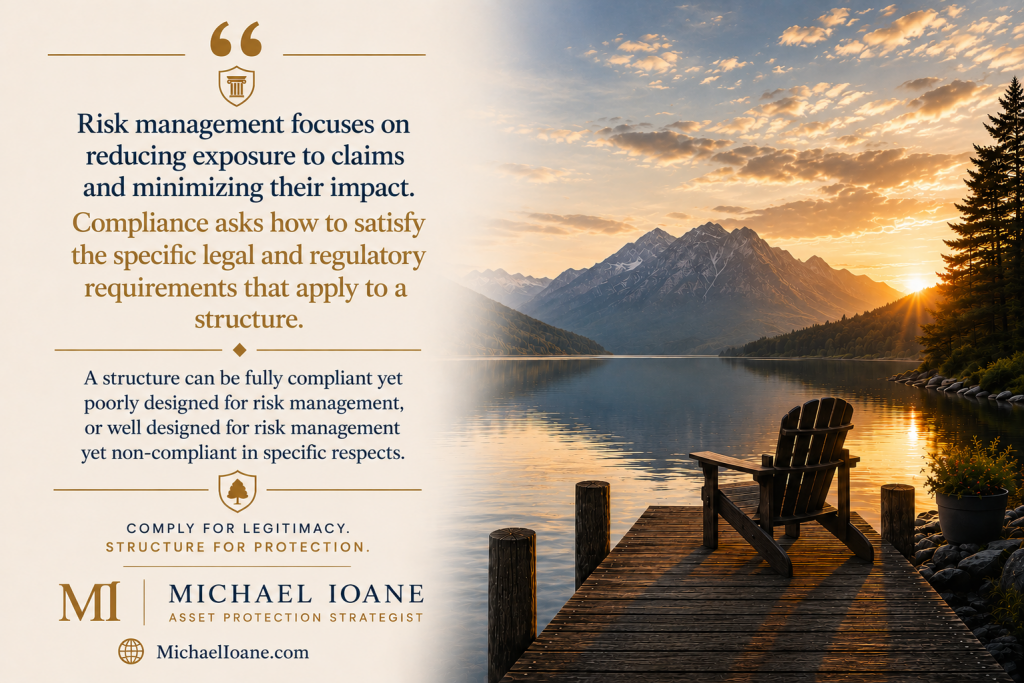
Risk management focuses on reducing exposure to claims and minimizing their impact. Compliance asks how to satisfy the specific legal and regulatory requirements that apply to a structure. A structure can be fully compliant yet poorly designed for risk management, or well designed for risk management yet non-compliant in specific respects.
The information in this article reflects general structural principles and practical observations from consulting experience and is provided for educational purposes only. It should not be interpreted as individualized legal or tax advice.
Michael Ioane | MichaelIoane.com
Continue Learning with Michael Ioane
Build your understanding of asset protection and business planning with the Asset Protection Manual . Explore taxation and private trust planning in Boston Tea Party . Both books are available on Amazon.