Michael Ioane
Article III
Practical Article
Strengthening Asset Protection Systems
Strengthening asset protection efforts is most effective when approached as a continuous improvement discipline rather than a one-time corrective project. A business owner who identifies and corrects the current weaknesses in their protection structure has improved their position, but the structure will continue to face new risks, new circumstances, and new opportunities for strengthening as the business evolves. Treating structural strengthening as an ongoing discipline rather than a completed project yields protection that improves continuously, rather than one that reaches a fixed level and then begins to erode through subsequent neglect.
Michael Ioane designs structural improvement programs that establish both the immediate corrections needed to address identified weaknesses and the ongoing practices required to continue strengthening the structure over time, because the most resilient protection systems are those that improve incrementally year over year rather than those that are designed once and never enhanced.
Adding Structural Layers for Strengthening
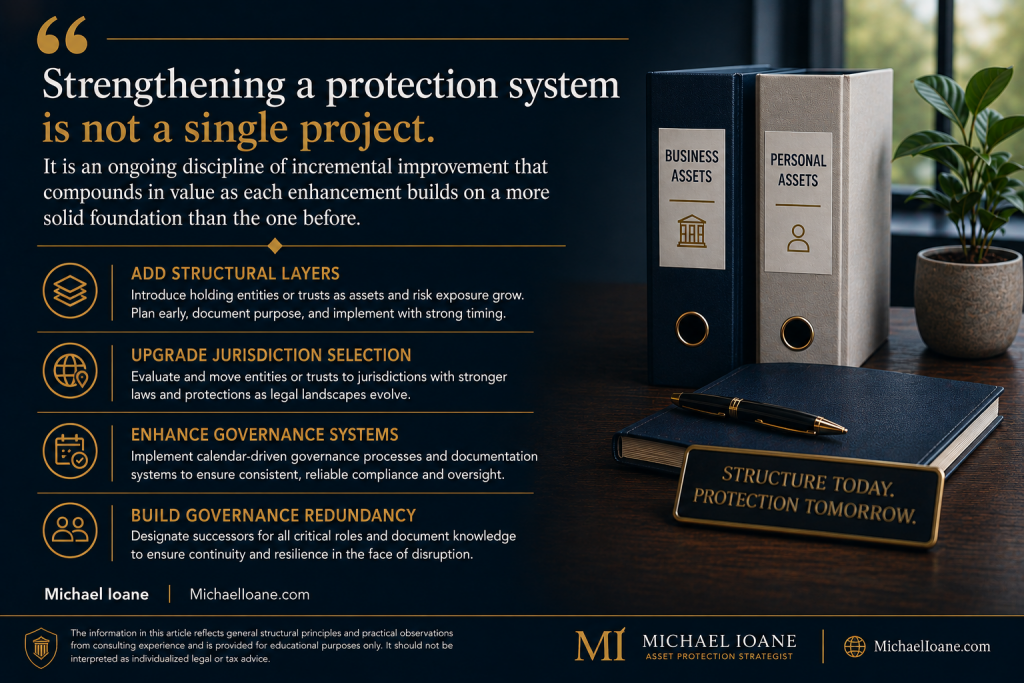
One of the most direct strategies for strengthening businesses whose risk profile has grown since their initial structure was implemented is to add structural layers not part of the original design. A business that began with a single operating entity may benefit from adding a holding entity to separate valuable assets from operational liabilities as its assets have grown in value. A business owner whose personal asset base has grown significantly since their initial planning may benefit from adding trust structures for personal asset protection that were not warranted at an earlier, less asset-rich stage.
Structural improvements of this type should be evaluated against the same timing principles that govern all asset protection planning: the addition of new structural layers should occur as early as possible relative to any anticipated future risk, and should be documented with contemporaneous evidence of legitimate planning purpose that supports the structure’s defensibility if challenged.
Upgrading Jurisdiction Selection for Strengthening
Risk mitigation through a jurisdiction upgrade involves evaluating whether the formation jurisdictions of existing entities and trusts continue to provide the strongest available legal protection, given developments in the law since the original formation decisions. A jurisdiction that offered adequate protective features when an entity was originally formed may have since been surpassed by other jurisdictions that have enacted stronger charging-order statutes, more favorable trust law, or other improvements.
Domesticating or redomiciling an entity to a more favorable jurisdiction, or decanting a trust into a jurisdiction with more favorable trust law, are both available mechanisms for upgrading jurisdiction selection without requiring a complete structural reconstruction. These mechanisms have their own specific legal requirements and should be evaluated by counsel familiar with the law of both the originating and destination jurisdictions.
Enhancing Governance Documentation Systems
A significant opportunity for strengthening many existing structures lies in improving the systems used to maintain governance documentation, moving from ad hoc or inconsistent practices to systematic, calendar-driven governance processes. Implementing a documented annual governance calendar that specifies when governing documents are reviewed, when governance meetings are held, and when financial separation compliance is verified converts governance maintenance from an occasional activity into a reliable, repeatable system.
Structural improvements at the systems level often provide more durable strengthening value than individual document corrections, because a well-designed system continues to generate the governance discipline that maintains the structure’s protection over time, while an individual correction addresses only the specific gap identified at the time of the correction without addressing the underlying process failures that allowed the gap to develop.
Building Redundancy into Critical Governance Roles
Strengthening a protection system also includes building redundancy into critical governance roles so that the structure does not depend entirely on any single individual’s continued availability. This means ensuring that every entity and trust has documented successor designations for its primary governance roles, and that the institutional knowledge required to administer the structure is documented in a way that is accessible to successors rather than existing only in the memory of the current governance actor.
Michael Ioane treats this redundancy-building as a core strengthening activity because the governance vacuum created by an undocumented succession failure can undo years of careful structural maintenance in a single disruptive event. The structure that has been strengthened to include genuine succession redundancy is more resilient than one strengthened only in its current operational details, which remains vulnerable to a single point of governance failure.
Strengthening a protection system is not a single project with a defined endpoint. It is an ongoing discipline of incremental improvement that compounds in value as each enhancement builds on a more solid foundation than the one before.
The information in this article reflects general structural principles and practical observations from consulting experience and is provided for educational purposes only. It should not be interpreted as individualized legal or tax advice.
Michael Ioane | MichaelIoane.com
Continue Learning with Michael Ioane
Build your understanding of asset protection and business planning with the Asset Protection Manual . Explore taxation and private trust planning in Boston Tea Party . Both books are available on Amazon.