Michael Ioane
Article II
Deep Topic Article
Correcting Weak Business Structures
Fixing a business structure identified as weak requires a methodical approach that addresses the specific category of weakness, evaluates the available correction options given the current circumstances, and implements the correction in a way that strengthens the structure’s legal position rather than creating new vulnerabilities. The correction process is fundamentally different depending on whether the weakness is governance-based, financial, documentary, or timing-related, and a generic restructuring approach that does not address the specific category of weakness is unlikely to be effective.
Michael Ioane approaches structural correction as a diagnostic and remedial process, identifying the specific weakness, determining the appropriate correction given the constraints and current circumstances, and implementing the correction with the documentation and consistency required to demonstrate that the structure is now being operated correctly going forward.
Correcting Governance Weaknesses
Governance weaknesses are corrected by establishing, going forward, the documented governance practices that should have been maintained from the beginning. This means updating governing documents to accurately reflect current ownership, management, and business purpose; establishing a regular schedule for documenting significant decisions through written resolutions or meeting minutes; and ensuring that the designated authority holders are actually exercising the authority assigned in the governing documents.
A restructuring strategy for governance correction cannot retroactively create the governance records that should have existed in prior years; however, it can establish a clean, consistent governance practice going forward that demonstrates the entity is now being operated correctly. While historical governance gaps cannot be erased, a demonstrated pattern of correction and consistent subsequent governance can mitigate, though not eliminate, the evidentiary impact of the historical gaps if the structure is later challenged.
Correcting Financial Weaknesses
Financial weaknesses are corrected by establishing genuine financial separation going forward: dedicated bank accounts for each entity used exclusively for that entity’s financial activity, a halt to any commingling practices that have been occurring, and correct documentation of all intercompany transfers as the specific category of transaction they represent, whether loan, distribution, or payment for services.
Asset protection fix efforts to address financial weaknesses should also address capitalization gaps, ensuring that each entity holds resources proportionate to the activities it conducts and the obligations it may incur. Where an entity has been undercapitalized, appropriately documented additional capital contributions can address the going-forward capitalization concern, though they cannot retroactively address claims that may have already arisen during the period of undercapitalization.
Correcting Documentary Weaknesses
Documentary weaknesses are corrected by systematically updating all governing documents to accurately reflect each entity’s current ownership, management, asset composition, and operational realities. This includes amending operating agreements and bylaws, executing any missing intercompany agreements, and reviewing trust documents against actual trust administration to identify and address any inconsistencies.
The correction of documentary weaknesses should be approached comprehensively rather than addressing only the most obviously outdated documents. A thorough review often reveals multiple smaller documentary gaps throughout the structure, and addressing them comprehensively in a single coordinated update process is more efficient and yields a more coherent result than addressing them piecemeal as they are identified.
Correcting Timing Weaknesses
Timing weaknesses present the most constrained options for correction because the legal significance of timing is fixed by historical facts and cannot be altered retroactively. Where a timing weakness is identified, the available corrections are generally limited to ensuring that any future transfers are appropriately timed and documented, and to consulting with legal counsel regarding the specific exposure created by the historical timing weakness and the defensive strategies that may be available if the transfer is challenged.
Michael Ioane addresses timing weaknesses by emphasizing that the most important corrective action is preventing future timing weaknesses through disciplined adherence to the principle that significant structural implementations should occur well in advance of any identifiable creditor relationship. Where a historical timing weakness cannot be corrected, the focus shifts to building the strongest possible defense for that specific transfer, including documentation of any legitimate business purpose and evidence of fair value exchanged.
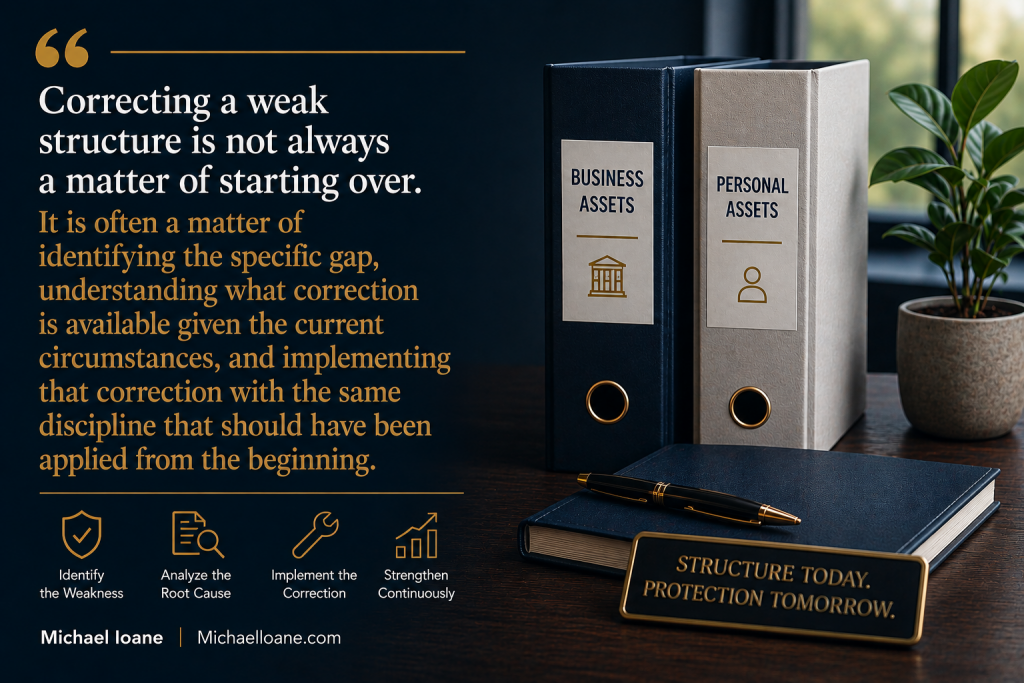
Correcting a weak structure is not always a matter of starting over. It is often a matter of identifying the specific gap, understanding what correction is available given the current circumstances, and implementing that correction with the same discipline that should have been applied from the beginning.
The information in this article reflects general structural principles and practical observations from consulting experience and is provided for educational purposes only. It should not be interpreted as individualized legal or tax advice.
Michael Ioane | MichaelIoane.com
Continue Learning with Michael Ioane
Build your understanding of asset protection and business planning with the Asset Protection Manual . Explore taxation and private trust planning in Boston Tea Party . Both books are available on Amazon.