Michael Ioane
Article IV
Summary Guide Article
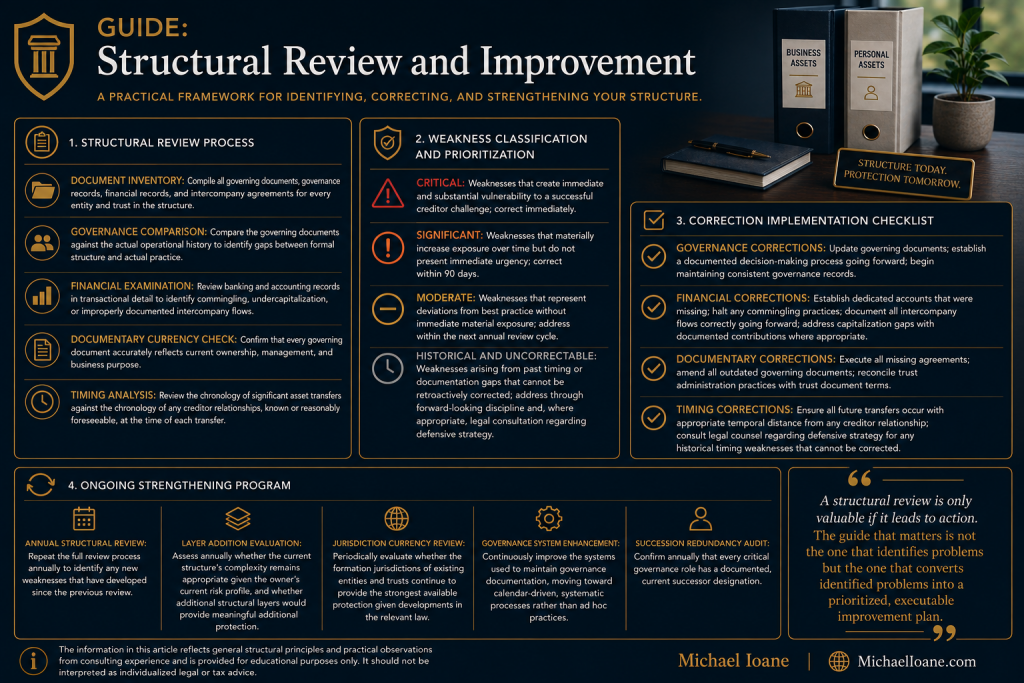
Guide: Structural Review and Improvement
This guide provides a practical framework for conducting structural reviews and implementing improvement plans across business and asset protection structures. The frameworks here reflect Michael Ioane’s approach to systematic identification of weak points, prioritized correction, and ongoing strengthening as an integrated structural improvement discipline.
Structural Review Process
Conduct a comprehensive structural review using the following process:
- Document inventory: compile all governing documents, governance records, financial records, and intercompany agreements for every entity and trust in the structure
- Governance comparison: Comparing the governing documents against the actual operational history to identify gaps between formal structure and actual practice
- Financial examination: review banking and accounting records in transactional detail to identify commingling, undercapitalization, or improperly documented intercompany flows
- Documentary currency check: confirm that every governing document accurately reflects current ownership, management, and business purpose
- Timing analysis: review the chronology of significant asset transfers against the chronology of any creditor relationships, known or reasonably foreseeable, at the time of each transfer
Weakness Classification and Prioritization
Classify identified weaknesses by severity to prioritize the correction sequence:
- Critical: weaknesses that create immediate and substantial vulnerability to a successful creditor challenge; correct immediately
- Significant: weaknesses that materially increase exposure over time but do not present immediate urgency; correct within 90 days
- Moderate: weaknesses that represent deviations from best practice without immediate material exposure; address within the next annual review cycle
- Historical and uncorrectable: weaknesses arising from past timing or documentation gaps that cannot be retroactively corrected; address through forward-looking discipline and, where appropriate, legal consultation regarding defensive strategy
Correction Implementation Checklist
Implement corrections using the following checklist for each weakness category:
- Governance corrections: update governing documents; establish a documented decision-making process going forward; begin maintaining consistent governance records
- Financial corrections: establish dedicated accounts that were missing; halt any commingling practices; document all intercompany flows correctly going forward; address capitalization gaps with documented contributions where appropriate
- Documentary corrections: execute all missing agreements; amend all outdated governing documents; reconcile trust administration practices with trust document terms
- Timing corrections: ensure all future transfers occur with appropriate temporal distance from any creditor relationship; consult legal counsel regarding defensive strategy for any historical timing weaknesses that cannot be corrected
Ongoing Strengthening Program
Establish the following ongoing strengthening practices to continuously improve the structure beyond the initial correction phase:
- Annual structural review: repeat the full review process annually to identify any new weaknesses that have developed since the previous review
- Layer addition evaluation: assess annually whether the current structure’s complexity remains appropriate given the owner’s current risk profile, and whether additional structural layers would provide meaningful additional protection
- Jurisdiction currency review: periodically evaluate whether the formation jurisdictions of existing entities and trusts continue to provide the strongest available protection given developments in the relevant law
- Governance system enhancement: continuously improve the systems used to maintain governance documentation, moving toward calendar-driven, systematic processes rather than ad hoc practices
- Succession redundancy audit: confirm annually that every critical governance role has a documented, current successor designation
A structural review is only valuable if it leads to action. The guide that matters is not the one that identifies problems but the one that converts identified problems into a prioritized, executable improvement plan.
The information in this article reflects general structural principles and practical observations from consulting experience and is provided for educational purposes only. It should not be interpreted as individualized legal or tax advice.
Michael Ioane | MichaelIoane.com
Continue Learning with Michael Ioane
Build your understanding of asset protection and business planning with the Asset Protection Manual . Explore taxation and private trust planning in Boston Tea Party . Both books are available on Amazon.