Michael Ioane
Article II
DEEP TOPIC ARTICLE
Structural Longevity
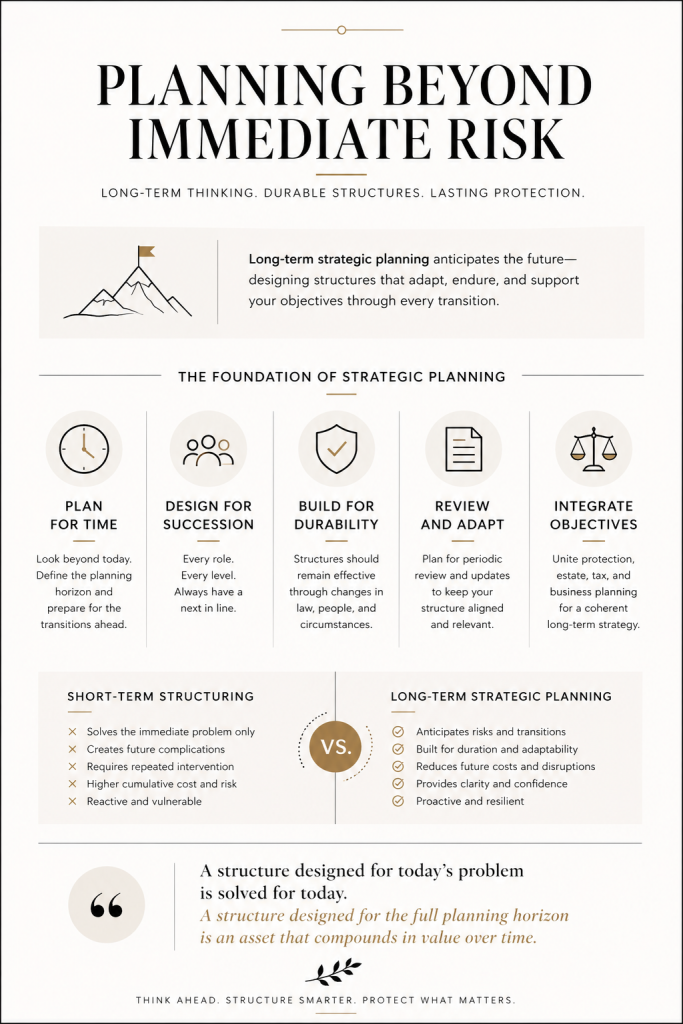
Long-term business structures are defined not by how well they are designed at the moment of implementation but by how well they continue to function as the people, assets, and legal landscape around them change over time. Structural longevity is a design quality that must be deliberately built into an arrangement; it does not arise automatically from correct initial implementation. The structures that last, that protect assets and serve their intended purposes across years and generations, are those that were designed with the mechanisms for ongoing relevance built in from the outset.
Michael Ioane addresses structural longevity as a primary design criterion in long-term planning engagements. The question is not only whether the structure works correctly on the day it is implemented. The question is whether it will continue to work correctly as conditions change, and whether the mechanisms required to keep it current are embedded in the structure’s design.
Why Structures Fail Over Time
Structures that were correctly designed at implementation fail over time through predictable mechanisms. The most common is governance obsolescence: the governing documents were drafted for the structure’s initial configuration and have never been updated to reflect changes in ownership, management, asset composition, or family circumstances. A structure operating under documents that no longer accurately reflect its current reality is not just administratively untidy; it is legally vulnerable, because the governing documents will be applied by courts according to their terms, regardless of whether those terms reflect what the parties currently intend.
A second common failure mechanism is personnel dependency: the structure’s function depends on a specific individual who departs, becomes incapacitated, or dies without a documented succession mechanism. The resulting governance vacuum often requires expensive, time-consuming legal intervention to resolve, and the interim period during which the structure lacks effective governance may expose assets to risks the structure was designed to prevent. Structural longevity requires that no single individual’s continued participation be a prerequisite for the structure’s continued function.
Designing for Personnel Independence
Personnel-independent structures are those in which every governance role has a documented succession mechanism that does not depend on a specific individual’s continued availability. For trusts, this means naming successor trustees and defining the process by which they assume authority. For LLCs, this means defining how the managing member is replaced if they are unable to continue, and who holds management authority during any transition period. For corporations, this means having a complete board with defined succession processes for each director position.
Personnel independence also requires that the structure’s institutional knowledge, governance history, financial records, and strategic rationale be documented in a form accessible to successors. A structure whose entire operational history exists only in the memory of the departing governance actor cannot effectively transition to a successor. Long-term business structures require documented institutional memory as a design component, not an afterthought.
Adaptability Within a Stable Framework
Structural longevity does not require that the structure remain unchanged over its lifetime. It requires that the structure be able to adapt to changing circumstances without losing its essential character and protective function. This means that governing documents should include amendment mechanisms that allow the structure to be updated as circumstances require, without requiring a complete reconstruction.
It also means that the structure’s core design logic should be robust enough to accommodate a range of future scenarios. A trust designed to distribute income to the settlor’s children with no consideration of what happens if a child predeceases the trust, becomes incapacitated, or divorces will require intervention to address each of those contingencies. A trust designed with contingency provisions for each of these foreseeable scenarios can adapt without intervention because the governing document already addresses the new circumstance.
Periodic Review as a Longevity Mechanism
The most practical mechanism for maintaining structural longevity over time is a scheduled periodic review process. An annual or biannual review evaluates whether the governing documents remain accurate, whether the governance actors in place are still appropriate, whether the asset composition and titling remain correct, and whether any changes in law or personal circumstances require structural adjustments.
Michael Ioane treats periodic review as a standard component of long-term planning relationships. The cost of a regular review is a small fraction of the cost of addressing a structural failure that a timely review would have prevented. A structure that is reviewed and updated regularly retains its effectiveness throughout its intended lifespan, rather than gradually accumulating deficiencies that lead to failure when it is most needed.
The measure of a structure’s quality is not how well it works on the day it is implemented. It is how well it continues to work on the day it is needed most.
The information in this article reflects general structural principles and practical observations from consulting experience and is provided for educational purposes only. It should not be interpreted as individualized legal or tax advice.
Michael Ioane | MichaelIoane.com
Continue Learning with Michael Ioane
Build your understanding of asset protection and business planning with the Asset Protection Manual . Explore taxation and private trust planning in Boston Tea Party . Both books are available on Amazon.