Michael Ioane
Article III
PRACTICAL ARTICLE
Evolution of Risk Management
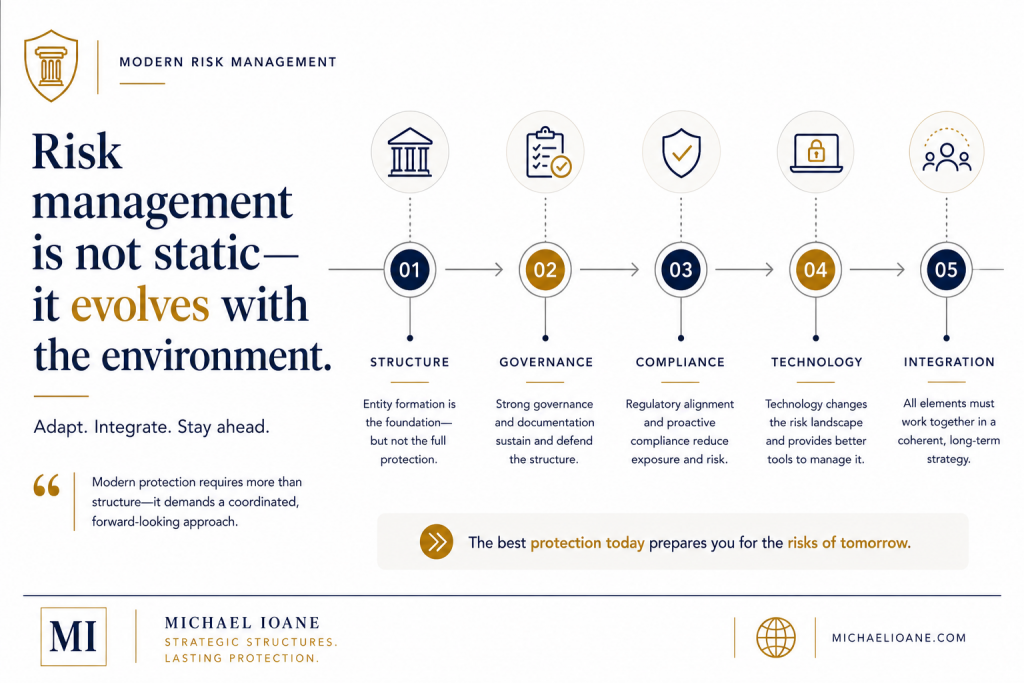
Modern risk management for business owners has evolved substantially from the simpler framework of a generation ago, when the primary risk management tools were insurance, entity formation, and basic estate planning. The current environment presents business owners with a risk landscape that is broader, more interconnected, and more rapidly evolving than the framework that most basic risk management education addresses. Understanding how risk management has evolved and what the current best practices are is essential for any business owner seeking protection strategies that remain effective as the landscape continues to change.
Michael Ioane approaches modern risk management as a discipline that integrates legal structure, governance practice, regulatory compliance, and strategic planning into a coherent framework rather than addressing each dimension as a separate concern. The integration of these dimensions is the defining characteristic of contemporary risk management, because the risks that business owners face in the current environment do not respect the boundaries between disciplines that traditional professional service delivery maintains.
From Single-Layer to Multi-Dimensional Protection
The risk management approach of previous generations relied primarily on a single protective layer: the business entity. Forming a corporation or LLC, maintaining adequate insurance, and keeping business and personal finances separate were the primary risk management practices for most business owners, and for many businesses in simpler regulatory and creditor environments, these practices were adequate.
The current environment requires multidimensional protection: an entity structure complemented by governance discipline, regulatory compliance, personal asset protection through appropriate structures, attention to IP ownership and protection, awareness of digital asset exposure, and integration of all these dimensions into a coherent, long-term plan. The business owner who relies on a single protective layer, however well-implemented, is protected against the risks that layer addresses and exposed to every risk it does not. Modern risk management identifies and addresses all of the exposure dimensions relevant to the specific business owner’s situation, not just the most visible ones.
The Role of Technology in Modern Risk Management
Technology has changed both the risk landscape business owners face and the tools available to manage it. On the risk side, digital business operations create data privacy and cybersecurity exposure that did not exist for businesses operating in a purely physical environment. Customer data, employee data, and proprietary business information are held in systems that are subject to breach, theft, and regulatory scrutiny in ways that physical records were not. The legal and regulatory framework around data privacy is developing rapidly and varies significantly across jurisdictions, creating compliance complexity that requires ongoing monitoring.
On the management side, technology provides tools for governance administration, compliance monitoring, and risk identification, making consistent risk management more achievable for businesses of every size. Automated compliance calendars, digital governance record systems, and electronic contract management platforms reduce the administrative burden of maintaining the governance discipline required for legal protection. The business owner who integrates these tools into their operational systems is more likely to maintain governance practices that protect the legal effectiveness of their structure.
Integrating Risk Management Across Professional Disciplines
One of the most significant developments in modern risk management is the increasing recognition that effective protection requires integration across professional disciplines that have traditionally operated independently. The legal advisor who designs the structural protection framework and the tax advisor who designs the tax planning strategy are addressing the same structure from different perspectives, and the decisions made in each discipline affect the other. The estate planning attorney who designs the trust structures and the business attorney who designs the entity structures are creating components of the same overall protection plan, and those components must be compatible and complementary.
Michael Ioane addresses cross-disciplinary integration as a planning requirement rather than a coordination preference. A protection plan that is coherent across legal, tax, estate, and regulatory dimensions is more effective and durable than one in which each dimension is designed independently and then assembled without reconciling conflicts and gaps. Modern risk management requires advisors who can work across disciplinary boundaries and clients who understand that the value of their professional relationships is maximized when those relationships are coordinated.
Preparing for the Next Decade
Preparing for the risk management landscape of the next decade requires awareness of the directions in which the current landscape is developing: increasing transparency requirements, expanding regulatory enforcement cooperation, evolving judicial approaches to protective structures, growing importance of digital asset management, and accelerating technological change in both the risk environment and the tools available for managing it.
The business owner who designs their protection framework with these developments in mind is building structures that will require less reactive modification as the landscape evolves. The business owner who designs only for the current environment will face a series of reactive adaptations as developments that were foreseeable from today’s vantage point require structural responses that would have been less costly to address at the design stage. Future-oriented risk management is not speculation about unknowable developments; it is thoughtful extrapolation of observable trends into structural design decisions that reflect where the environment is heading and where it currently stands.
Risk management is not a response to a static threat. It is an ongoing discipline applied to an evolving landscape, and the discipline that was adequate for yesterday’s landscape must be updated for tomorrow’s.
The information in this article reflects general structural principles and practical observations from consulting experience and is provided for educational purposes only. It should not be interpreted as individualized legal or tax advice.
Michael Ioane | MichaelIoane.com
Continue Learning with Michael Ioane
Build your understanding of asset protection and business planning with the Asset Protection Manual . Explore taxation and private trust planning in Boston Tea Party . Both books are available on Amazon.