Michael Ioane
Article II
DEEP TOPIC ARTICLE
Increasing Global Complexity
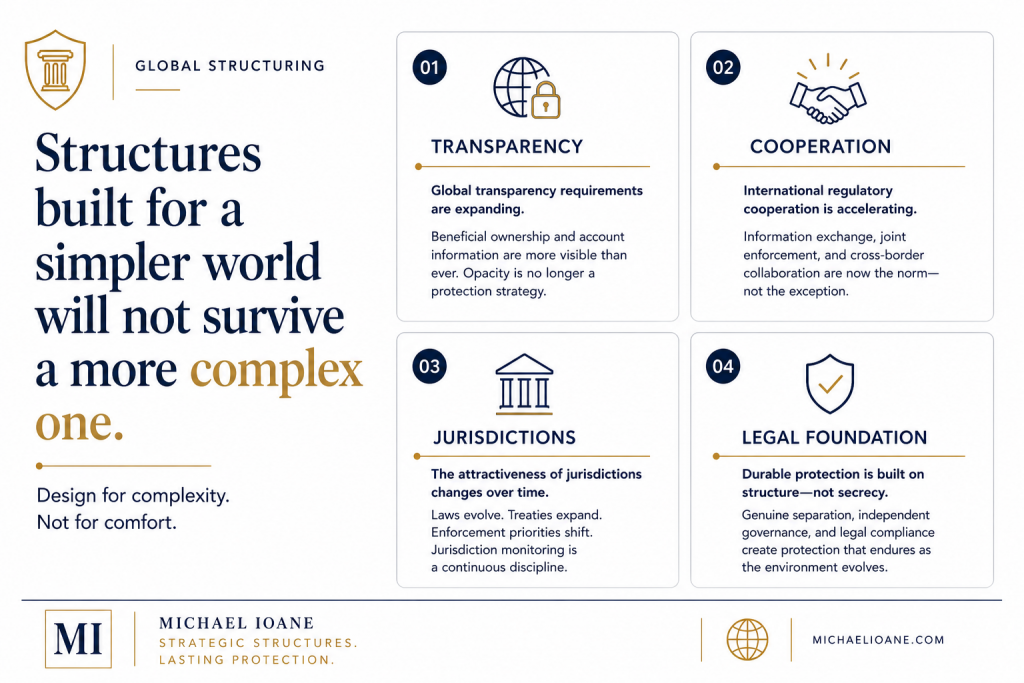
Global asset protection has become substantially more complex over the past two decades as international regulatory cooperation has intensified, transparency requirements have expanded, and the legal frameworks that asset protection structures rely upon have evolved in response to both legitimate planning activity and publicized abuses. The business owner or advisor who approaches international structuring with the frameworks and assumptions of a decade ago is designing for an environment that no longer exists, and the resulting structures are likely to be less effective and more legally exposed than their designers intend.
Michael Ioane addresses global complexity as a defining characteristic of the current asset protection environment, not a temporary condition that will resolve itself. The direction of international regulatory and legal development is toward greater transparency, more aggressive enforcement, cross-jurisdictional cooperation, and stricter scrutiny of structures that appear designed primarily to frustrate legitimate creditor rights or regulatory obligations.
International Regulatory Cooperation
International regulatory cooperation, developed through frameworks such as the Common Reporting Standard, the OECD’s multilateral instrument implementing BEPS recommendations, and bilateral tax information exchange agreements, has fundamentally changed the information environment within which international structures operate. Financial institutions in participating jurisdictions are required to identify the beneficial owners of accounts and report that information to the account holder’s home jurisdiction tax authority. The automatic exchange of this information across jurisdictions means that financial accounts in foreign jurisdictions are not private to the account holder’s home-country tax authority.
This development does not make international structures ineffective; it makes opacity an unreliable component of protection strategy. A structure that provides genuine legal separation, genuine governance independence, and full compliance with applicable reporting requirements is not undermined by increased international information exchange. A structure that relied on the practical difficulty of obtaining information about foreign accounts and entities as a component of its protection is substantially weakened by the systematic exchange of exactly that information.
Beneficial Ownership Transparency
Beneficial ownership transparency requirements have expanded significantly in major jurisdictions over the past several years and continue to expand. In addition to the Corporate Transparency Act in the United States, the European Union has implemented beneficial ownership registers for most EU member states, and many other jurisdictions have adopted or are adopting similar requirements. These registers are increasingly accessible not only to regulatory authorities but also to the public, altering the privacy dimension of entity ownership and affecting some protection strategies.
The practical consequence for asset protection structuring is that the structural layer of protection, meaning genuine legal separation and genuine governance independence, has become more important relative to the informational layer of protection, meaning the difficulty of identifying who owns and controls the assets. A structure whose protection depends primarily on legal separation, proper governance, and consistent operational discipline is not undermined by beneficial ownership transparency; its protection is grounded in legal principles rather than informational opacity.
Jurisdiction Selection in an Evolving Landscape
The attractiveness of specific jurisdictions for asset protection structuring changes over time as those jurisdictions’ legal frameworks evolve, their relationships with major enforcement jurisdictions change, and their participation in international transparency and information exchange frameworks develops. A jurisdiction that offered strong protection based on non-recognition of foreign judgments and limited information exchange may become significantly less protective as its treaty relationships develop and its international regulatory obligations expand.
Modern international asset protection planning requires ongoing monitoring of the jurisdictions in which structures are maintained, with attention to changes in local law, treaty relationships, and regulatory enforcement priorities that may affect the effectiveness of the structure. Michael Ioane argues that jurisdiction monitoring should be a standing component of long-term advisory relationships for international structures, because the jurisdiction selection decision that was correct at the time of implementation may need to be revisited as the jurisdictional landscape evolves.
The Future of International Structuring
The direction of development in international asset protection structuring favors approaches grounded in substantive legal separation and genuine governance independence rather than jurisdictional arbitrage that relies primarily on differences in information availability or enforcement capabilities between jurisdictions. The regulatory frameworks being developed internationally are specifically designed to reduce the effectiveness of structures that rely primarily on those differences, while structures built on genuine legal principles are less affected because their effectiveness is grounded in the law rather than in enforcement gaps.
This direction of development is not detrimental to asset protection planning; it clarifies the source of durable protection. The business owner who invests in structures built on genuine legal separation, genuine governance independence, and consistent operational discipline is building protection that becomes more valuable relative to alternatives as the international landscape evolves toward greater transparency and enforcement cooperation.
The global asset protection landscape is becoming more complex, more transparent, and more interconnected. The structures that navigate this environment successfully are those that were designed for its complexity rather than for the simpler environment that preceded it.
The information in this article reflects general structural principles and practical observations from consulting experience and is provided for educational purposes only. It should not be interpreted as individualized legal or tax advice.
Michael Ioane | MichaelIoane.com
Continue Learning with Michael Ioane
Build your understanding of asset protection and business planning with the Asset Protection Manual . Explore taxation and private trust planning in Boston Tea Party . Both books are available on Amazon.