Michael Ioane
Article IV
SUMMARY GUIDE ARTICLE
Guide: Oversight Structures
This guide provides a practical reference for designing and implementing oversight structures within business and asset protection governance frameworks. The frameworks here reflect Michael Ioane’s approach to defining oversight roles, selecting oversight participants, and integrating oversight activity into the governance record.
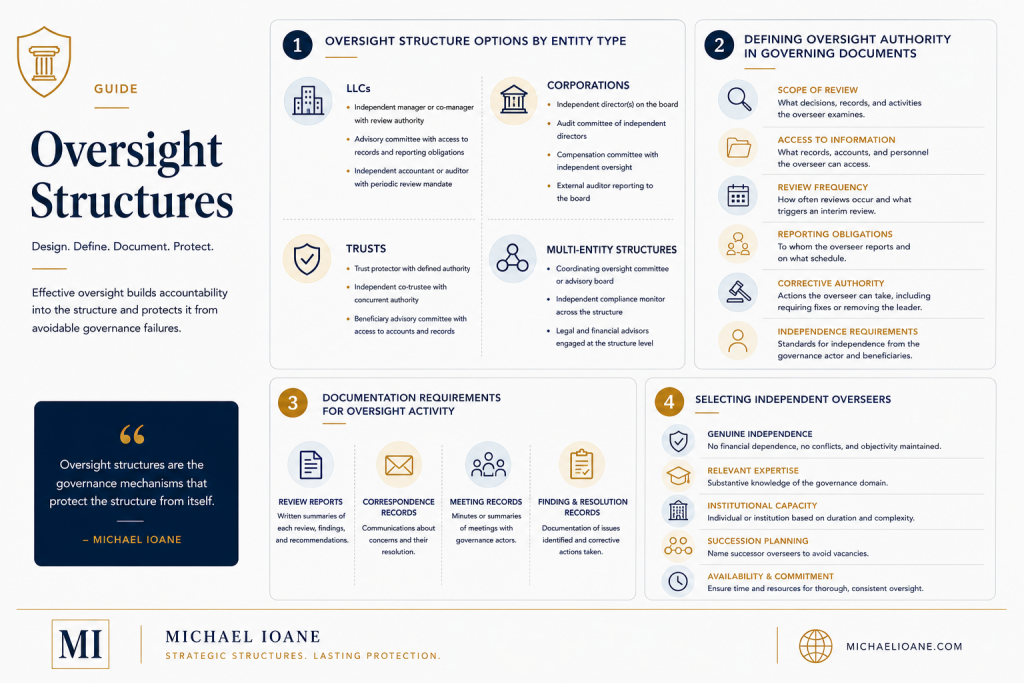
Oversight Structure Options by Entity Type
Select oversight mechanisms appropriate to each entity type in the structure:
For LLCs: independent manager or co-manager with defined review authority; advisory committee with access to governance records and defined reporting obligations; independent accountant or auditor with periodic review mandate.
For corporations: independent director or directors on the board; audit committee composed of independent directors; compensation committee with independent oversight of executive compensation; external auditor with defined reporting relationship to the board.
For trusts: trust protector with defined authority to review trustee performance and remove and replace the trustee in defined circumstances; independent co-trustee with concurrent authority over specified decisions; advisory committee of beneficiaries with access to trustee accounts and records.
For multi-entity structures: coordinating oversight committee or advisory board with visibility across all entities; independent compliance monitor with defined review scope across the structure; legal and financial advisors engaged at the structure level rather than the individual entity level.
Defining Oversight Authority in Governing Documents
Every oversight role should be defined in the governing documents of the entity or trust it oversees. The definition should address:
- Scope of review: what decisions, records, and activities the overseer is authorized and expected to examine
- Access to information: what records, accounts, and personnel the overseer can access to conduct their review
- Review frequency: how often the overseer is expected to conduct formal reviews, and what triggers an interim review
- Reporting obligations: to whom the overseer reports findings and on what schedule
- Corrective authority: what actions the overseer can take when governance failures are identified, including whether they can require corrective action or remove and replace the primary governance actor
- Independence requirements: any requirements for the overseer’s independence from the primary governance actor and from the beneficiaries or members whose interests they protect
Documentation Requirements for Oversight Activity
- Oversight activity should be documented to serve the governance record and demonstrate the genuineness of the oversight relationship:
- Review reports: written summaries of each periodic review, identifying what was examined, what was found, and what recommendations or requirements were communicated
- Correspondence records: written communications between the overseer and the primary governance actor regarding governance concerns and their resolution
- Meeting records: minutes or written summaries of meetings between the overseer and governance actors
- Finding and resolution records: documentation of any governance failures identified and the corrective actions taken in response
Selecting Independent Overseers
Apply the following criteria when selecting individuals or entities to serve in independent oversight roles:
- Genuine independence: no financial dependence on the primary governance actor; no personal relationships that would compromise objectivity; no conflicts of interest arising from other roles
- Relevant expertise: substantive knowledge of the governance domain they are overseeing, whether legal, financial, industry-specific, or trust administration
- Institutional capacity: for trust protector and similar roles, consider whether an individual or a professional institution is more appropriate, given the structure’s duration and complexity
- Succession planning: identify successor overseers in the governing documents so that the oversight role does not become vacant if the current overseer is unable to continue
- Availability and commitment: confirm that the selected overseer has the time and resources to fulfill the oversight mandate with the frequency and depth the structure requires
Oversight structures are the governance mechanisms that protect the structure from itself. They are most valuable before problems arise and most obviously necessary after they have.
The information in this article reflects general structural principles and practical observations from consulting experience and is provided for educational purposes only. It should not be interpreted as individualized legal or tax advice.
Michael Ioane | MichaelIoane.com
Continue Learning with Michael Ioane
Build your understanding of asset protection and business planning with the Asset Protection Manual . Explore taxation and private trust planning in Boston Tea Party . Both books are available on Amazon.