Michael Ioane
Article I
AUTHORITY ARTICLE
Trends in Modern Structuring
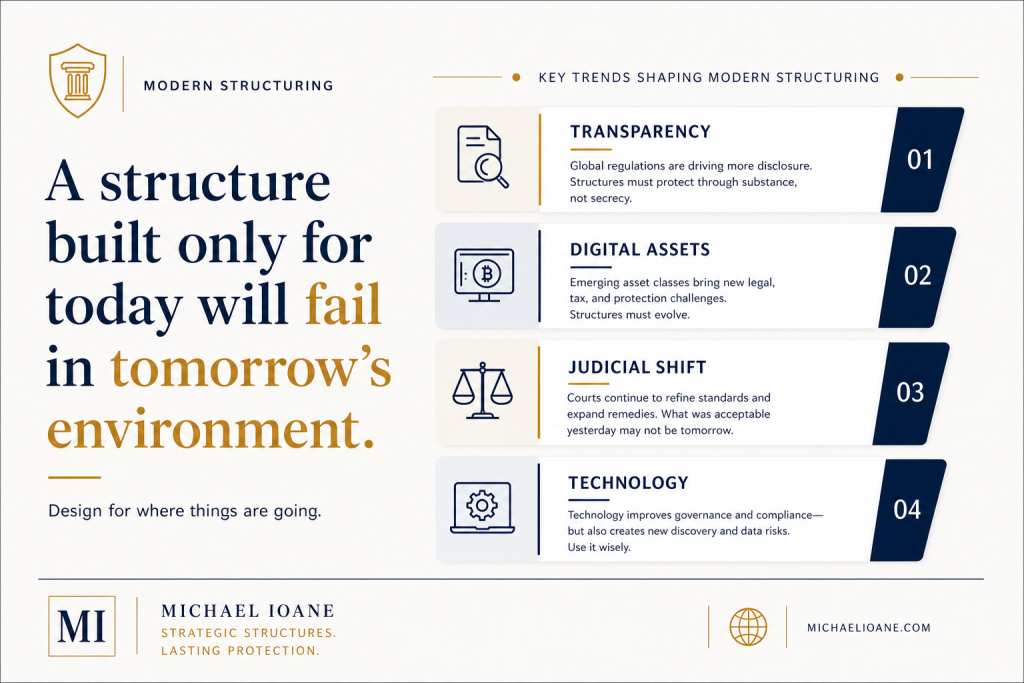
Asset protection trends in modern structuring reflect a convergence of legal, regulatory, technological, and geopolitical developments that are reshaping the landscape within which protective structures operate. The strategies that were standard practice a decade ago are being tested by developments that their designers did not anticipate, and the strategies that will prove most effective over the next decade require an awareness of where the landscape is heading, not merely a mastery of the current environment.
Michael Ioane addresses trend awareness as a component of long-term planning discipline, because a structure designed without awareness of the direction in which relevant legal and regulatory frameworks are evolving may achieve its short-term objectives while becoming progressively less effective over its intended lifespan. The planner who designs for both the current and anticipated environments builds structures with greater durability than one who designs only for current conditions.
Increasing Transparency Requirements
One of the most significant trends affecting asset protection structuring is the global push for greater transparency in entity ownership and financial structures. The Corporate Transparency Act in the United States, which requires most small businesses to report their beneficial owners to the Financial Crimes Enforcement Network, represents a domestic expression of a global trend that has been developing for over a decade through international initiatives, including the OECD’s Base Erosion and Profit Shifting framework and the Common Reporting Standard for automatic exchange of financial information.
These transparency requirements do not eliminate the effectiveness of protective structures, but they change the design considerations that inform them. Structures that relied on opacity as part of their protection strategy must be redesigned for an environment where beneficial ownership is more widely reported and readily accessible to regulatory authorities. Structures that were built on legal separation, genuine governance independence, and consistent operational discipline are less affected by transparency requirements because their effectiveness does not depend on concealment.
Digital Assets and Emerging Asset Classes
The emergence of digital assets as a significant asset class in many business owners’ portfolios presents structuring challenges that existing frameworks address imperfectly. The characterization of digital assets for tax, creditor protection, and estate planning purposes remains an area of ongoing legal development, with courts and regulators in multiple jurisdictions reaching different conclusions about how existing legal frameworks apply to assets whose technical characteristics do not map cleanly onto the categories those frameworks were designed to address.
Modern structuring increasingly requires attention to how digital assets are held, who controls the private keys that provide access to them, how they are characterized for regulatory and tax purposes, and how existing creditor protection frameworks apply to them. A protective structure designed without consideration of the digital assets the owner holds may provide comprehensive protection for traditional assets while leaving digital assets entirely unaddressed, creating a material gap in the overall protection framework.
Evolving Judicial Approaches to Protective Structures
Judicial attitudes toward protective structures have evolved over time and continue to evolve in response to perceived abuses of structural mechanisms that legislatures and courts regard as going beyond the legitimate use of available legal frameworks. Courts in multiple jurisdictions have expanded the range of circumstances in which they will pierce entity protections, apply equitable remedies beyond charging orders, or treat nominally independent structures as shams based on patterns of control retention that they regard as inconsistent with the structure’s claimed independence.
Staying current with judicial developments in the jurisdictions most relevant to a structure’s design is an ongoing planning requirement, not a one-time research exercise. A structure that was correctly designed under the case law as it existed at the time of its implementation may become vulnerable to challenge as courts refine their analysis of the specific structural features on which it relies. Michael Ioane addresses judicial trend monitoring as a component of the long-term advisory relationships that maintain structures effectively over their intended lifespan.
Technology and Governance Infrastructure
Technology is transforming the governance infrastructure available to businesses and asset protection structures, creating both new opportunities and new risks. Digital document management systems allow governance records to be maintained more consistently and accessed more reliably than paper-based systems. Electronic signature and contract management platforms facilitate the execution and administration of governing documents and intercompany agreements with greater efficiency. Automated compliance calendars and reminder systems reduce the administrative burden of meeting regulatory deadlines.
At the same time, records maintained in electronically administered systems may be more susceptible to discovery in litigation than paper records stored in a single physical location. Modern structuring must address the governance infrastructure question with awareness of both the operational efficiency benefits and the discovery implications of technology-based governance administration.
The structures that will remain effective over the next decade are those being designed today with awareness of where the legal, regulatory, and technological landscape is heading, not only where it currently stands.
The information in this article reflects general structural principles and practical observations from consulting experience and is provided for educational purposes only. It should not be interpreted as individualized legal or tax advice.
Michael Ioane | MichaelIoane.com
Continue Learning with Michael Ioane
Build your understanding of asset protection and business planning with the Asset Protection Manual . Explore taxation and private trust planning in Boston Tea Party . Both books are available on Amazon.