Michael Ioane
Article II
Deep Topic Article
Methods of Interpreting Statutes
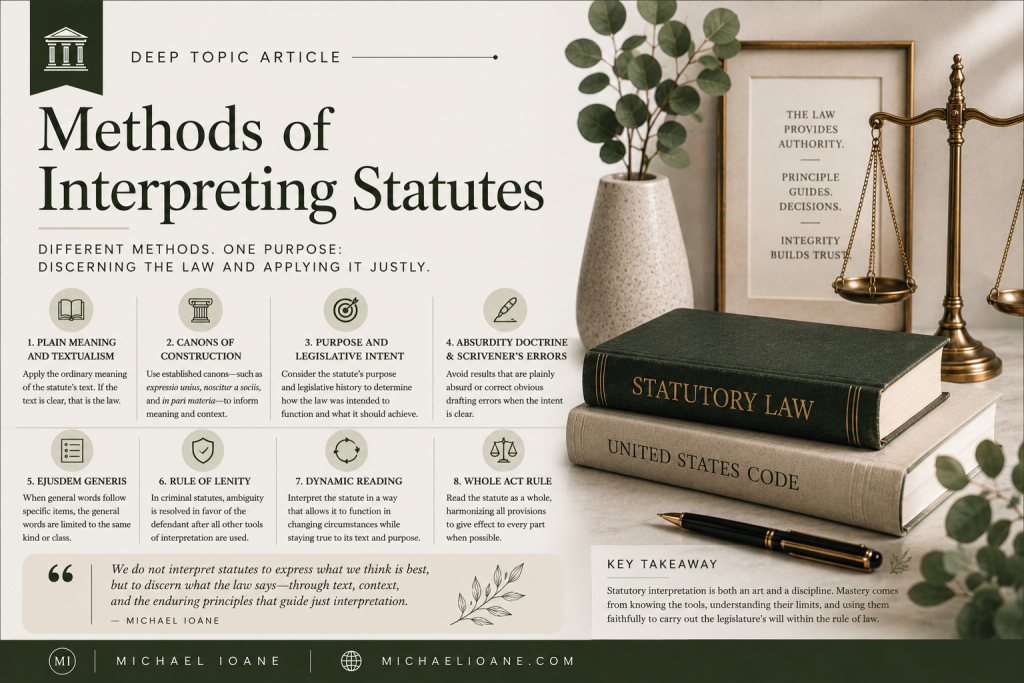
Interpreting statutes draws on a set of recognized interpretive methods and canons of construction that guide how courts resolve ambiguity when the enacted text does not clearly answer a specific question. These methods overlap substantially with the methods used in constitutional interpretation. Still, statutory interpretation has developed its own specialized body of canons tailored to the distinct legislative process that produces statutes.
Michael Ioane treats familiarity with these canons as a practical necessity for legal analysis generally: nearly every contested statutory question can be traced to a disagreement about which canon or combination of canons should control the outcome.
The Plain Meaning Rule and Textualism
The plain meaning rule holds that where a statute’s text is unambiguous, courts should apply it according to its ordinary meaning without resorting to legislative history or other extrinsic evidence. Textualist judges generally favor this approach, emphasizing that the enacted text, not the unenacted intentions behind it, is what actually carries the force of law.
Canons of Construction
Courts apply a range of specific interpretive canons developed over generations of judicial practice. Expressio unius est exclusio alterius holds that the express mention of one item in a list implies the exclusion of items not mentioned. Noscitur a sociis holds that an ambiguous term should be interpreted in light of the more specific words surrounding it. In pari materia holds that statutes addressing the same subject matter should be interpreted consistently with one another. Each canon supplies a default inference, not an absolute rule, and courts weigh them against the specific statutory context at hand.
Purposivism and Legislative Intent
Purposivist interpretation looks beyond the literal text to the broader purpose a statute was enacted to achieve, asking how a given interpretation would advance or frustrate that purpose. Proponents argue this approach better captures what a reasonable legislature actually intended to accomplish, particularly where a literal reading would produce a result plainly at odds with the statute’s evident purpose.
The Absurdity Doctrine and Scrivener’s Errors
Courts have also recognized a narrow doctrine permitting departure from a statute’s literal text where a literal reading would produce an absurd result the legislature could not plausibly have intended, or where the text contains an evident drafting error, a scrivener’s error, that a straightforward correction would resolve. This doctrine is applied narrowly, since expanding it too broadly risks substituting judicial judgment for the legislature’s actual enacted text.
Ejusdem Generis and General Terms Following Specific Ones
A closely related canon, ejusdem generis, holds that where a statute lists specific items followed by a general catchall term, the general term should be read to include only items of the same kind as those specifically listed. A statute referring to ‘cars, trucks, motorcycles, and other vehicles,’ for instance, would generally be read under this canon to exclude an item like an airplane, since the specifically listed items share a common category; the general term is understood to continue rather than expand indefinitely.
The Rule of Lenity
In criminal statutes specifically, courts apply the rule of lenity, resolving genuine ambiguity in favor of the defendant, reflecting the principle that individuals should have fair notice of what conduct is criminally prohibited before being subjected to punishment. This canon applies only where a statute remains genuinely ambiguous after exhausting the ordinary tools of interpretation, not merely because a defendant offers a plausible alternative reading.
Conclusion
Methods of interpreting statutes range from strict textualism through purposivism, supported by a body of specific interpretive canons, including ejusdem generis and the rule of lenity, and a narrow absurdity doctrine for genuinely anomalous cases. Recognizing which method or canon a given argument relies on is essential to evaluating statutory analysis accurately, a skill applied directly in Applying Statutory Law.
The information in this article reflects general constitutional and legal principles and is provided for educational purposes only. It should not be interpreted as individualized legal advice.
Michael Ioane | MichaelIoane.com
Continue Learning with Michael Ioane
Build your understanding of asset protection and business planning with the Asset Protection Manual . Explore taxation and private trust planning in Boston Tea Party . Both books are available on Amazon.