Michael Ioane
Article I
Authority Article
Understanding Legal Statutes
Statutory interpretation is the process courts and practitioners use to determine what a legislative enactment actually means and how it applies to specific facts. Understanding legal statutes requires more than reading the enacted text; it requires understanding the statute’s structure, its relationship to other provisions, and the interpretive conventions courts apply when the text alone does not resolve a given question.
Michael Ioane treats statutory interpretation as a discipline distinct from, though closely related to, constitutional interpretation. While both begin with text and structure, statutes are enacted through an ordinary legislative process that leaves a different and often more detailed record than constitutional ratification. That record plays a correspondingly larger role in statute meaning.
The Statute as Enacted Text
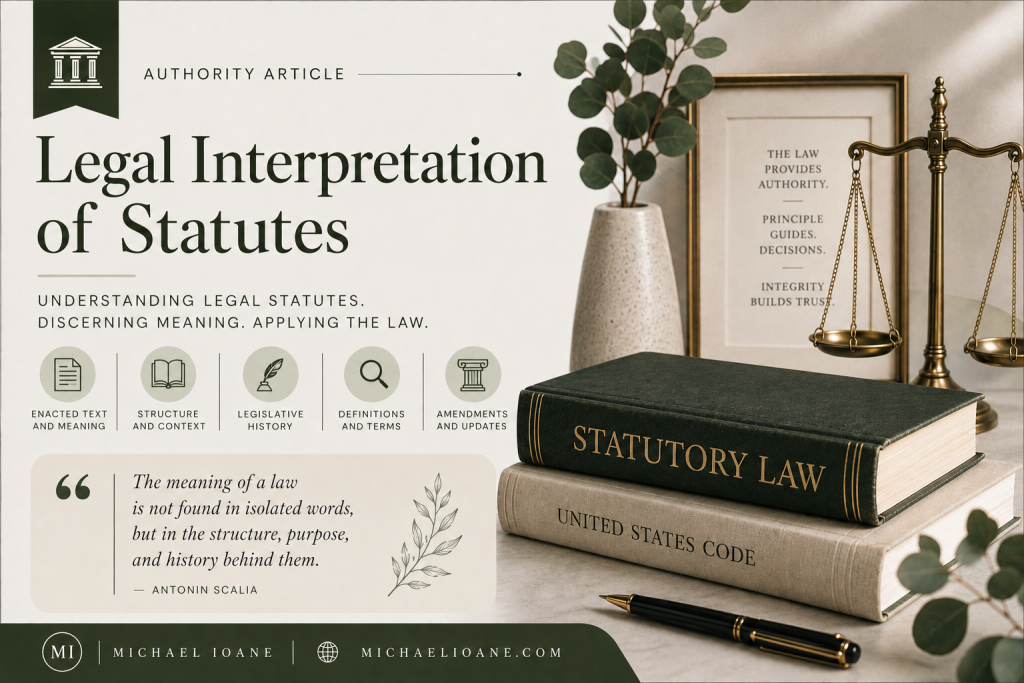
A statute’s authoritative meaning begins with its enacted text, the specific words that passed both houses of the legislature and were signed into law or enacted over a veto. Courts generally give this text its ordinary meaning at the time of enactment, unless the statute itself defines a term differently or the term carries an established technical or legal meaning within the relevant field.
Statutory Structure and Context
Individual provisions are read in light of the statute’s overall structure, including its stated purpose, its definitional sections, and how a given provision relates to surrounding sections addressing related subjects. A provision that appears ambiguous in isolation is often clarified by examining how it fits within the statute’s broader scheme, an approach reflecting the interpretive principle that statutes should be read as a coherent whole rather than as a collection of isolated sentences.
Legislative History as Interpretive Evidence
Where the text and structure alone do not resolve a question, courts and practitioners often turn to legislative history, committee reports, floor debates, and prior drafts, as evidence of what the enacting legislature intended a provision to accomplish. The proper weight to give this evidence remains a genuinely contested question among judges and scholars, closely related to the broader methodological debates discussed in Methods of Interpreting Statutes.
Definitions Sections and Terms of Art
Most substantial statutes include a dedicated definitions section establishing precisely how key terms are to be understood throughout the statute, sometimes departing significantly from the term’s ordinary usage elsewhere. A word like ’employee’ or ‘person’ may be defined broadly or narrowly for purposes of a specific statute in ways that diverge from how the same word is used in an entirely different statute, which is why understanding legal statutes requires always checking the specific definitions section governing the provision at issue rather than assuming a term’s meaning carries over from another context.
Amendments and the Evolving Text
Statutes are rarely static; Congress and state legislatures amend existing statutes regularly, and understanding a statute’s current meaning requires tracking these amendments and their effective dates carefully. A provision’s original enactment may differ meaningfully from its current, amended form, and confusing the two is a common and avoidable source of interpretive error.
Conclusion
Understanding legal statutes requires moving through several layers together: the enacted text itself, its definitions and amendments, the statute’s overall structure, and, where necessary, the legislative history surrounding its passage. Statute meaning, like constitutional meaning, rarely emerges from a single source in isolation, a theme developed further in Methods of Interpreting Statutes.
The information in this article reflects general constitutional and legal principles and is provided for educational purposes only. It should not be interpreted as individualized legal advice.
Michael Ioane | MichaelIoane.com
Continue Learning with Michael Ioane
Build your understanding of asset protection and business planning with the Asset Protection Manual . Explore taxation and private trust planning in Boston Tea Party . Both books are available on Amazon.