Michael Ioane
Article III
Practical Article
Overview of the Tax System
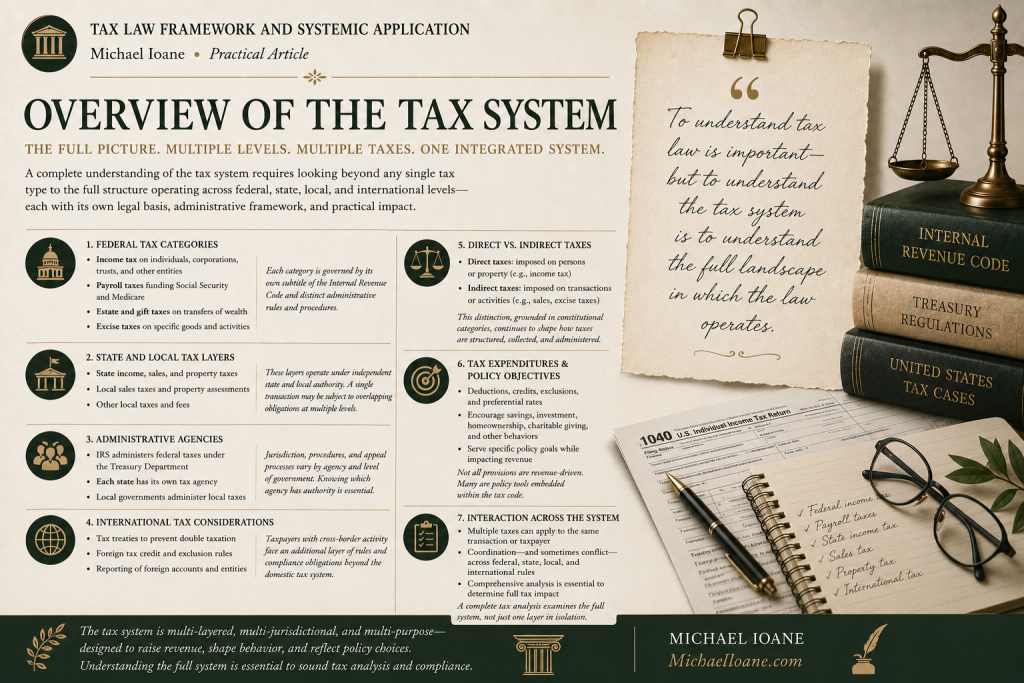
A tax system overview requires looking beyond the federal income tax alone to the full taxation structure operating across multiple levels of government and multiple categories of tax, each with its own legal basis and administrative apparatus. Understanding this broader system is essential context for any specific tax law question, since a given transaction is often subject to more than one type of tax simultaneously.
Michael Ioane treats this systemic view as a necessary complement to detailed statutory analysis: knowing precisely how a single Code section applies is of limited value without understanding where that section fits within the larger taxation structure a taxpayer actually faces.
Federal Tax Categories
At the federal level, the tax system includes the income tax, applicable to individuals, corporations, and other entities; payroll taxes funding Social Security and Medicare; estate and gift taxes on the transfer of wealth; and excise taxes on specific goods and activities. Each category operates under its own specific subtitle of the Internal Revenue Code and its own distinct administrative rules.
State and Local Tax Layers
Beyond the federal system, states impose their own income, sales, and property taxes under independent state constitutional authority, and local governments frequently add further layers, including local sales taxes and property tax assessments. These state and local layers operate under their own separate legal systems, meaning a single transaction can be subject to overlapping federal, state, and local tax obligations, each requiring its own independent legal analysis.
Administrative Agencies Across the System
The federal system is administered primarily by the Internal Revenue Service, under the Treasury Department, while each state maintains its own tax agency responsible for administering state-level taxes. Understanding which agency has jurisdiction over a specific tax question, and how that agency’s procedures differ from the IRS’s, is a practical necessity for anyone navigating the tax system beyond the federal level alone.
International Tax Considerations
For taxpayers and entities with international activity, the tax system overview extends further still, to treaties between the United States and foreign countries addressing double taxation, foreign tax credit rules, and reporting requirements for foreign accounts and entities. This international layer adds a further degree of complexity beyond the purely domestic federal, state, and local framework.
Direct Versus Indirect Taxes in the System
The tax system also distinguishes between direct taxes, imposed directly on a person or property, such as the income tax, and indirect taxes, imposed on transactions or activities, such as sales and excise taxes, ultimately borne by the purchaser or end user. This distinction, rooted in the same constitutional categories discussed in Structure of Tax Law, continues to shape how different taxes are structured, collected, and administered throughout the system today.
Tax Expenditures and Policy Objectives
Beyond raising revenue, the tax system is frequently used to advance specific policy objectives through targeted deductions, credits, and exclusions, often referred to collectively as tax expenditures. Provisions encouraging retirement savings, homeownership, charitable giving, and business investment each represent a deliberate policy choice embedded within the broader revenue-raising structure, meaning a complete tax system overview requires recognizing which provisions serve a revenue function primarily and which serve a policy function primarily.
Conclusion
The tax system overview extends well beyond the federal income tax to a multi-layered structure spanning federal, state, local, and international tax obligations, distinguishing direct from indirect taxes and revenue-focused from policy-focused provisions, each administered by its own agency under its own legal framework. Understanding this full system is what allows a specific tax question to be evaluated in its complete legal context rather than in isolation.
The information in this article reflects general constitutional and legal principles and is provided for educational purposes only. It should not be interpreted as individualized legal advice.
Michael Ioane | MichaelIoane.com
Continue Learning with Michael Ioane
Build your understanding of asset protection and business planning with the Asset Protection Manual . Explore taxation and private trust planning in Boston Tea Party . Both books are available on Amazon.