Michael Ioane
Article IV
Summary Guide Article
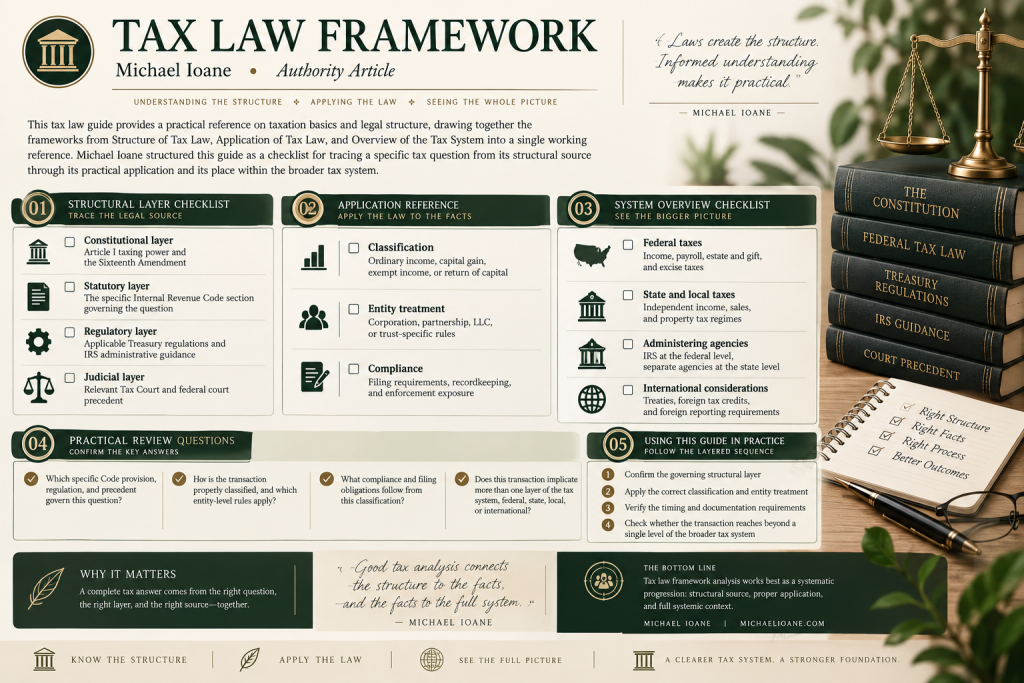
Guide: Tax Law Framework
This tax law guide provides a practical reference on taxation basics and legal structure, drawing together the frameworks covered in Structure of Tax Law, Application of Tax Law, and Overview of the Tax System into a single working reference.
Michael Ioane structured this guide as a checklist for tracing a specific tax question from its structural source through its practical application and its place within the broader tax system.
Structural Layer Checklist
- Constitutional layer: Article I taxing power and the Sixteenth Amendment
- Statutory layer: the specific Internal Revenue Code section governing the question
- Regulatory layer: applicable Treasury regulations and IRS administrative guidance
- Judicial layer: relevant Tax Court and federal court precedent
Application Reference
- Classification: ordinary income, capital gain, exempt income, or return of capital
- Entity treatment: corporation, partnership, LLC, or trust-specific rules
- Compliance: filing requirements, recordkeeping, and enforcement exposure
System Overview Checklist
- Federal taxes: income, payroll, estate and gift, and excise
- State and local taxes: independent income, sales, and property tax regimes
- Administering agencies: IRS at the federal level, separate agencies at the state level
- International considerations: treaties, foreign tax credits, and foreign reporting requirements
Practical Review Questions
- Which specific Code provision, regulation, and precedent govern this question
- How is the transaction properly classified, and which entity-level rules apply
- What compliance and filing obligations follow from this classification
- Does this transaction implicate more than one layer of the tax system, federal, state, local, or international?
Using This Guide in Practice
This tax law guide works best applied directly to a specific transaction: confirm the governing structural layer, apply the correct classification and entity treatment, verify the timing and documentation requirements, and check whether the transaction reaches beyond a single level of the broader tax system.
Michael Ioane applies this same layered sequence to every entity and transaction reviewed, treating the structural, applied, and systemic layers as three distinct steps that each need to be confirmed rather than assumed.
Conclusion
Tax law framework analysis works best as a systematic progression: confirming the structural layer that governs a question, applying it correctly to the specific facts, and situating the result within the full multi-level tax system a taxpayer actually faces. This tax law guide is intended as a working reference for carrying out that progression consistently.
The information in this article reflects general constitutional and legal principles and is provided for educational purposes only. It should not be interpreted as individualized legal advice.
Michael Ioane | MichaelIoane.com
Continue Learning with Michael Ioane
Build your understanding of asset protection and business planning with the Asset Protection Manual . Explore taxation and private trust planning in Boston Tea Party . Both books are available on Amazon.