Michael Ioane
Article I
Authority Article
Structure of Tax Law
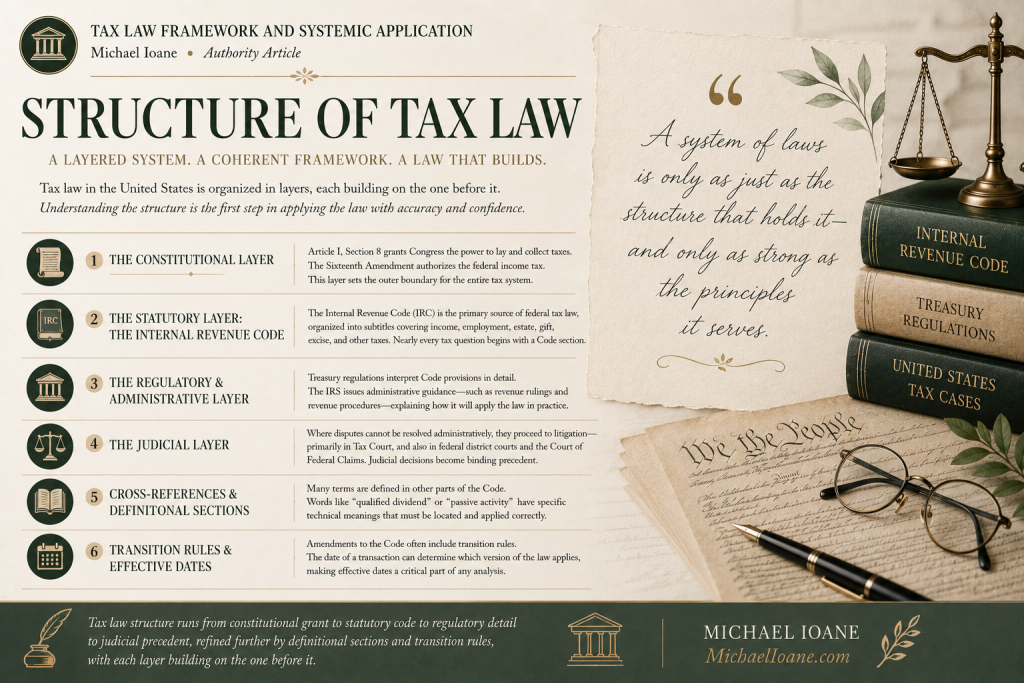
Tax law structure in the United States is organized in layers, running from the constitutional grant of taxing power through statutory enactment, administrative regulation, and judicial interpretation. Understanding this layered structure is essential to navigating the tax system accurately, since a given tax question is rarely resolved by consulting a single source in isolation.
Michael Ioane approaches tax law the same way he approaches any other structured body of law: by identifying which layer of the structure actually governs a specific question, and tracing that question through each subsequent layer that refines or applies it.
The Constitutional Layer
At the foundation sits the constitutional grant of taxing authority, Article I, Section 8’s power to lay and collect taxes, and the Sixteenth Amendment’s specific authorization for an unapportioned federal income tax. This constitutional layer rarely resolves specific tax questions directly, but it establishes the outer boundary within which every other layer of the taxation system must operate.
The Statutory Layer: The Internal Revenue Code
The Internal Revenue Code, enacted and periodically amended by Congress, is the primary statutory source of federal tax law, organized into subtitles covering income taxes, employment taxes, estate and gift taxes, and excise taxes, among other categories. Nearly every specific federal tax question traces back to a particular Code section, and identifying the applicable section is typically the first practical step in any tax law structure analysis.
The Regulatory and Administrative Layer
Because the Code’s general statutory language cannot address every possible transaction, the Treasury Department issues detailed regulations interpreting and applying specific Code provisions, and the Internal Revenue Service issues further administrative guidance, including revenue rulings and revenue procedures, addressing how the agency will apply the law in specific recurring situations. This layer supplies the practical detail the statutory text alone does not provide.
The Judicial Layer
Where a tax dispute cannot be resolved administratively, it proceeds to litigation, primarily in the United States Tax Court, though also in federal district courts and the Court of Federal Claims. The resulting body of judicial precedent becomes part of the legal framework governing how the same statutory and regulatory language is subsequently applied.
Cross-References and Definitional Sections
A significant part of navigating tax law structure involves working through the Code’s extensive cross-references and definitional sections, since terms used in one part of the Code are frequently defined, sometimes narrowly, in an entirely different part. A term like ‘qualified dividend’ or ‘passive activity’ carries a specific technical meaning established elsewhere in the Code, and applying the general provision without locating and applying the relevant definition is a common source of analytical error.
Transition Rules and Effective Dates
Because Congress frequently amends the Internal Revenue Code, tax law structure also includes a layer of transition rules and effective date provisions governing exactly when a new or amended provision applies. A transaction occurring near a statutory change date may be governed by materially different rules than an otherwise identical transaction occurring shortly before or after it, making the applicable effective date a necessary part of any structural analysis rather than an afterthought.
Conclusion
Tax law structure runs from constitutional grant to statutory code to regulatory detail to judicial precedent, refined further by definitional sections and transition rules, with each layer building on the one before it. Understanding which layer governs a specific question, and how the layers interact, is the necessary foundation for the practical application discussed in Application of Tax Law.
The information in this article reflects general constitutional and legal principles and is provided for educational purposes only. It should not be interpreted as individualized legal advice.
Michael Ioane | MichaelIoane.com
Continue Learning with Michael Ioane
Build your understanding of asset protection and business planning with the Asset Protection Manual . Explore taxation and private trust planning in Boston Tea Party . Both books are available on Amazon.