Michael Ioane
Article III
Practical Article
Federal Governance Framework
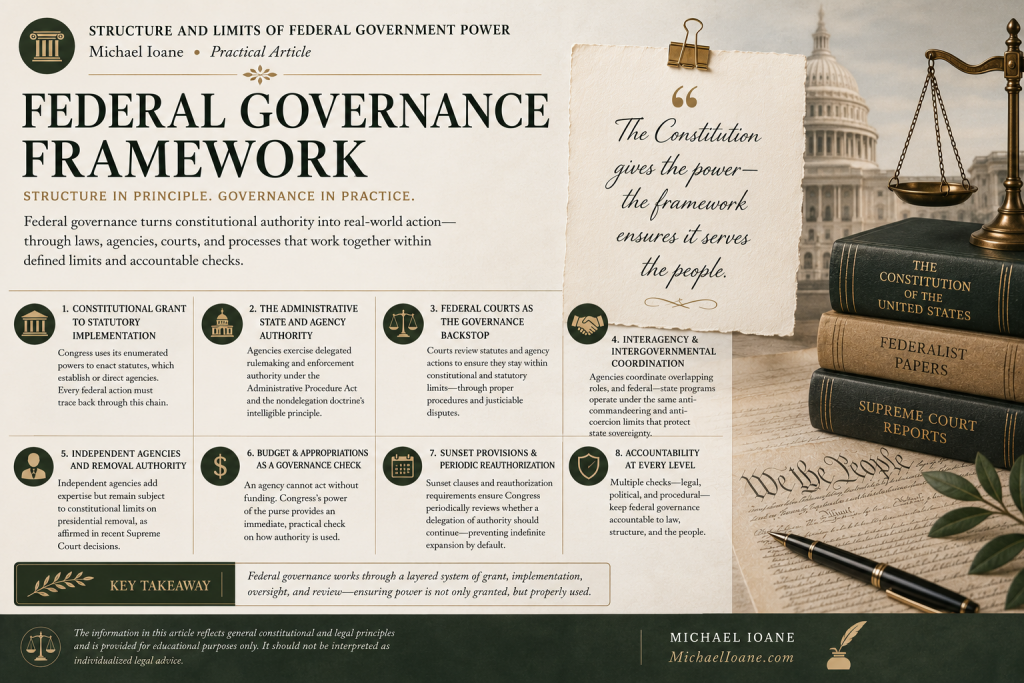
Federal governance in practice operates through a layered framework of constitutional grant, statutory implementation, and administrative execution, extending well beyond the three branches in the abstract to the actual agencies, courts, and processes that carry out federal authority on a daily basis. Understanding this practical framework is essential to seeing how constitutional structure translates into functioning governance.
Michael Ioane treats this practical layer as the point where constitutional structure becomes operationally real: an enumerated power on paper only matters once it is implemented through specific statutes, agencies, and enforcement mechanisms.
From Constitutional Grant to Statutory Implementation
Congress exercises its enumerated powers by enacting specific statutes, and those statutes in turn establish or direct the executive agencies responsible for administering them. This chain, constitutional grant to statute to agency, is the backbone of the modern federal governance framework, and a break at any link, a statute exceeding its constitutional grant, or an agency exceeding its statutory authority, can render the resulting action legally invalid regardless of how reasonable the underlying policy may be.
The Administrative State and Agency Authority
Federal executive agencies, from cabinet departments to independent regulatory commissions, exercise substantial rulemaking and enforcement authority delegated to them by Congress. This administrative authority operates under the Administrative Procedure Act, which establishes the procedures agencies must generally follow when issuing binding rules, and under the constitutional structure discussed in Legal Boundaries of Federal Authority, which requires that any delegated authority be accompanied by an intelligible principle constraining how it may be exercised.
Federal Courts as the Governance Backstop
The federal judiciary functions as the governance framework’s ultimate check, resolving disputes over whether a given statute or agency action exceeds its proper constitutional or statutory authority. This judicial role, exercised through the specific procedural mechanisms discussed in Challenging Government Authority Legally, ensures that the governance framework remains subject to ongoing legal accountability rather than operating as a self-certifying system.
Interagency and Intergovernmental Coordination
Modern federal governance also depends heavily on coordination, among federal agencies with overlapping jurisdiction, and between federal and state governments implementing cooperative programs, such as federal grant programs administered in part by state agencies. This coordination operates within, rather than outside, the constitutional structure already discussed: cooperative programs remain subject to the same anti-commandeering and anti-coercion limits that constrain any other exercise of federal authority over the states.
Independent Agencies and Removal Authority
A distinct feature of the modern governance framework is the independent regulatory agency, headed by officials the President cannot remove at will, unlike principal officers in traditional executive departments. This structure has been the subject of significant litigation over how much insulation from presidential removal is constitutionally permissible, with the Supreme Court in recent decisions, including Seila Law LLC v. Consumer Financial Protection Bureau (2020), narrowing the circumstances under which Congress may shield a single agency director from at-will presidential removal, reinforcing that even the administrative state’s internal structure remains subject to constitutional limits on executive authority.
Budget and Appropriations as a Governance Check
Beyond substantive statutory limits, Congress’s control over federal appropriations functions as an ongoing practical check on how federal governance actually operates: an agency cannot implement a program, however valid its underlying statutory authority, without funding Congress has appropriated for that purpose. This power of the purse operates alongside, and often more immediately than, litigation-based checks, since it allows Congress to constrain agency action through the annual budget process rather than waiting for a specific dispute to reach the courts.
Sunset Provisions and Periodic Reauthorization
Some federal statutory authority is structured with built-in sunset provisions or periodic reauthorization requirements, meaning the underlying legal authority itself expires unless Congress affirmatively renews it. This governance mechanism functions as a further practical check, distinct from litigation or budget control, forcing periodic legislative reconsideration of whether a given delegation of authority should continue rather than allowing it to persist indefinitely by default.
Conclusion
The federal governance framework translates constitutional structure into daily operation through a chain running from enumerated power to statute to agency implementation, checked continuously by judicial review, constrained by removal-authority limits on the administrative state, disciplined by Congress’s power of the purse, and periodically reconsidered through sunset and reauthorization requirements. Understanding this practical framework is what allows abstract constitutional structure to be evaluated against how federal power actually operates in specific cases.
The information in this article reflects general constitutional and legal principles and is provided for educational purposes only. It should not be interpreted as individualized legal advice.
Michael Ioane | MichaelIoane.com
Continue Learning with Michael Ioane
Build your understanding of asset protection and business planning with the Asset Protection Manual . Explore taxation and private trust planning in Boston Tea Party . Both books are available on Amazon.