Michael Ioane
Article IV
Summary Guide Article
Guide: Federal Authority Structure
This federal structure guide provides a practical governance system and legal framework reference, drawing together the frameworks covered in Structure of Federal Power, Legal Boundaries of Federal Authority, and Federal Governance Framework into a single working reference.
Michael Ioane structured this guide as a checklist for tracing a specific exercise of federal authority from its constitutional source through its practical implementation and applicable limits.
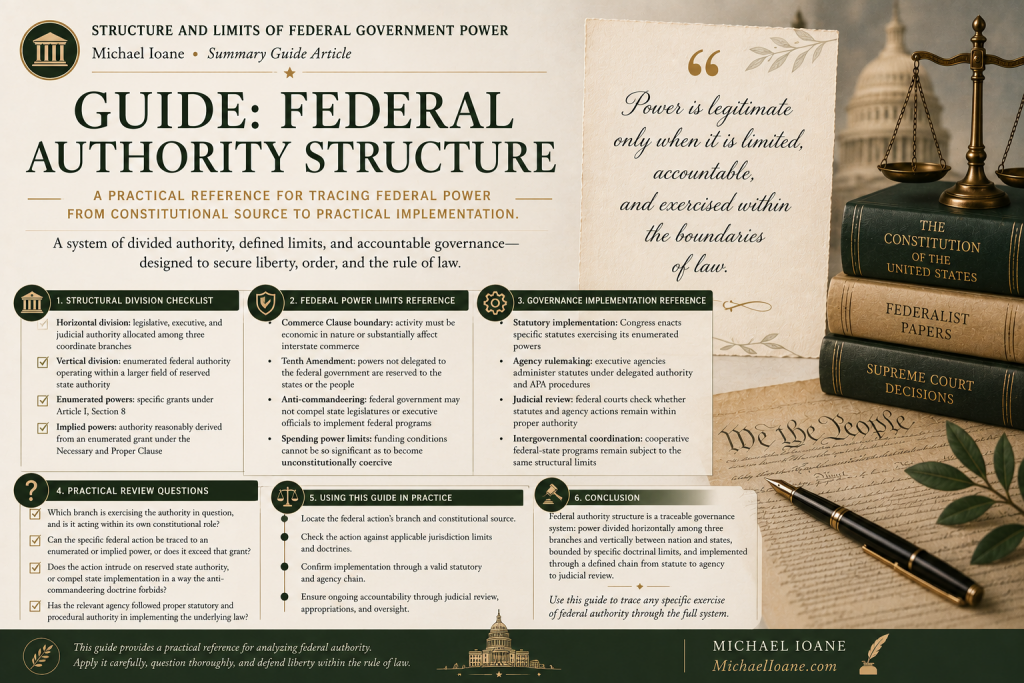
Structural Division Checklist
- Horizontal division: legislative, executive, and judicial authority allocated among three coordinate branches
- Vertical division: enumerated federal authority operating within a larger field of reserved state authority
- Enumerated powers: specific grants under Article I, Section 8
- Implied powers: authority reasonably derived from an enumerated grant under the Necessary and Proper Clause
Federal Power Limits Reference
- Commerce Clause boundary: activity must be economic in nature or substantially affect interstate commerce
- Tenth Amendment: powers not delegated to the federal government are reserved to the states or the people
- Anti-commandeering: federal government may not compel state legislatures or executive officials to implement federal programs
- Spending power limits: funding conditions cannot be so significant as to become unconstitutionally coercive
Governance Implementation Reference
- Statutory implementation: Congress enacts specific statutes exercising its enumerated powers
- Agency rulemaking: executive agencies administer statutes under delegated authority and APA procedures
- Judicial review: federal courts check whether statutes and agency actions remain within proper authority
- Intergovernmental coordination: cooperative federal-state programs remain subject to the same structural limits
Practical Review Questions
- Which branch is exercising the authority in question, and is it acting within its own constitutional role
- Can the specific federal action be traced to an enumerated or implied power, or does it exceed that grant
- Does the action intrude on reserved state authority, or compel state implementation in a way the anti-commandeering doctrine forbids
- Has the relevant agency followed proper statutory and procedural authority in implementing the underlying law
Using This Guide in Practice
This federal structure guide is most useful applied to a specific federal action directly: locate its branch and constitutional source, check it against the applicable jurisdiction limits, and confirm it was implemented through a valid statutory and agency chain subject to ongoing judicial and budgetary accountability.
Michael Ioane applies this same systematic sequence whenever a question of federal authority arises in the course of broader legal or structural analysis, tracing each specific action back through the full governance system rather than evaluating it in isolation.
Conclusion
Federal authority structure reduces to a traceable governance system: power divided horizontally among three branches and vertically between the nation and the states, bounded by specific doctrinal limits, and implemented through a defined chain from statute to agency to judicial review. This federal structure guide is intended as a working reference for tracing any specific exercise of federal authority through that full system.
The information in this article reflects general constitutional and legal principles and is provided for educational purposes only. It should not be interpreted as individualized legal advice.
Michael Ioane | MichaelIoane.com
Continue Learning with Michael Ioane
Build your understanding of asset protection and business planning with the Asset Protection Manual . Explore taxation and private trust planning in Boston Tea Party . Both books are available on Amazon.