Michael Ioane
Article II
Deep Topic Article
Legal Boundaries of Federal Authority
Federal power limits are not incidental features of the constitutional system; they are a central design element, reflecting the framers’ judgment that a national government strong enough to govern effectively must nonetheless be confined to a defined scope. Understanding where these limits sit, and how courts have enforced them, is essential to evaluating whether any specific federal action falls within or outside proper federal authority.
Michael Ioane approaches these limits the way he approaches any question of legal authority: by identifying the specific constitutional source claimed to support a federal action and testing whether that source actually extends as far as the action requires.
The Commerce Clause as the Primary Modern Boundary
Article I, Section 8 grants Congress the power to regulate commerce among the several states, and this Commerce Clause has become the single most significant source of federal regulatory authority in the modern era. The Supreme Court has interpreted this power broadly to reach not only interstate transactions themselves but also intrastate activity that, in the aggregate, substantially affects interstate commerce, as established in Wickard v. Filburn (1942).
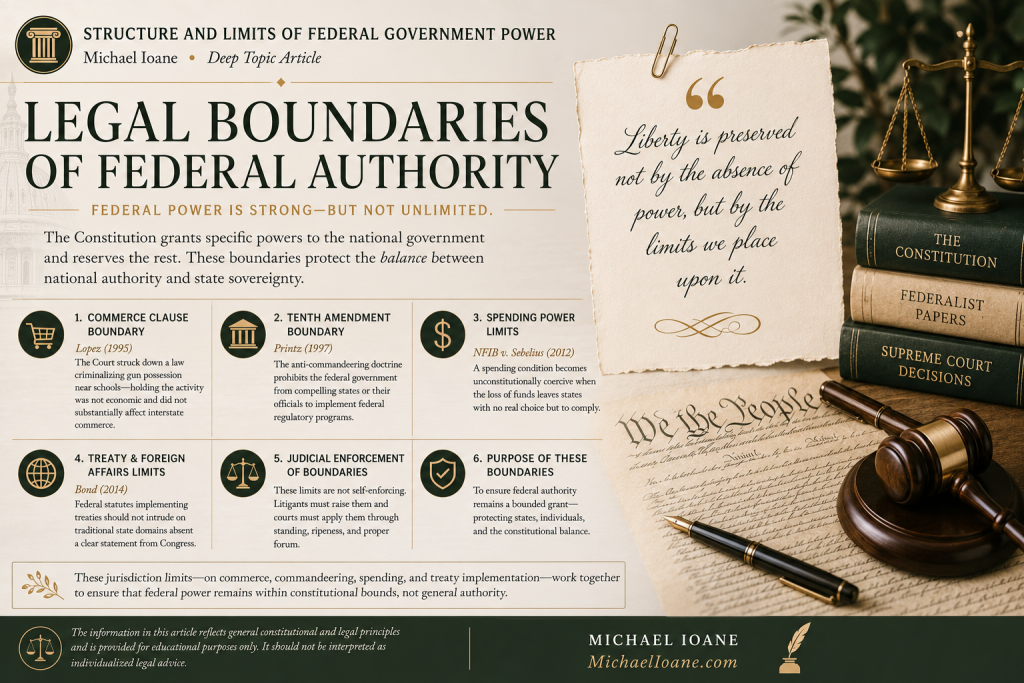
This broad interpretation is not unlimited. In United States v. Lopez (1995), the Supreme Court struck down a federal law criminalizing gun possession near schools, holding that the activity regulated was not itself economic and did not substantially affect interstate commerce, marking one of the first modern decisions to enforce meaningful outer limits on the commerce power.
The Tenth Amendment as a Structural Boundary
The Tenth Amendment reserves to the states, or to the people, any power not delegated to the federal government and not prohibited to the states. Beyond simply confirming that federal authority is limited to its enumerated grants, this amendment has supported the anti-commandeering doctrine, which prohibits the federal government from compelling state legislatures or state executive officials to implement federal regulatory programs directly, a jurisdiction limits principle applied in New York v. United States (1992) and Printz v. United States (1997).
Spending Power Limits
Congress may also influence state behavior indirectly through its spending power, conditioning federal funds on state compliance with specified requirements. This authority is itself bounded: in National Federation of Independent Business v. Sebelius (2012), the Supreme Court held that a spending condition can become unconstitutionally coercive if the amount of funding at stake is so significant that a state has no genuine choice but to comply, transforming what should be a voluntary condition into effective compulsion.
Together, these boundaries, the outer edge of the commerce power, the Tenth Amendment’s anti-commandeering protection, and limits on coercive spending conditions, define the practical legal perimeter of federal authority in the areas where federal and state power most often intersect. For a broader look at how this authority is exercised day to day, see Federal Governance Framework.
Treaty and Foreign Affairs Power Limits
Federal authority over foreign affairs and treaty-making, while broad, is not entirely without internal limits. In Bond v. United States (2014), the Supreme Court declined to read a federal statute implementing a chemical weapons treaty as reaching an ordinary local assault, applying a clear-statement principle that federal statutes implementing international agreements should not be read to intrude on matters traditionally handled by the states absent a clear congressional statement to that effect. This reflects the same underlying concern running through the domestic jurisdiction limits: federal authority, however broad its constitutional source, is not presumed to displace state authority without a clear basis for doing so.
Judicial Enforcement of These Boundaries
These federal power limits are not self-enforcing; they depend on litigants raising them and courts applying them, through the same procedural mechanisms, standing, ripeness, and proper forum, discussed in Challenging Government Authority Legally. A federal power limit that is never litigated functions, in practice, as no limit at all, which is why understanding both the substantive boundary and the procedural path to enforcing it matters equally.
Conclusion
Legal boundaries of federal authority operate through several distinct but related doctrines: the substantial effects test limiting the Commerce Clause, the anti-commandeering protection grounded in the Tenth Amendment, the anti-coercion limit on the spending power, and the clear-statement principle bounding treaty implementation, all enforced only through active judicial engagement. These jurisdiction limits collectively confirm that federal authority, however broad in practice, remains a bounded grant rather than a general power.
The information in this article reflects general constitutional and legal principles and is provided for educational purposes only. It should not be interpreted as individualized legal advice.
Michael Ioane | MichaelIoane.com
Continue Learning with Michael Ioane
Build your understanding of asset protection and business planning with the Asset Protection Manual . Explore taxation and private trust planning in Boston Tea Party . Both books are available on Amazon.