Michael Ioane
Article IV
Summary Guide Article
Guide: Legal Challenges to Authority
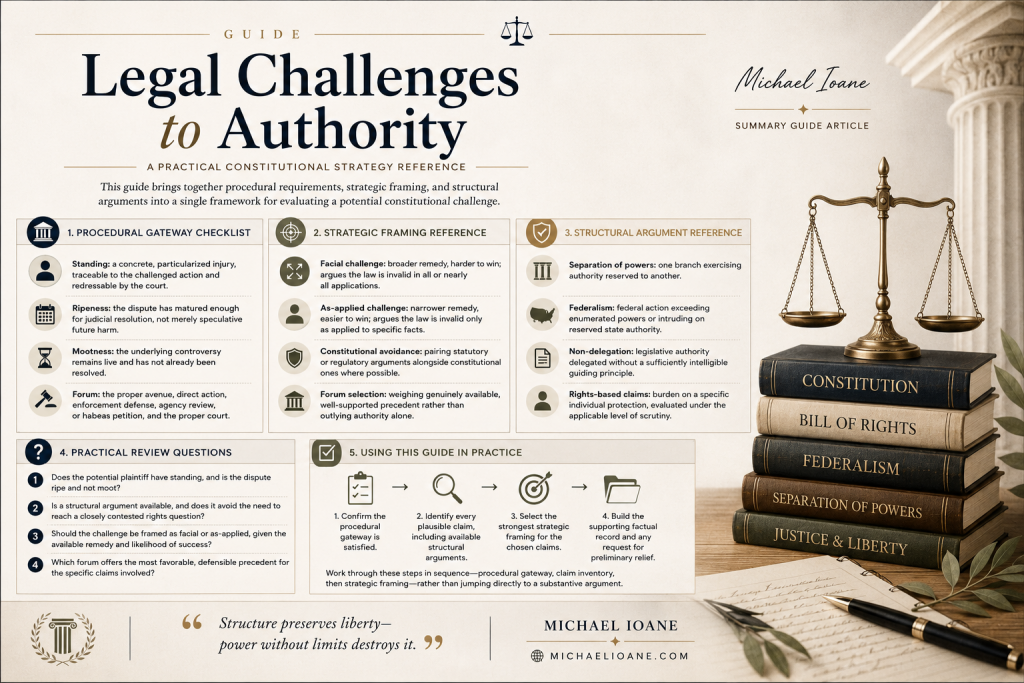
This legal challenge guide provides a practical constitutional strategy reference drawing together the frameworks covered in Challenging Government Authority Legally, Legal Strategy in Constitutional Matters, and Structural Legal Arguments in Constitutional Law into a single working legal framework.
Michael Ioane structured this guide as a sequential checklist for evaluating a potential constitutional challenge, from procedural gateway through claim selection to available structural arguments.
Procedural Gateway Checklist
- Standing: a concrete, particularized injury, traceable to the challenged action and redressable by the court
- Ripeness: the dispute has matured enough for judicial resolution, not merely speculative future harm
- Mootness: the underlying controversy remains live and has not already been resolved
- Forum: the proper avenue, direct action, enforcement defense, agency review, or habeas petition, and the proper court
Strategic Framing Reference
- Facial challenge: broader remedy, harder to win; argues the law is invalid in all or nearly all applications
- As-applied challenge: narrower remedy, easier to win; argues the law is invalid only as applied to specific facts
- Constitutional avoidance: pairing statutory or regulatory arguments alongside constitutional ones where possible
- Forum selection: weighing genuinely available, well-supported precedent rather than outlying authority alone
Structural Argument Reference
- Separation of powers: one branch exercising authority reserved to another
- Federalism: federal action exceeding enumerated powers or intruding on reserved state authority
- Non-delegation: legislative authority delegated without a sufficiently intelligible guiding principle
- Rights-based claims: burden on a specific individual protection, evaluated under the applicable level of scrutiny
Practical Review Questions
- Does the potential plaintiff have standing, and is the dispute ripe and not moot
- Is a structural argument available, and does it avoid the need to reach a closely contested rights question
- Should the challenge be framed as facial or as-applied, given the available remedy and likelihood of success
- Which forum offers the most favorable, defensible precedent for the specific claims involved
Using This Guide in Practice
This legal challenge guide is most useful applied to a specific dispute in sequence: confirm the procedural gateway is satisfied, identify every plausible claim including available structural arguments, select the strongest strategic framing, and only then move to building the supporting factual record and any request for preliminary relief.
Michael Ioane applies this same sequence across every legal challenge reviewed, treating the procedural gateway, the claim inventory, and the strategic framing as three distinct steps that each need to be worked through in order, rather than jumping directly to a substantive argument before confirming it can actually be heard.
Conclusion
Legal challenges to government authority succeed through a disciplined sequence: clearing the procedural gateway, selecting the most effective strategic framing, and identifying whether a structural argument offers a more direct path than a rights-based claim alone. This legal challenge guide is intended as a working reference for applying that sequence systematically to any specific dispute.
The information in this article reflects general constitutional and legal principles and is provided for educational purposes only. It should not be interpreted as individualized legal advice.
Michael Ioane | MichaelIoane.com
Continue Learning with Michael Ioane
Build your understanding of asset protection and business planning with the Asset Protection Manual . Explore taxation and private trust planning in Boston Tea Party . Both books are available on Amazon.