Michael Ioane
Article IV
Summary Guide Article
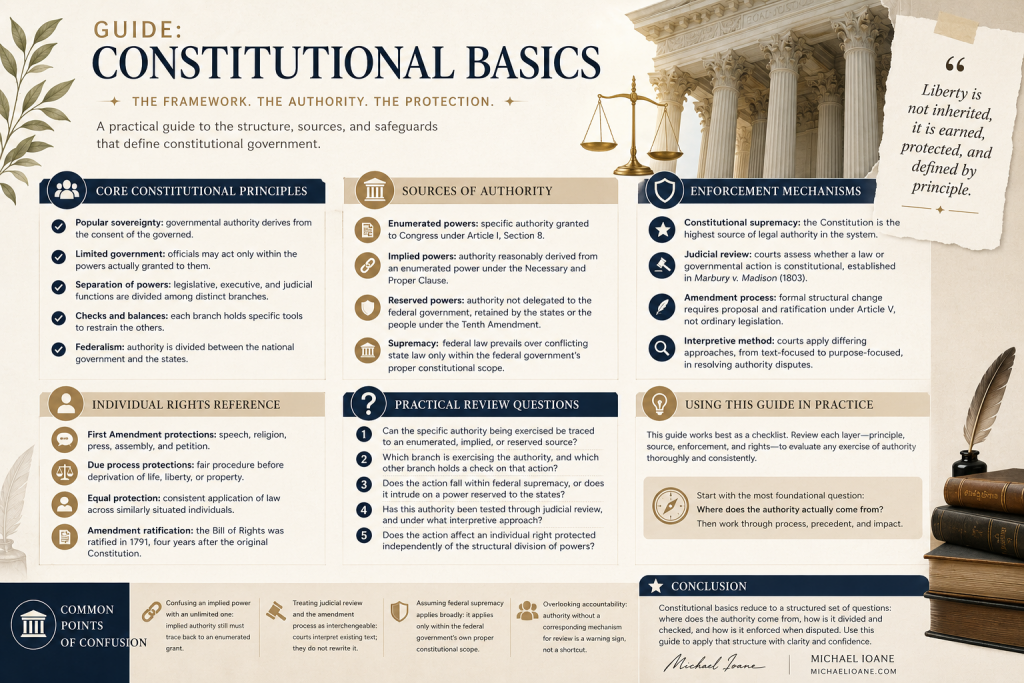
Guide: Constitutional Basics
This guide provides a practical guide to the Constitution for reviewing the core structural principles, sources of authority, and enforcement mechanisms that define constitutional government. It draws together the frameworks covered in Understanding Constitutional Principles, Authority and Governance in Constitutional Law, and Legal Foundations of Constitutional Authority into a single practical reference.
Michael Ioane developed this guide format specifically for readers who already have some familiarity with the underlying principles and want a fast, structured way to apply them, rather than a full narrative explanation of each concept. Each section below functions as a standalone checklist that can be used on its own or in combination with the others.
Core Constitutional Principles Checklist
- Popular sovereignty: governmental authority derives from the consent of the governed
- Limited government: officials may act only within the powers actually granted to them
- Separation of powers: legislative, executive, and judicial functions are divided among distinct branches
- Checks and balances: each branch holds specific tools to restrain the others
- Federalism: authority is divided between the national government and the states
Sources of Authority Framework
- Enumerated powers: specific authority granted to Congress under Article I, Section 8
- Implied powers: authority reasonably derived from an enumerated power under the Necessary and Proper Clause
- Reserved powers: authority not delegated to the federal government, retained by the states or the people under the Tenth Amendment
- Supremacy: federal law prevails over conflicting state law only within the federal government’s proper constitutional scope
Enforcement Mechanisms Reference
- Constitutional supremacy: the Constitution is the highest source of legal authority in the system
- Judicial review: courts assess whether a law or governmental action is constitutional, established in Marbury v. Madison (1803)
- Amendment process: formal structural change requires proposal and ratification under Article V, not ordinary legislation
- Interpretive method: courts apply differing approaches, from text-focused to purpose-focused, in resolving authority disputes
Individual Rights Reference
- First Amendment protections: speech, religion, press, assembly, and petition
- Due process protections: fair procedure before deprivation of life, liberty, or property
- Equal protection: consistent application of law across similarly situated individuals
- Amendment ratification: the Bill of Rights was ratified in 1791, four years after the original Constitution
Practical Review Questions
- Can the specific authority being exercised be traced to an enumerated, implied, or reserved source?
- Which branch is exercising the authority, and which other branch holds a check on that action
- Does the action fall within federal supremacy, or does it intrude on a power reserved to the states
- Has this authority been tested through judicial review, and under what interpretive approach
- Does the action affect an individual right protected independently of the structural division of powers?
Using This Guide in Practice
This constitution guide is most useful as a working checklist rather than a one-time read. Each section corresponds to a distinct layer of analysis, principle, source of authority, enforcement mechanism, and individual right, and a thorough review of any specific exercise of authority typically requires working through all four layers rather than relying on any single one in isolation.
Michael Ioane structures this guide the same way he approaches any structural review: starting from the most foundational question, where does the authority actually come from, and working systematically toward the more specific questions of process, precedent, and individual impact. Readers new to the subject may wish to begin with Understanding Constitutional Principles before working through this guide’s checklists in detail.
Common Points of Confusion
- Confusing an implied power with an unlimited one: implied authority still must trace back to an enumerated grant
- Treating judicial review and the amendment process as interchangeable: courts interpret existing text; they do not rewrite it.
- Assuming federal supremacy applies broadly: it applies only within the federal government’s own proper constitutional scope.
- Overlooking accountability: authority without a corresponding mechanism for review is a warning sign, not a shortcut.
Conclusion
Constitutional basics ultimately reduce to a structured set of questions: where does the authority come from, how is it divided and checked, and how is it enforced when disputed. This constitution guide is intended as a working reference for applying that structure consistently, whether the context is a specific governmental action or a broader review of how authority is organized and legitimized within the system.
The information in this article reflects general constitutional and legal principles and is provided for educational purposes only. It should not be interpreted as individualized legal advice.
Michael Ioane | MichaelIoane.com
Continue Learning with Michael Ioane
Build your understanding of asset protection and business planning with the Asset Protection Manual . Explore taxation and private trust planning in Boston Tea Party . Both books are available on Amazon.