Michael Ioane
Article III
Practical Article
Enforcement of Legal Rights
Rights enforcement is the practical mechanism by which an individual whose constitutional rights have been violated obtains an actual legal remedy. Identifying that a right exists, and that it has been violated, is only the first step; enforcement requires knowing which legal vehicle is available, against which defendant, and what that vehicle can and cannot provide.
Michael Ioane treats enforcement as inseparable from the substantive rights analysis: a rights violation without an available, effective remedy provides limited practical protection, which is why understanding the enforcement mechanism is as important as understanding the underlying right itself.
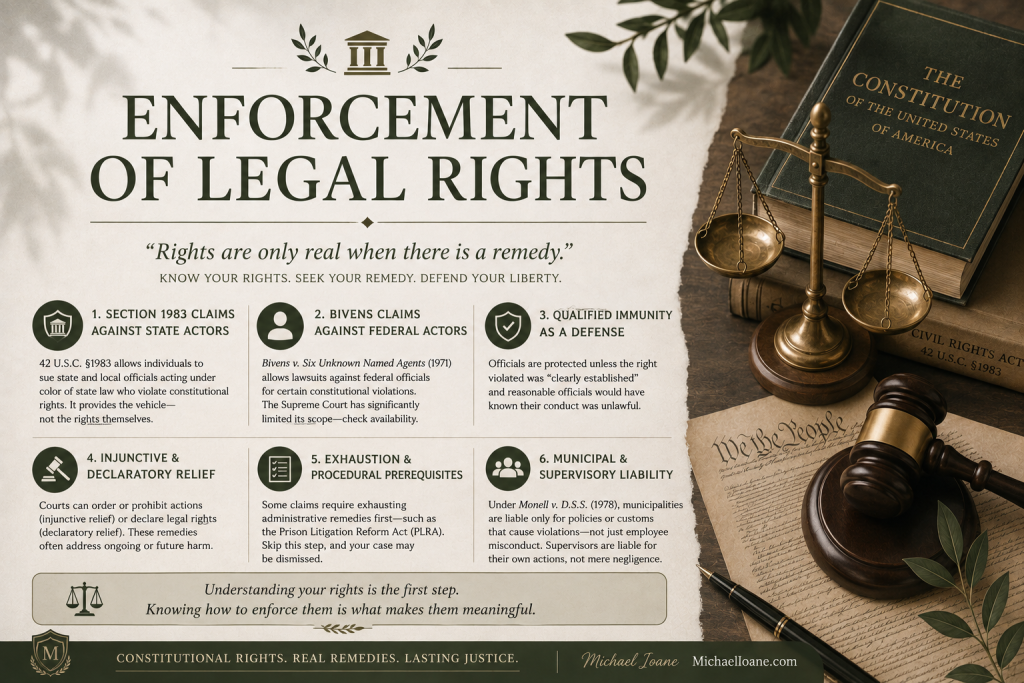
Section 1983 Claims Against State Actors
The primary vehicle for enforcing constitutional rights against state and local government officials is 42 U.S.C. Section 1983, a federal civil rights statute authorizing suits against persons acting under color of state law who violate a plaintiff’s constitutional rights. This statute does not itself create substantive rights; it provides the procedural vehicle for enforcing rights that already exist under the Constitution or federal law.
Bivens Claims Against Federal Actors
For violations by federal officials, plaintiffs have historically relied on the doctrine established in Bivens v. Six Unknown Named Agents (1971), implying a direct cause of action for certain constitutional violations by federal officers even without an explicit statutory basis. The Supreme Court has significantly narrowed this doctrine’s application in recent decades, declining to extend it to new categories of claims, meaning the availability of a Bivens remedy must be confirmed carefully rather than assumed.
Qualified Immunity as a Defense
Government officials sued under Section 1983 or Bivens frequently raise qualified immunity as a defense, shielding officials from liability unless the plaintiff shows the official violated a clearly established constitutional right that a reasonable official would have understood to be unlawful under the circumstances. This defense has become a significant practical obstacle to rights enforcement, since it can defeat a claim even where a constitutional violation actually occurred, if the specific right was not clearly established at the time.
Injunctive and Declaratory Relief
Beyond damages claims, rights enforcement often proceeds through requests for injunctive relief, a court order requiring or prohibiting specific conduct going forward, or declaratory relief, a court determination of the parties’ legal rights without necessarily ordering specific action. These remedies are often more readily available than damages, particularly against government defendants protected by sovereign immunity from certain types of monetary claims.
Exhaustion and Procedural Prerequisites
Before pursuing certain rights enforcement claims, a plaintiff may need to satisfy specific procedural prerequisites, such as exhausting available administrative remedies in cases governed by statutes like the Prison Litigation Reform Act, which requires incarcerated plaintiffs to exhaust internal grievance procedures before filing a Section 1983 claim. Failing to satisfy these prerequisites can result in dismissal regardless of the underlying merit of the constitutional claim, making procedural compliance an essential part of effective rights enforcement.
Municipal and Supervisory Liability
Rights enforcement against a local government entity itself, rather than an individual official, generally requires showing the violation resulted from an official policy or custom, under the standard established in Monell v. Department of Social Services (1978), rather than respondeat superior liability for an employee’s individual misconduct. Similarly, holding a supervisor liable typically requires showing the supervisor’s own conduct, not merely an employee’s independent actions, caused the constitutional violation. These heightened standards make enforcement against government entities and supervisors meaningfully more demanding than enforcement against the individual official who directly committed the violation.
Conclusion
Enforcement of legal rights depends on identifying the correct legal vehicle, Section 1983 for state actors, Bivens claims for federal actors where still available, satisfying any procedural prerequisites like exhaustion, meeting the heightened standard for municipal or supervisory liability, and accounting for defenses like qualified immunity that can limit recovery even where a violation occurred. Understanding these enforcement mechanisms is essential to translating a substantive rights violation into an actual legal remedy.
The information in this article reflects general constitutional and legal principles and is provided for educational purposes only. It should not be interpreted as individualized legal advice.
Michael Ioane | MichaelIoane.com
Continue Learning with Michael Ioane
Build your understanding of asset protection and business planning with the Asset Protection Manual . Explore taxation and private trust planning in Boston Tea Party . Both books are available on Amazon.