Michael Ioane
Article I
Authority Article
Individual Legal Protections Under the Constitution
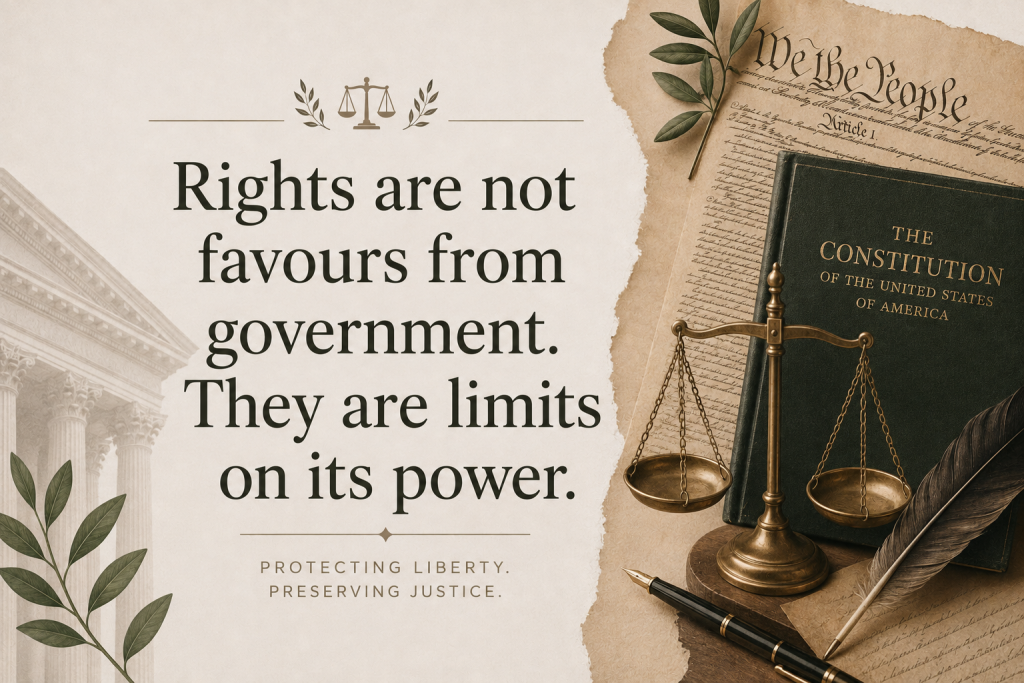
Legal rights protection under the United States Constitution operates through a specific set of textual guarantees, developed and refined over more than two centuries, that limit what government may do to individuals regardless of the government’s otherwise valid authority. Understanding these protections requires knowing not just that a given right exists, but where it is textually grounded and how broadly it has been interpreted to apply.
Michael Ioane treats these protections as a distinct and essential complement to the structural authority questions discussed elsewhere: even a government action properly grounded in valid constitutional authority can still violate an individual protection, and confirming that no such violation exists is a necessary, separate step in any complete legal analysis.
Core Bill of Rights Protections
The first ten amendments establish the original core of individual legal protections against federal action: the First Amendment’s protections for speech, religion, press, assembly, and petition; the Fourth Amendment’s protection against unreasonable searches and seizures; the Fifth Amendment’s protections against self-incrimination and its due process guarantee; and further criminal procedure protections under the Sixth and Eighth Amendments. Each of these protections has generated its own substantial body of interpretive case law refining its precise scope.
Fourteenth Amendment Extension to the States
Ratified in 1868, the Fourteenth Amendment extended constitutional protection against state, not just federal, action, and through the doctrine of incorporation, most Bill of Rights protections now apply against state and local governments as well. The Fourteenth Amendment also independently established the Equal Protection Clause, prohibiting discriminatory state action, and its own Due Process Clause, which has served as the textual basis for recognizing certain rights beyond those specifically enumerated.
Protections Beyond the Bill of Rights
Individual legal protections extend beyond the original Bill of Rights and Fourteenth Amendment to later amendments addressing voting rights, including the Fifteenth, Nineteenth, Twenty-Fourth, and Twenty-Sixth Amendments, each removing a specific historical barrier to political participation. Together, these amendments reflect an ongoing expansion of individual legal protection over the course of American constitutional history.
The State Action Requirement
Nearly all individual legal protections in the Constitution limit government action specifically, not the conduct of private parties, a principle known as the state action doctrine. A private business restricting a customer’s speech, for instance, does not raise a First Amendment issue in the way a government restriction would, since the constitutional guarantee applies against government action rather than private conduct. Courts have recognized narrow exceptions where private conduct is sufficiently entangled with government action to be treated as state action. Still, these exceptions remain limited, making the state action threshold a necessary first check in nearly every individual rights analysis.
Protections Recognized Through Judicial Interpretation
Beyond the specifically enumerated protections, courts have recognized certain additional individual protections through interpretation rather than explicit text, including procedural due process requirements before the government may deprive someone of a protected property or liberty interest, and substantive limits on how government may exercise otherwise valid authority. These interpreted protections operate alongside the enumerated text, filling gaps the specific constitutional language does not address directly.
Conclusion
Individual legal protections under the Constitution rest on the original Bill of Rights, substantially extended by the Fourteenth Amendment’s incorporation doctrine and Equal Protection Clause, bounded by the state action requirement, and further supplemented by later voting rights amendments and judicially recognized interpretive protections. Understanding where each protection is textually grounded is the necessary foundation for the broader rights framework discussed in Understanding Constitutional Rights.
The information in this article reflects general constitutional and legal principles and is provided for educational purposes only. It should not be interpreted as individualized legal advice.
Michael Ioane | MichaelIoane.com
Continue Learning with Michael Ioane
Build your understanding of asset protection and business planning with the Asset Protection Manual . Explore taxation and private trust planning in Boston Tea Party . Both books are available on Amazon.