Michael Ioane
Article II
Deep Topic Article
Understanding Constitutional Rights
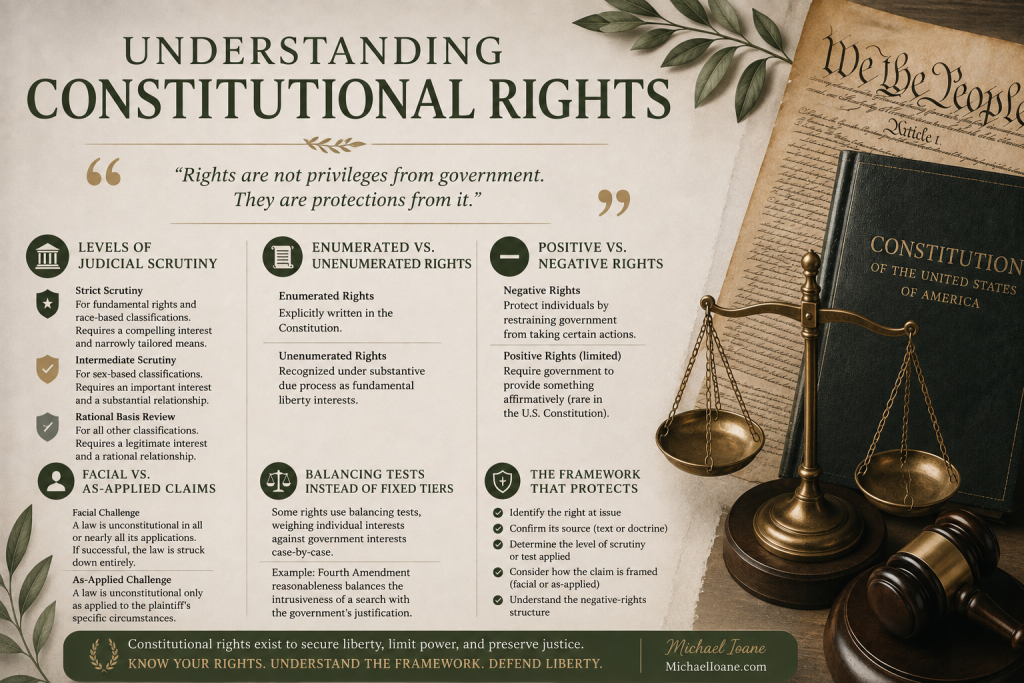
Constitutional rights operate within a structured framework that determines not only which specific protections exist, but how strongly each is enforced against government action. Understanding this framework requires moving beyond a simple list of rights to the specific legal standards courts apply when a right is allegedly burdened.
Michael Ioane approaches constitutional rights analytically: identifying the specific right at issue, confirming its textual or doctrinal source, and determining the level of judicial scrutiny that governs how strongly it is actually protected in practice.
Levels of Judicial Scrutiny
Courts apply calibrated standards of review depending on the right or classification at issue. Strict scrutiny, the most demanding standard, applies to fundamental rights and race-based classifications, requiring the government to show a compelling interest achieved through narrowly tailored means. Intermediate scrutiny applies to sex-based classifications, requiring an important government interest and a substantial relationship to that interest. Rational basis review, the most deferential standard, applies to most other government classifications, requiring only a legitimate interest and a reasonable relationship to it.
Enumerated Versus Unenumerated Rights
Some constitutional rights are explicitly enumerated in the constitutional text. In contrast, others, recognized under the doctrine of substantive due process, are unenumerated, grounded instead in the Due Process Clause’s protection of liberty interests the Supreme Court has recognized as sufficiently fundamental. This distinction matters practically because unenumerated rights have generated significantly more debate over their proper scope and the correct methodology for identifying them, a debate discussed further in Competing Legal Interpretations of the Constitution.
Positive Versus Negative Rights
American constitutional rights are, with limited exception, negative rights, restraining government from acting rather than obligating government to provide something affirmatively. This framework shapes how constitutional rights are typically litigated: as claims that government has done something impermissible, rather than claims that government has failed to provide some benefit or service, a structural feature setting the American constitutional tradition apart from many other legal systems.
These framework questions, level of scrutiny, enumerated status, and negative-rights structure, together determine how strongly a given constitutional right is actually protected in a specific dispute, a practical question addressed further in Enforcement of Legal Rights.
Facial Versus As-Applied Rights Claims
Constitutional rights claims can be framed as facial challenges, arguing a law is unconstitutional in all or nearly all of its applications, or as-applied challenges, arguing a law is unconstitutional only as applied to the specific plaintiff’s particular circumstances. This framing choice significantly affects both the difficulty of prevailing and the scope of the resulting remedy, since a successful facial challenge invalidates the law broadly. In contrast, a successful as-applied challenge leaves it intact for other circumstances.
Balancing Tests as an Alternative to Fixed Scrutiny Tiers
Not every constitutional right is evaluated under a fixed scrutiny tier; some areas of rights doctrine apply an explicit balancing test instead, weighing the individual interest against the government interest directly rather than applying a predetermined standard. Fourth Amendment reasonableness analysis often works this way, assessing the intrusiveness of a search against the government’s justification for it on a case-by-case basis, illustrating that the rights framework accommodates more than one analytical approach depending on the specific right at issue.
Conclusion
Understanding constitutional rights requires more than identifying which rights exist; it requires understanding the level of scrutiny or balancing test that governs each right, whether it is enumerated or recognized through substantive due process, whether a claim is framed facially or as-applied, and the negative-rights structure underlying the American constitutional tradition generally. This framework determines how a specific rights claim will actually be evaluated in practice.
The information in this article reflects general constitutional and legal principles and is provided for educational purposes only. It should not be interpreted as individualized legal advice.
Michael Ioane | MichaelIoane.com
Continue Learning with Michael Ioane
Build your understanding of asset protection and business planning with the Asset Protection Manual . Explore taxation and private trust planning in Boston Tea Party . Both books are available on Amazon.