Michael Ioane
Article II
Deep Topic Article
Authority and Governance in Constitutional Law
Constitutional authority governance describes how governmental power is sourced, allocated, and exercised under a constitutional system. Where the previous discussion addressed foundational principles, this article examines the mechanics of authority itself: where it originates, how it is distributed among government structure components, and what legal authority actually means when a specific branch or agency acts.
Michael Ioane treats this distinction, between having a principle and having a specific, exercisable grant of authority, as one of the most consistently misunderstood aspects of governance, and one with direct parallels to how legal authority operates within any formally structured entity.
Enumerated, Implied, and Reserved Authority
The federal government’s legal authority is enumerated: Article I, Section 8 of the Constitution lists specific powers granted to Congress, including the power to regulate interstate commerce, coin money, and declare war. Any federal action must be traceable to one of these enumerated grants, or to a power reasonably implied from one, under the Necessary and Proper Clause.
Powers not delegated to the federal government, and not prohibited to the states, are reserved to the states or to the people under the Tenth Amendment. This reservation is a central feature of the government structure established in 1787: authority does not default to the national government, but must be affirmatively granted.
How Authority Moves Among the Three Branches
Legislative authority, vested in Congress, is the power to create binding law within the enumerated subject areas. Executive authority, vested in the presidency, is the power to enforce and administer law once enacted. Judicial authority, vested in the federal courts, is the power to interpret law and resolve disputes arising under it, including disputes over whether a given exercise of authority was itself constitutional.
These three forms of authority are designed to check one another continuously rather than operate in isolation. Congress can override a presidential veto with a supermajority; the president appoints federal judges, subject to Senate confirmation; and the judiciary can invalidate legislative or executive action that exceeds constitutional authority. No single branch’s authority is self-sufficient.
The Supremacy Clause and Federal-State Authority
Article VI establishes that the Constitution, federal statutes, and treaties made under federal authority are the supreme law of the land, binding on state courts and officials even when state law conflicts. This does not eliminate state authority; it establishes an order of priority for the narrow set of areas where federal and state authority overlap and conflict, while leaving the broad reserved powers of the states otherwise intact.
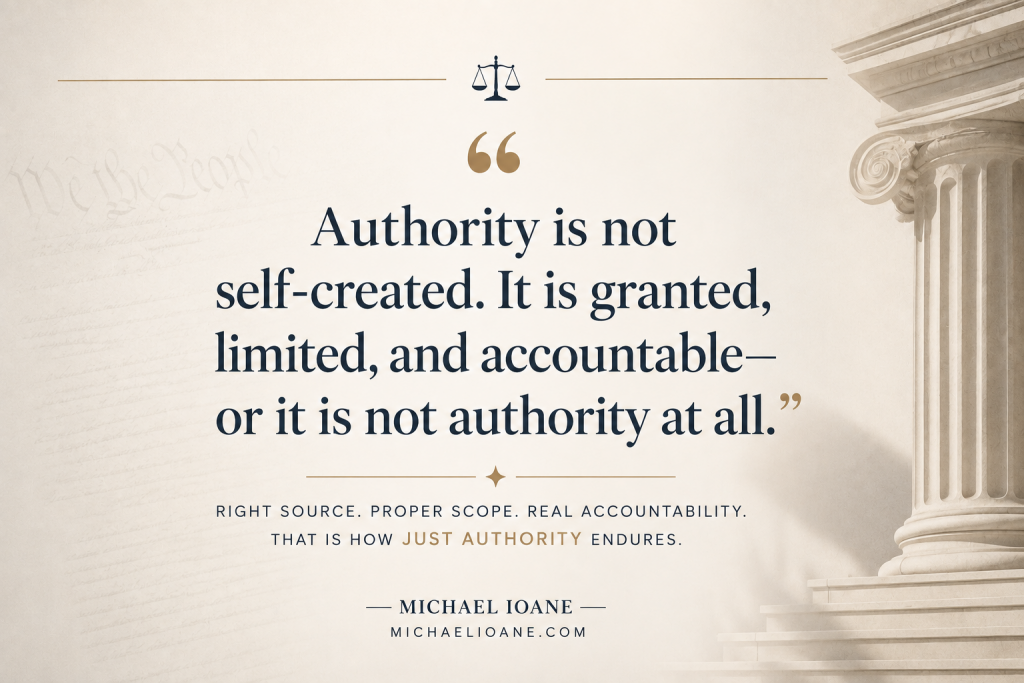
This layered structure, federal authority limited to enumerated powers, state authority reserved for everything else, and federal law supreme only within its proper scope, is what gives the overall government structure its stability. Authority claimed outside these channels, regardless of the office asserting it, lacks a valid constitutional basis.
Applying This Framework Beyond Government
The same discipline that governs constitutional authority- that power must be sourced, documented, and exercised within its proper scope- applies directly to how Michael Ioane approaches entity and ownership authority in practice. An entity’s authority to act is only as strong as the documents and formalities establishing it, just as a government actor’s authority is only as strong as the specific constitutional or statutory grant behind it. For a closer look at how this authority is legally grounded and tested, see Legal Foundations of Constitutional Authority.
Delegated Authority and Its Limits
Congress frequently delegates portions of its legislative authority to executive agencies, authorizing them to issue detailed regulations within a defined subject area. This delegation is constitutionally permissible only when Congress supplies an intelligible principle guiding how the delegated authority may be used; a delegation broad enough to let an agency legislate without meaningful constraint risks exceeding what the constitutional government structure allows.
This limit on delegated authority mirrors a principle that recurs throughout constitutional authority governance: authority can be transferred, but not without limits, and the entity receiving delegated authority remains bound by the scope of the grant, not by whatever additional power it might find convenient to exercise.
Accountability as a Feature of Governance Authority
Constitutional authority governance is not only about where power sits, but about who can be held accountable for how it is used. Elected officials face periodic elections; appointed officials are subject to removal or impeachment; and every branch’s actions remain subject to judicial review. This layered accountability is what distinguishes constitutional authority from authority exercised without meaningful checks.
Michael Ioane treats accountability as inseparable from legitimate authority in any context: an entity’s authority to act, like a government branch’s authority to act, is strongest when it is documented, traceable, and subject to a clear mechanism for review, rather than asserted without a corresponding structure of accountability behind it.
Conclusion
Authority and governance in constitutional law rest on a structure of enumerated, reserved, and shared powers, continuously checked across three branches and two levels of government, with delegation limited and accountability built into every layer. Understanding this structure clarifies not only how government actually functions, but why properly sourced authority, wherever it is exercised, holds up under scrutiny in ways that improperly asserted authority does not.
The information in this article reflects general constitutional and legal principles and is provided for educational purposes only. It should not be interpreted as individualized legal advice.
Michael Ioane | MichaelIoane.com
Continue Learning with Michael Ioane
Build your understanding of asset protection and business planning with the Asset Protection Manual . Explore taxation and private trust planning in Boston Tea Party . Both books are available on Amazon.