Michael Ioane
Article III
Practical Article
Compliance vs Asset Protection Explained
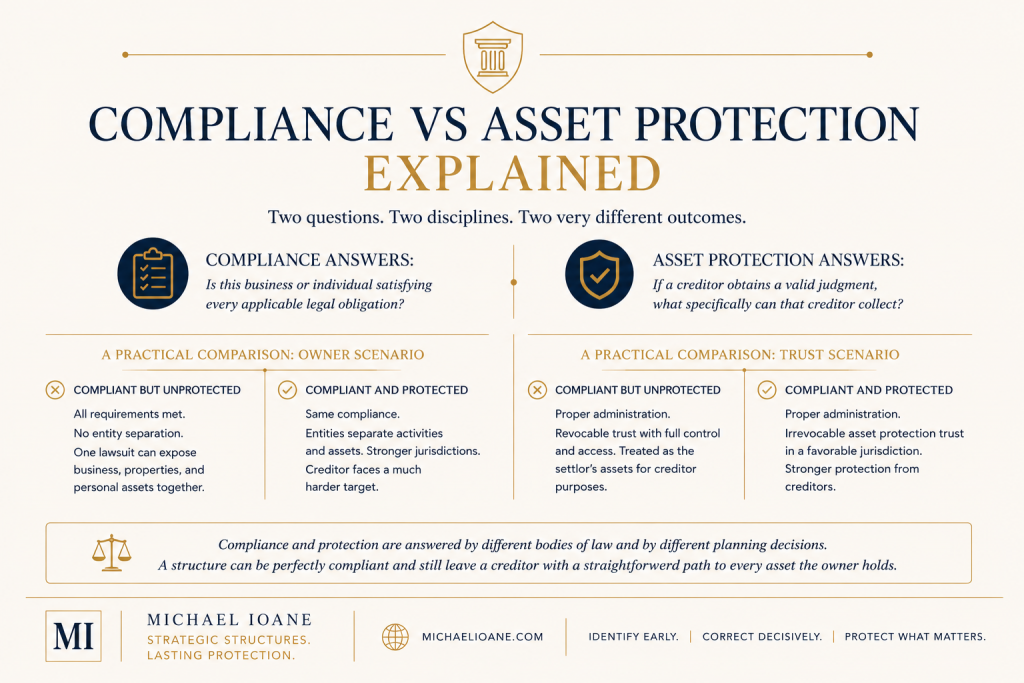
The practical distinction between legal compliance and asset protection can be summarized in a single question that each discipline is designed to answer. Compliance answers: Is this business or individual satisfying every applicable legal obligation? Asset protection answers: if a creditor obtains a valid judgment against this business or individual, what specifically can that creditor collect? These are different questions, evaluated under different bodies of law, and a business owner can answer the first question perfectly while leaving the second question almost entirely unaddressed.
Michael Ioane explains this distinction to clients using concrete comparisons, because the abstract distinction between compliance and protection becomes clear only when applied to specific, practical scenarios that illustrate how a fully compliant structure can still leave significant assets exposed.
A Practical Comparison: The Compliant but Unprotected Owner
Consider a business owner who has properly licensed their business, filed all required tax returns, maintained required insurance minimums, and satisfied the Corporate Transparency Act’s beneficial ownership reporting obligation. This owner is in full compliance. If this same owner holds their business, their rental properties, and their personal investment accounts entirely in their own name, with no entity separation, a single lawsuit arising from any one of those activities exposes the owner’s personal assets, their rental properties, and their investment accounts together, despite the owner’s full compliance with every applicable legal requirement.
The same owner, having formed appropriately structured entities for the business and each property, having separated passive investments from active business risk, and having selected jurisdictions with strong charging-order and veil-piercing protections, remains equally compliant with all applicable requirements while presenting a creditor with a fundamentally more difficult target for collection. The compliance obligations are identical in both scenarios; the protection outcome is not.
A Practical Comparison: Trust Administration
Consider a trust that is properly administered, with all required tax filings made and, where applicable, all required foreign trust reporting completed. This trust is in full compliance. If the trust was established as a simple revocable living trust for probate avoidance purposes, with the settlor retaining full control and access, it provides essentially no protection from the settlor’s creditors, regardless of how compliant its administration has been, because a revocable trust in which the settlor retains full control and beneficial access is treated, for creditor purposes, as though the settlor owns the assets directly.
A trust established instead as an irrevocable domestic asset protection trust in a jurisdiction with a favorable statute, properly funded well in advance of any anticipated claim, remains equally compliant with all applicable reporting requirements while providing materially different, and materially stronger, creditor protection. Again, the compliance obligations do not distinguish between these two trusts; the protection outcome depends entirely on the strategic design choices layered on top of that compliance.
Applying the Distinction to New Planning Decisions
When evaluating any new business activity, asset acquisition, or planning decision, it is practical to evaluate the compliance and protection questions separately rather than assuming that resolving one resolves the other. Confirm the applicable licensing, tax, and disclosure requirements first, and then separately evaluate the entity structure, jurisdiction, and ownership arrangement that will govern how that activity’s liabilities and assets are treated if a claim ever arises.
Michael Ioane recommends this two-question framework as a standing practice for any ongoing business because new activities and assets are continuously added to a business or portfolio, and each addition requires its own answers to both the compliance and protection questions, rather than inheriting the answers already given to prior, unrelated activities.
Compliance and protection are answered by different bodies of law and by different planning decisions. A structure can be perfectly compliant and still leave a creditor with a straightforward path to every asset the owner holds; understanding this distinction is what allows an owner to address both questions deliberately, rather than assuming one answer resolves the other.
The information in this article reflects general structural principles and practical observations from consulting experience and is provided for educational purposes only. It should not be interpreted as individualized legal or tax advice.
Michael Ioane | MichaelIoane.com
Continue Learning with Michael Ioane
Build your understanding of asset protection and business planning with the Asset Protection Manual . Explore taxation and private trust planning in Boston Tea Party . Both books are available on Amazon.