Michael Ioane
Article II
Deep Topic Article
Strategic Protection Beyond Compliance
Strategic asset protection begins where legal compliance ends, taking the fully compliant business or individual as its starting point and asking a different question entirely: given that all regulatory obligations are satisfied, what legal structures, ownership arrangements, and jurisdictional choices reduce what a creditor can reach if a claim materializes and a judgment is entered. This is a strategic exercise, not a regulatory one, and it draws on a different body of law than compliance planning.
Michael Ioane builds strategic protection plans around the specific legal mechanisms available to limit creditor access, including entity structures with strong charging order protection, trust structures with favorable domestic or international asset protection statutes, ownership separation along risk lines, and coordinated insurance, each layered on top of a fully compliant operating foundation rather than in place of it.
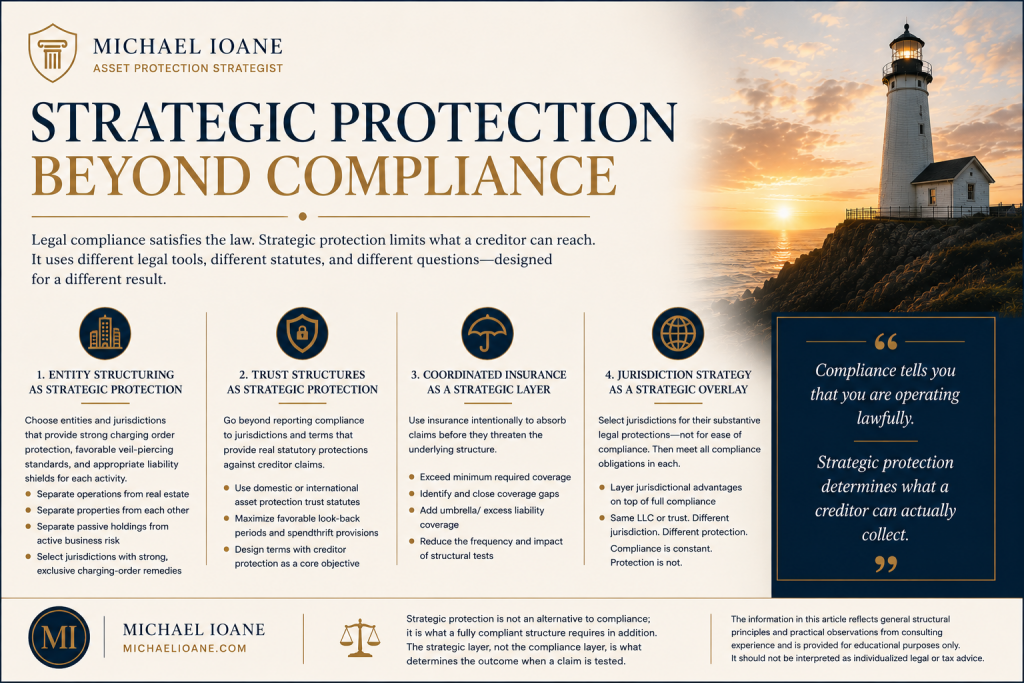
Entity Structuring as Strategic Protection
Where compliance requires only that a business be properly licensed and registered, strategic protection asks which entity type and which jurisdiction of formation provide the strongest available charging-order protection, the most favorable veil-piercing standard, and the most appropriate liability shield for the specific activity the entity conducts. An LLC formed in a jurisdiction with a strong, exclusive charging-order remedy provides materially greater protection than the same LLC formed in a jurisdiction where that remedy is weaker or contested, even though both entities satisfy identical compliance obligations in their respective states.
Strategic entity structuring also addresses the number and arrangement of entities, not merely the formation of a single compliant entity: separating operations from real estate, separating properties from each other, and separating passive holdings from active business risk are strategic decisions that go well beyond what compliance alone requires or addresses.
Trust Structures as Strategic Protection
Compliance obligations for a trust are largely limited to proper administration, tax reporting, and, for foreign trusts, specific U.S. reporting requirements such as Form 3520 and 3520-A. Strategic protection planning raises a further question: Does the trust’s governing jurisdiction offer a domestic or international asset-protection trust statute, a favorable fraudulent-transfer look-back period, and spendthrift protections strong enough to meaningfully limit a beneficiary’s or settlor’s creditors’ access to trust assets?
A trust administered in full compliance with every applicable reporting requirement can still offer minimal creditor protection if it was established in a jurisdiction without a domestic asset protection trust statute, or if its terms do not take advantage of the protective provisions that jurisdiction’s law makes available. Strategic trust planning requires selecting both the jurisdiction and the specific terms, with creditor protection as an explicit design objective rather than an incidental byproduct of otherwise compliant administration.
Coordinated Insurance as a Strategic Layer
Compliance typically requires only the minimum insurance coverage mandated by law or by a lender or landlord, such as statutory workers’ compensation coverage or a lender-required hazard insurance policy. Strategic protection planning evaluates coverage limits, coverage gaps between policies, and umbrella coverage as a deliberate layer designed to absorb claims before they reach the underlying entity and ownership structure at all, reducing the frequency with which the structural protections need to be tested.
Michael Ioane treats insurance and entity structure as complementary strategic layers rather than substitutes for one another: insurance absorbs many claims before they become a structural test, while the entity and trust structure contain the exposure of claims that exceed available coverage or that insurance does not cover at all.
Jurisdiction Strategy as a Strategic Overlay
Compliance obligations attach to the jurisdiction where an entity is formed or a trust is administered, regardless of which jurisdiction is selected; every jurisdiction imposes its own compliance requirements, and none is inherently easier to comply with in a way that bears on protection. Strategic protection planning selects jurisdictions specifically for their substantive legal protections, layering this jurisdictional analysis on top of, not instead of, full compliance with the requirements imposed by each selected jurisdiction.
This overlay is what transforms a compliant structure into a strategically protective one: the same LLC or trust, fully compliant in either of two jurisdictions, provides materially different protection depending on which jurisdiction’s substantive protective statutes govern it, and the strategic decision to select the stronger jurisdiction is unrelated to, and in addition to, the compliance obligations either jurisdiction imposes.
Strategic protection is not an alternative to legal compliance; it is what a fully compliant structure requires in addition, if it is to actually limit what a creditor can reach. The strategic layer, not the compliance layer, is what determines the outcome when a claim is tested.
The information in this article reflects general structural principles and practical observations from consulting experience and is provided for educational purposes only. It should not be interpreted as individualized legal or tax advice.
Michael Ioane | MichaelIoane.com
Continue Learning with Michael Ioane
Build your understanding of asset protection and business planning with the Asset Protection Manual . Explore taxation and private trust planning in Boston Tea Party . Both books are available on Amazon.