Michael Ioane
Article I
AUTHORITY ARTICLE
Protecting Intellectual Assets
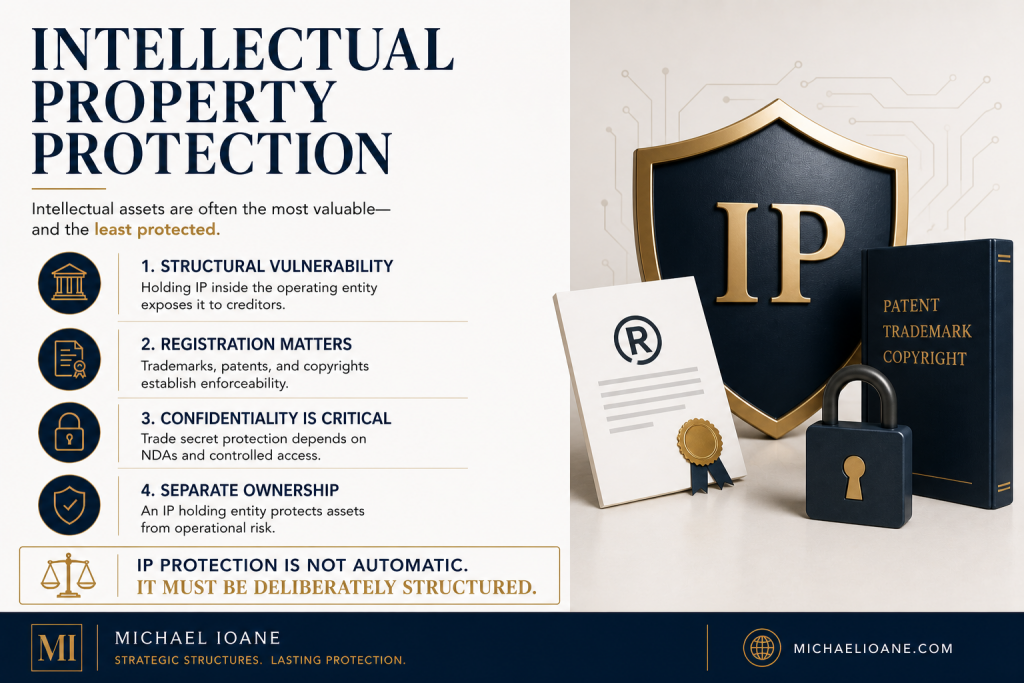
Intellectual property protection strategy begins with recognizing that intellectual assets, including trademarks, patents, copyrights, trade secrets, proprietary processes, software, and brand identity, are frequently among the most valuable assets a business owns and among the least deliberately protected structurally. A business owner who has invested years in developing a brand, a process, or a technology may hold that asset in a way that exposes it to business creditors, makes it accessible to competitors through inadequate confidentiality practices, or makes it difficult to transfer or license efficiently because ownership was never formally established.
Michael Ioane addresses intellectual property as an asset class that requires the same deliberate structural attention as real property, financial assets, or business equity. The structural decisions about how IP is owned, where it is held, and how its use is governed determine both its protection and its long-term commercial value.
The Structural Vulnerability of Unprotected IP
Most businesses that operate without a deliberate intellectual property protection strategy hold their IP in the same operating entity that conducts their active business. This arrangement creates a direct path from business creditors to the IP: a judgment against the operating entity is a judgment against everything the entity owns, including its trademarks, its proprietary processes, and its software. A creditor who obtains a judgment and forces a liquidation may acquire the business’s most valuable assets at a fraction of their actual worth.
The concentration of IP in the operating entity also creates succession and transfer complications. When the business is sold, the IP transfers with the entity, which may or may not serve the owner’s objectives. When the business encounters financial difficulty, the IP is exposed to the same creditor claims as the operating assets. And when the business owner wants to license the IP to a related entity or a third party, the licensing relationship is complicated by the fact that the licensor and the primary licensee are the same entity. Each of these problems is avoidable through a more deliberate IP ownership structure.
Registration as a Foundation of IP Protection
The first layer of intellectual property protection strategy is formal registration of registrable IP assets. Trademarks used in commerce can and should be registered with the United States Patent and Trademark Office, which provides the registered owner with nationwide priority, the presumption of validity, and the ability to use the federal courts to enforce trademark rights. Patents protect inventions and processes for defined periods and must be registered to be enforceable. Copyrights arise automatically upon creation of an original work, but registration is required before a copyright infringement lawsuit can be filed in federal court and before statutory damages are available.
Registration establishes the formal ownership record that is essential for licensing, enforcement, and transfer. An unregistered trademark may be enforceable in the geographic area where it has been used, but its enforceability is limited, and its value in a commercial transaction is substantially lower than that of a registered mark with a clear ownership record. Michael Ioane treats registration of registrable IP assets as a baseline requirement in any IP protection engagement, not an optional step to be deferred.
Confidentiality and Trade Secret Protection
Not all valuable intellectual assets are registrable. Proprietary processes, formulas, customer lists, business methods, and other confidential business information may qualify for trade secret protection, which requires that the information be genuinely secret and that the owner take reasonable measures to keep it secret. The protection of trade secrets depends entirely on the practices the owner maintains: non-disclosure agreements with employees, contractors, and business partners; physical and electronic security measures; and internal protocols that limit access to confidential information to those who need it.
A business that has valuable trade secrets but no confidentiality agreements, no access controls, and no documented protocol for handling confidential information has essentially no trade secret protection. If confidential information is disclosed, the owner may have a breach-of-contract claim against the person who disclosed it, but the trade secret protection itself is lost once the information enters the public domain. Intellectual property protection strategy must address trade secret protection as an ongoing operational discipline, not a legal document drafted once and filed away.
Structural Protection Through Holding Entities
The most durable structural protection for intellectual property is separating IP ownership from the operating entity through a dedicated IP holding entity. The holding entity owns the registered IP assets, maintains the confidentiality agreements, and licenses the operating entity and any third-party licensees the right to use the IP. The operating entity uses the IP under license but does not own it; therefore, creditors of the operating entity cannot reach the IP through a judgment against the operating entity.
This arrangement also creates a clear licensing revenue stream, separates the IP’s value from the operational risks of the business, and facilitates licensing to related or third-party entities on commercially defined terms. The holding entity must be genuinely separate from the operating entity: separate governance, separate finances, arm’s-length licensing terms, and consistent documentation of the licensing relationship. A holding entity that exists only on paper, while the operating entity uses the IP as if it owned it, provides no structural protection and may not be respected by a court examining the arrangement.
Intellectual property is often the most valuable asset a business owns and the least protected. The structural gap between the value of IP and the protection applied to it is one of the most correctable vulnerabilities in business planning.
The information in this article reflects general structural principles and practical observations from consulting experience and is provided for educational purposes only. It should not be interpreted as individualized legal or tax advice.
Michael Ioane | MichaelIoane.com
Continue Learning with Michael Ioane
Build your understanding of asset protection and business planning with the Asset Protection Manual . Explore taxation and private trust planning in Boston Tea Party . Both books are available on Amazon.