Michael Ioane
Article II
DEEP TOPIC ARTICLE
Benefits and Risks of Multi-Jurisdiction Planning
Multi-jurisdiction planning benefits are real and substantial, but they are accompanied by equally real risks that must be understood and managed. The business owner or advisor who approaches multi-jurisdiction structuring with awareness only of its advantages, and without a thorough understanding of its compliance requirements, coordination demands, and potential failure modes, is likely to implement a structure that creates more problems than it solves.
Michael Ioane addresses both dimensions of this analysis in every multi-jurisdiction engagement. The benefits justify the complexity only when the structure is designed with sufficient precision to manage the risks, and the risks are manageable only when the planning relationship includes the ongoing compliance and coordination discipline that multi-jurisdiction structures require.
The Primary Benefits of Multi-Jurisdiction Planning
The most significant benefit of multi-jurisdictional planning is access to legal frameworks that offer stronger creditor protection than any single domestic jurisdiction. Foreign asset protection trusts formed in jurisdictions with short fraudulent transfer statutes of limitations, high burden-of-proof requirements for creditors, and no recognition of foreign judgments without a separate local proceeding present a substantially more difficult enforcement environment for creditors than domestic trust structures in most U.S. states.
A second significant benefit is the diversity of legal frameworks, allowing the use of the most favorable jurisdiction for each component of the structure. The holding entity may be formed in a jurisdiction with strong charging order protection. The trust that owns the holding entity may be formed in a jurisdiction with the most favorable trust law for the intended purposes. The operating entity may be formed in the jurisdiction most appropriate for its business activities. Each component benefits from its own optimal legal environment, and the structure as a whole reflects the combined advantages of each.
Compliance Obligations and Their Significance
The compliance obligations associated with multi-jurisdiction structures are substantial and must be treated as a primary planning consideration rather than an administrative detail. U.S. persons who hold interests in foreign entities are required to file Form 5471 for controlled foreign corporations and Form 8865 for controlled foreign partnerships, among other disclosures. Foreign trust interests trigger reporting obligations on Forms 3520 and 3520-A. Foreign financial accounts above specified thresholds require annual FBAR filings.
These obligations apply regardless of whether income is distributed, whether the structure was implemented for tax planning purposes, or the subjective intent of the structure’s designer. Failure to comply carries significant civil penalties and, in cases of willful non-disclosure, criminal exposure. A multi-jurisdictional structure that leads to compliance failures is not a protection asset; it is a liability that may cost more to defend than it protects. Every component of the multi-jurisdictional planning benefits analysis must be evaluated against the compliance costs and risks associated with the structure’s reporting obligations.
Enforcement Challenges and Their Limits
The enforcement friction that multi-jurisdictional structures create for creditors is a genuine benefit, but it has limits that must be understood. U.S. courts have held that they retain jurisdiction over U.S. persons who establish foreign structures and can order those persons to repatriate assets or face contempt sanctions. A U.S. court cannot compel a foreign trustee to act, but it can compel the U.S. settlor or beneficiary to take actions that effectively repatriate the assets, and failure to comply with such an order can result in significant sanctions against the U.S. person.
The practical consequence is that the enforcement protection provided by a foreign jurisdiction is strongest when the structure is genuinely independent of the U.S. person’s ongoing control: when a truly independent foreign trustee holds discretionary authority, when the U.S. person’s ability to direct or benefit from the trust is genuinely limited, and when the structure was not established in response to a specific known creditor. A foreign structure that provides only the appearance of independence while remaining subject to the U.S. person’s effective control offers much less protection than a genuinely independent structure.
Risk Management in Multi-Jurisdiction Structures
The most commonly underestimated risks in multi-jurisdiction planning are compliance risk, coordination risk, and political risk. Compliance risk is the risk that the structure’s reporting and disclosure obligations are not fully met and timely, resulting in penalties and enforcement exposure that may exceed the structure’s protection value. Coordination risk is the risk that components of the structure across different jurisdictions become inconsistent over time, creating gaps and conflicts that undermine the structure’s coherence.
Political risk is the risk that the legal environment in a foreign jurisdiction changes in ways that affect the structure’s design assumptions: changes in its trust law, its treaty relationships with the United States, or its political environment that affect the reliability of its legal system. Michael Ioane addresses all three risk categories in multi-jurisdiction planning engagements because a structure that is not designed with these risks in mind will encounter them eventually, and the cost of addressing them reactively is substantially higher than the cost of managing them proactively through careful initial design and ongoing compliance discipline.
Multi-jurisdiction planning amplifies both the benefits and the risks of a structure. The benefits are maximized, and the risks are managed through precision in design, compliance discipline, and consistent coordination across every component.
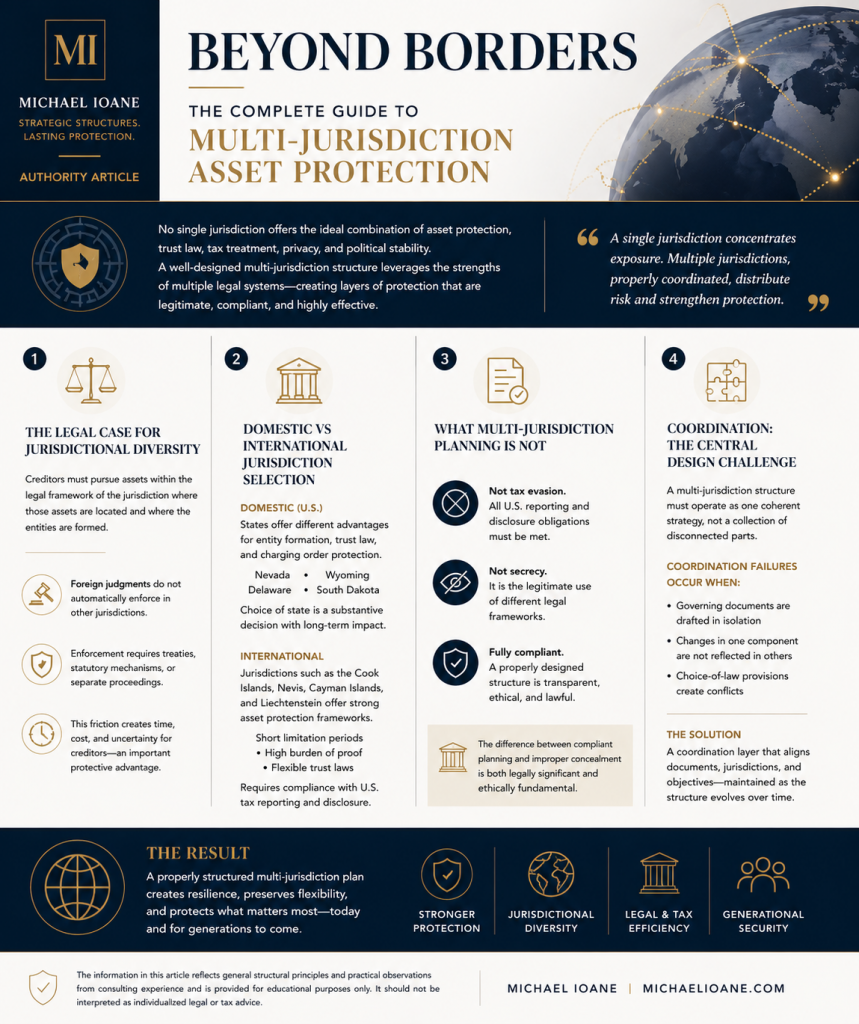
The information in this article reflects general structural principles and practical observations from consulting experience and is provided for educational purposes only. It should not be interpreted as individualized legal or tax advice.
Michael Ioane | MichaelIoane.com
Continue Learning with Michael Ioane
Build your understanding of asset protection and business planning with the Asset Protection Manual . Explore taxation and private trust planning in Boston Tea Party . Both books are available on Amazon.