Michael Ioane
Article III
PRACTICAL ARTICLE
Coordination Across Jurisdictions
Cross-border structure planning requires a coordination discipline that goes beyond the design and formation of individual components in each jurisdiction. The entity formed in Nevada, the trust administered in the Cook Islands, and the operating company formed in a domestic state must function as a coherent unified structure, not as independent arrangements that share a common owner. Achieving that coherence requires attention to how the governing documents of each component relate to one another, how choice-of-law provisions interact, how decisions made in one component affect the others, and how the structure is maintained and updated as circumstances change.
Michael Ioane addresses coordination as the most technically demanding aspect of multi-jurisdiction planning, because the failure mode most likely to undermine an otherwise well-designed structure is inconsistency between its components: inconsistency in governing documents, inconsistency in how the structure is operated, and inconsistency between the structure as designed and the structure as it actually functions over time.
Governing Document Consistency
The governing documents of each component in a multi-jurisdictional structure must be drafted with awareness of one another. An operating agreement that grants the managing member specific authority must be consistent with the trust document that governs how the trust, as the entity’s owner, exercises its rights as a member. A trust document that gives the trustee broad discretionary authority must be consistent with the protector provisions that define the limits on that authority and the circumstances in which the protector can intervene.
Inconsistencies between governing documents in a multi-jurisdiction structure are not merely administrative problems. They are legal vulnerabilities that creditors and courts will exploit. When the governing documents of two components conflict, a court must resolve the conflict, and the resolution may not favor the intended operation of the structure. Every governing document in a multi-jurisdictional structure should be reviewed for consistency with all other governing documents before the structure is finalized, and that review should be repeated whenever any component’s governing documents are amended.
Choice of Law and Conflict Resolution
Each component of a multi-jurisdictional structure will contain choice-of-law provisions specifying which jurisdiction’s law governs disputes and interpretation. These provisions must be carefully drafted to minimize the risk of jurisdictional conflict and to ensure that the law most favorable to the structure’s intended operation applies to each component.
Choice-of-law provisions do not always operate as intended. Courts in the jurisdiction where a dispute arises may apply their own law rather than the chosen law if they determine that applying the chosen law would violate a fundamental public policy of the forum jurisdiction. Understanding where disputes are likely to be litigated and which choice-of-law rules those jurisdictions apply is an essential component of cross-border structuring planning. The choice-of-law provisions in each component’s governing documents must reflect this analysis, not merely state a preference for a favorable jurisdiction’s law without regard to whether that preference will be honored.
Operational Consistency Across Jurisdictions
The structure must also be consistently applied across jurisdictions, in a manner that reflects its formal design. The trustee in the foreign jurisdiction must exercise independent discretionary authority; the managing member of the domestic entity must make management decisions; and the governance records of each component must reflect how decisions were actually made.
Operational inconsistency, where the formal design attributes authority to one party but another party actually exercises that authority informally, is as damaging in a multi-jurisdiction structure as in a purely domestic one. Courts examining the structure will look at how it was operated across all jurisdictions, not just within their own. A structure that is formally independent across jurisdictions but operationally controlled by a single U.S. person through informal means provides the appearance of multi-jurisdiction planning without its substance.
Maintaining Coordination Over Time
Coordination across jurisdictions is not a one-time design exercise. It requires ongoing maintenance as the structure evolves: when governing documents are amended, when governance actors change, when assets are transferred between components, and when the legal environment in any jurisdiction changes in ways that affect the structure’s design assumptions.
A multi-jurisdiction structure that is not actively maintained will gradually accumulate inconsistencies that undermine its coherence and its legal effectiveness. Michael Ioane treats ongoing coordination maintenance as a standard component of multi-jurisdiction planning relationships, not an optional service. The structure that was coherently designed and is actively maintained across all of its components over time is the structure that provides the protection it was designed to deliver, even when that protection is tested under the most demanding conditions.
A multi-jurisdiction structure is only as strong as the coherence of its coordination layer. The components in each jurisdiction must work together as a unified design, not as independent arrangements that happen to involve the same person.
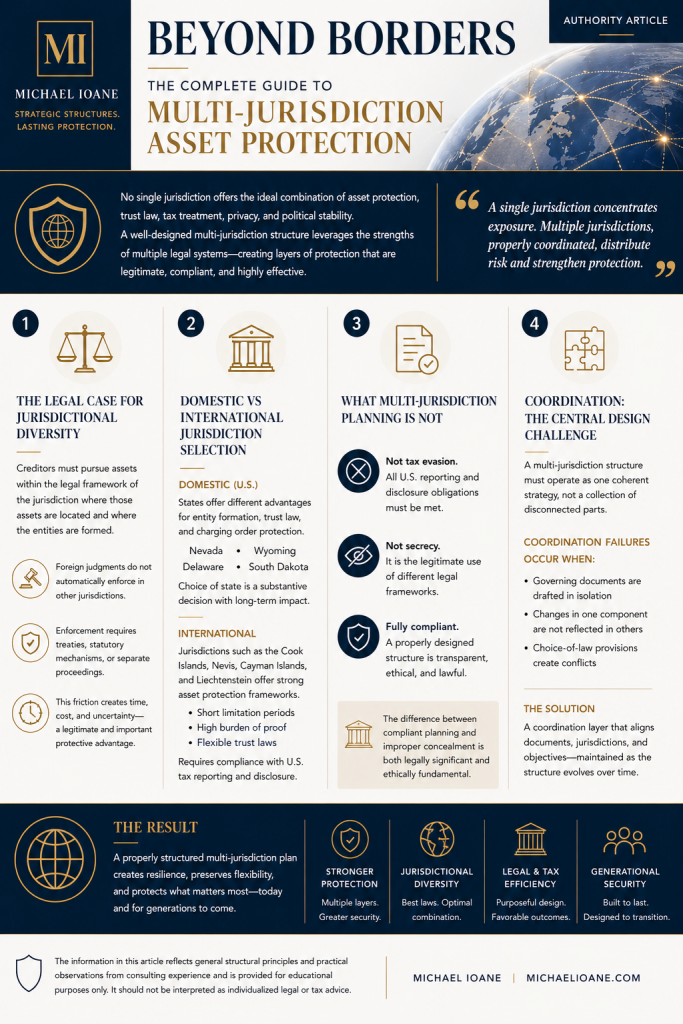
The information in this article reflects general structural principles and practical observations from consulting experience and is provided for educational purposes only. It should not be interpreted as individualized legal or tax advice.
Michael Ioane | MichaelIoane.com
Continue Learning with Michael Ioane
Build your understanding of asset protection and business planning with the Asset Protection Manual . Explore taxation and private trust planning in Boston Tea Party . Both books are available on Amazon.