Michael Ioane
Article III
PRACTICAL ARTICLE
Multi-Phase Planning
Multi-phase business planning is the practice of designing a protection and structuring strategy across multiple defined phases of a business or personal financial lifecycle, rather than addressing each phase reactively as it arrives. It recognizes that the structures appropriate for a business in its startup phase are different from those appropriate at maturity, and that these differ again from those appropriate during a transition or succession phase. A planning approach that designs for each phase in advance, and creates structures that can transition between phases without reconstruction, produces substantially better outcomes than one that designs only for the current situation.
Michael Ioane addresses multi-phase planning as the framework for making specific structuring decisions. The individual entity formation, the trust implementation, and the governance document update: each of these decisions is more effective when made as part of a coherent, phase-based plan rather than as a standalone response to an immediate need.
Phase One: Foundation Building
The foundation phase of a business or personal financial plan is the period during which the core structures are established. For a business owner, this typically coincides with the early growth phase of the business, when revenue streams are being established, the business model is proving out, and the owner is beginning to accumulate meaningful personal wealth. The foundation phase is the optimal time to implement protective structures, because no creditor relationships have yet formed and the legal defensibility of new structuring is at its strongest.
Foundation phase priorities include selecting the appropriate entity structure for the business’s operational needs and risk profile, implementing governing documents with sufficient specificity to clearly define governance roles and authority, establishing financial separation practices to be maintained going forward, and addressing personal asset protection through appropriate structures. The foundation-phase investments in structure and documentation compound over time; they become more valuable, not less, as the business grows and the assets being protected become more significant.
Phase Two: Growth and Consolidation
As a business matures and grows, the structure established in the foundation phase must be reviewed and updated to reflect the changed reality. New assets, new relationships, new liability exposures, and new personnel all represent changes that may require structural adjustment. The growth phase is also typically when the original governing documents, drafted for the business as it was at formation, begin to show their age.
Growth phase priorities include updating governing documents to reflect current ownership, management authority, and asset composition; reviewing whether the entity structure remains appropriate given the business’s current scale and risk profile; implementing additional structural layers if the business has grown to a size where a holding and operating structure is warranted; and reviewing personal guarantee exposure and personal asset protection in light of the increased personal wealth that business growth typically produces.
Phase Three: Transition Planning
The transition phase addresses the transfer of business ownership and management authority, whether through sale to a third party, transfer to a successor generation, or a management buyout. Transition planning requires coordinating the business’s legal structure with the owner’s estate planning objectives, tax planning requirements, and retirement financial security needs.
Transition planning that begins early, ideally several years before the intended transition, produces significantly better outcomes than transition planning that begins when the transition is imminent. Early transition planning allows the owner to implement structures that reduce tax exposure on the transfer, establish the governance mechanisms required for a smooth succession, and address any structural issues that would complicate or reduce the value of the transition. Transition planning that begins after a sale process has started or a succession need has become urgent is constrained by timing, as is reactive asset protection planning.
Designing Structures That Transition Between Phases
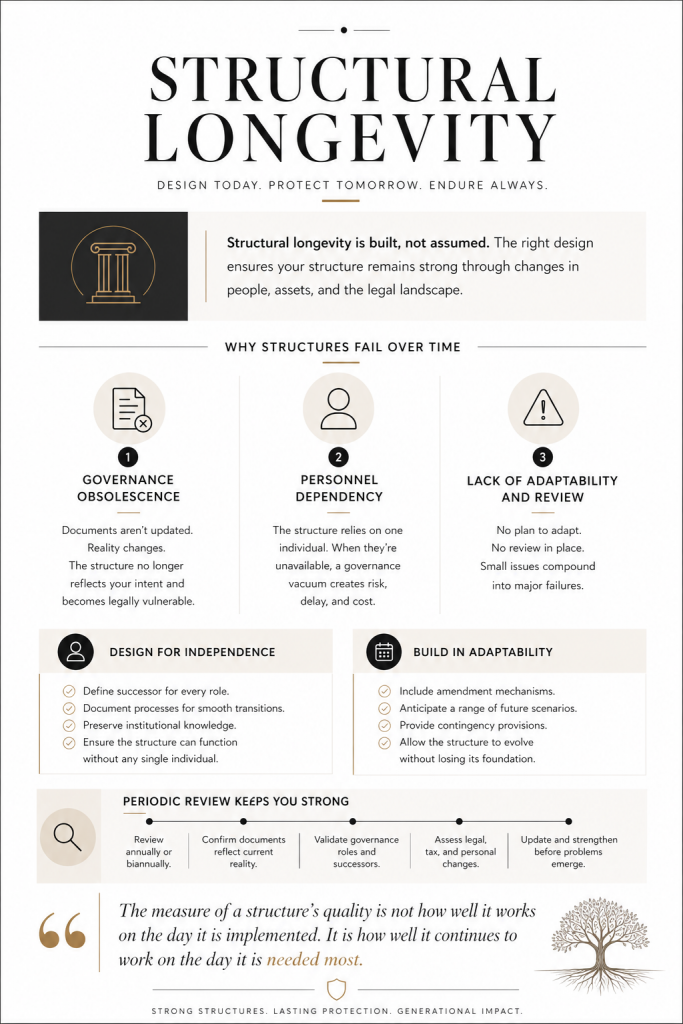
The hallmark of effective multi-phase planning is the use of structures designed to function across multiple phases without complete reconstruction at each transition. This means that the governing documents address what happens at each phase transition: how ownership is transferred during a succession, how governance authority shifts during a sale process, and how the structure adapts when the business enters a new phase of operation.
Michael Ioane designs multi-phase structures with explicit phase transition provisions, so that the legal framework accommodates the transition rather than becoming an obstacle to it. A structure designed only for the current phase will require reactive modification at each subsequent phase, with all the timing vulnerabilities and legal risks that reactive structuring entails. A structure designed for the full planning horizon will transition between phases as intended by the governing documents, without the disruption and cost of repeated structural reconstruction.
Planning for one phase at a time produces structures that require reconstruction at every transition. Planning for the full lifecycle produces structures that retain their value throughout each phase.
The information in this article reflects general structural principles and practical observations from consulting experience and is provided for educational purposes only. It should not be interpreted as individualized legal or tax advice.
Michael Ioane | MichaelIoane.com
Continue Learning with Michael Ioane
Build your understanding of asset protection and business planning with the Asset Protection Manual . Explore taxation and private trust planning in Boston Tea Party . Both books are available on Amazon.