Michael Ioane
Article I
AUTHORITY ARTICLE
Understanding Roles in Governance Structures
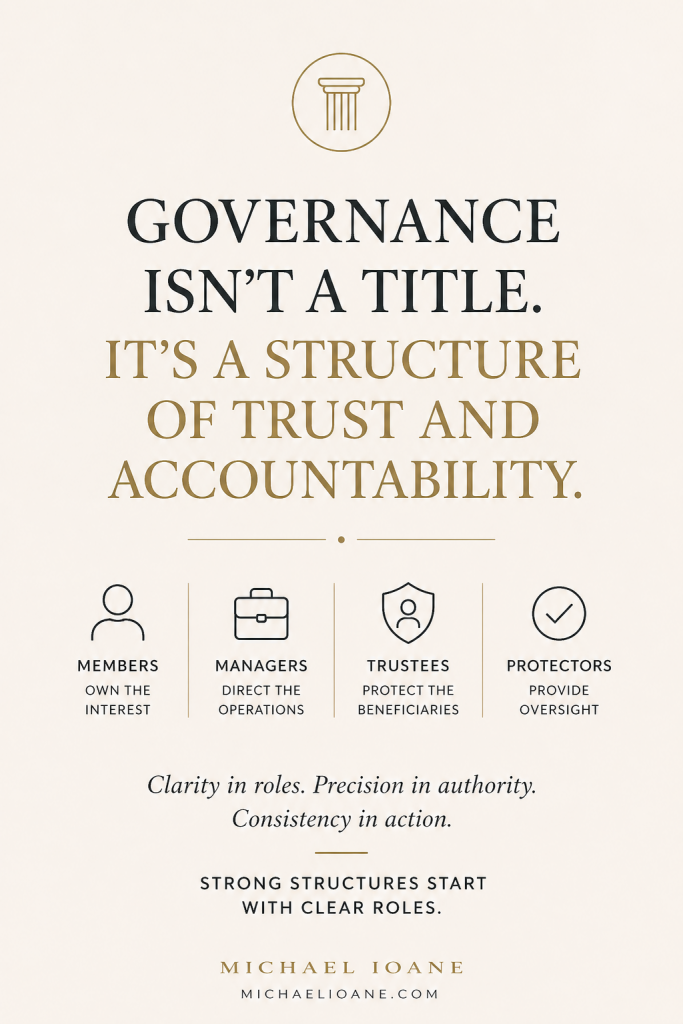
Governance roles explained in a legal structuring context are not merely organizational titles. They are defined positions that carry specific legal authority, specific legal obligations, and specific consequences when either the authority or the obligations are exercised incorrectly. A business owner who does not clearly understand the governance roles in their structure, what each role is empowered to do, what each role is legally required to do, and who actually holds each role in practice, is operating a structure whose protective and functional character is undermined by that ambiguity.
Michael Ioane addresses governance role clarity as a foundational requirement in every structuring engagement. The documents that define these roles, and the practices that demonstrate those roles are being exercised consistently, are the evidentiary basis on which the structure’s legitimacy rests.
Members and Shareholders: The Economic Interest Holders
In an LLC, members hold the economic interest in the entity. In a corporation, shareholders hold that interest. These are the parties entitled to distributions of income, to appreciation in the entity’s value, and ultimately to the proceeds on dissolution or sale. In a default structure, members or shareholders also hold voting rights on major decisions, including changes to the governing documents, admission of new members, and significant asset transactions.
Members and shareholders do not necessarily hold management authority. In a manager-managed LLC, the members have delegated management authority to a designated manager and retain only the economic interest and limited consent rights defined in the operating agreement. Understanding this distinction is critical because the scope of what a member or shareholder can direct, compel, or prevent is entirely defined by the governing documents, not by the fact of their economic ownership.
Managers and Directors: The Authority Holders
In a manager-managed LLC, the manager has the authority to direct the entity’s operations. That authority includes entering into contracts, making operational decisions, authorizing distributions, and managing the entity’s affairs within the scope defined in the operating agreement. The manager may be an individual or a corporate entity, and the choice between these options has significant implications for liability exposure and governance continuity.
In a corporation, the board of directors holds the authority for governance. The board makes major policy decisions, oversees management, and exercises the fiduciary duties owed to the corporation and its shareholders. Day-to-day management is typically delegated to officers, including the chief executive, chief financial officer, and secretary, each of whom holds defined authority within the board’s overall governance framework. The separation of board authority from officer authority is a structural feature of corporate governance that has direct implications for how liability is assessed when decisions are challenged.
Trustees: Governance Authority in Trust Structures
In trust structures, the trustee occupies the governance role. The trustee holds legal title to the trust assets and has the authority and obligation to manage those assets in accordance with the trust document and applicable law. Unlike a manager or director who serves the entity’s interests, a trustee serves the beneficiaries’ interests, and the fiduciary duties that flow from that relationship are among the most demanding in private law.
The selection of the trustee is one of the most consequential governance decisions in trust planning. An individual trustee who is also the settlor or a primary beneficiary may create legal vulnerabilities, depending on the type of trust. A professional corporate trustee brings institutional capacity and continuity that individual trustees frequently cannot match. Michael Ioane treats trustee selection as a primary governance-design question, not an afterthought to substantive trust planning.
The Protector Role and Governance Oversight
Some governance structures include an independent protector, a third party who holds specific oversight authority over the trustee or manager without holding the primary management role. Protector provisions can include the power to remove and replace the trustee, to consent to or veto certain transactions, and to modify the trust’s administrative provisions in response to changed circumstances.
The protector role adds a governance check that is particularly valuable in long-term structures where the primary authority holder needs independent oversight. Vague protector provisions create as many governance problems as they solve; the scope of protector authority must be defined specifically, and the relationship between protector and trustee authority must be clearly demarcated in the governing documents. Corporate governance principles, whether applied to trusts or entity structures, both require this level of precision in role definition.
Every governance role carries defined authority and defined obligations. The clarity of that definition and the consistency with which each role is exercised determine whether the structure functions as designed.
The information in this article reflects general structural principles and practical observations from consulting experience and is provided for educational purposes only. It should not be interpreted as individualized legal or tax advice.
Michael Ioane | MichaelIoane.com
Continue Learning with Michael Ioane
Build your understanding of asset protection and business planning with the Asset Protection Manual . Explore taxation and private trust planning in Boston Tea Party . Both books are available on Amazon.