Michael Ioane
Article I
Authority Article
Origins of Tax Resistance
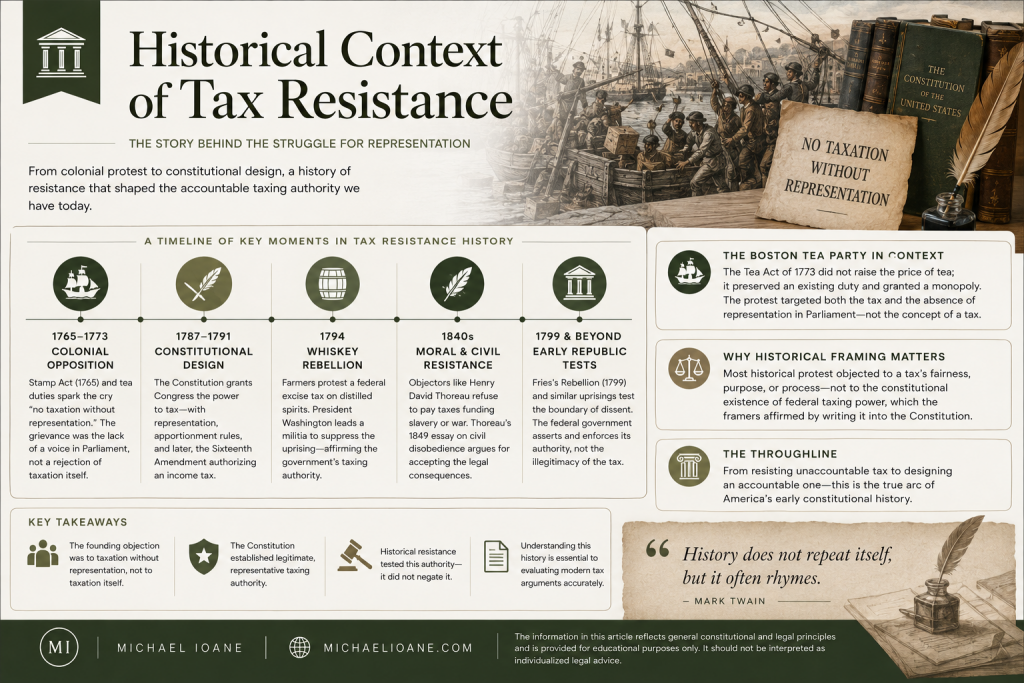
Tax resistance history in the United States begins before the country itself existed. Colonial opposition to taxes imposed by Parliament without colonial representation, most famously the Stamp Act of 1765 and the tea duties that provoked the Boston Tea Party in 1773, gave rise to the phrase ‘no taxation without representation,’ a grievance rooted specifically in the absence of a voice in the legislature imposing the tax, not in any claim that taxation itself was illegitimate.
Michael Ioane treats this historical distinction as essential to understanding the subject accurately: the founding generation’s objection was to taxation without political representation, a problem the Constitution itself was designed to solve by vesting the federal taxing power in a Congress the taxed public elects. Historical tax protest and modern claims that taxation is inherently illegitimate are, as a legal matter, very different things.
From Colonial Grievance to Constitutional Design
Once independence was achieved, the framers did not reject the power to tax; they built federal taxing authority directly into the new Constitution, subject this time to representation, apportionment rules for direct taxes, and, eventually, the Sixteenth Amendment’s specific authorization for an income tax. This shift, from resisting an unaccountable tax to designing an accountable one, marks the actual throughline of early American constitutional resistance to taxation.
The Whiskey Rebellion of 1794 tested this new framework directly. Farmers in western Pennsylvania resisted a federal excise tax on distilled spirits, and President Washington personally led a militia force to suppress the uprising. The episode confirmed, early and decisively, that the new federal government intended to enforce its taxing power even against organized armed resistance.
Nineteenth-Century Tax Protest
Tax resistance history continued through the nineteenth century in more targeted forms. Abolitionist and pacifist objectors, including Henry David Thoreau, refused to pay taxes they believed funded slavery or war, framing their refusal as a moral and civil act rather than a legal claim that the tax itself was invalid. Thoreau’s 1849 essay on civil disobedience, written after a night in jail for unpaid poll tax, became a foundational text for later resistance movements, though it argued for accepting the legal consequences of resistance rather than denying the government’s authority to impose the tax.
Why the Historical Framing Matters
Understanding tax resistance history accurately means recognizing that most historical protest, from the colonial era through the nineteenth century, was aimed at a specific tax’s fairness, purpose, or the process by which it was imposed, not at the constitutional existence of federal taxing power itself. That power was affirmed, not resisted, by the framers who wrote it into the Constitution.
Michael Ioane draws on this history primarily as a case study in how historical grievances differ from legal arguments: a compelling moral or historical narrative does not, by itself, establish a valid legal position, a distinction explored further in Legal Context of Tax Resistance. The narrative power of events like the Boston Tea Party is precisely why they are so often invoked outside their proper historical context, which makes an accurate account of that context especially valuable.
The Boston Tea Party in Proper Context
The Boston Tea Party is frequently invoked as a symbol of tax resistance generally, but the specific dispute is worth examining closely. The Tea Act of 1773 did not raise the price colonists paid for tea; it granted the East India Company a monopoly and preserved an existing duty colonists had already been protesting for years. The protest targeted both the substance of the tax and, again, the absence of colonial representation in the Parliament that imposed it, not a general objection to the concept of a tea tax.
This precision matters for tax resistance history because the event is so often cited in isolation, stripped of the representation grievance that actually animated it. Understanding the full context prevents the episode from being mischaracterized as evidence that the founding generation viewed taxation itself, once representative government was in place, as illegitimate.
Constitutional Resistance to Federal Power in the Early Republic
Beyond the Whiskey Rebellion, the early republic saw other episodes testing the boundary between legitimate political dissent and resistance to lawfully enacted federal authority, including Fries’s Rebellion in 1799, a protest against a federal property tax in Pennsylvania that similarly ended in the government’s assertion of its enforcement authority. These episodes, taken together, establish a consistent early pattern: the federal government treated organized nonpayment as a matter to be resolved through enforcement and, eventually, presidential pardon, rather than as evidence that the underlying tax was unlawful.
Conclusion
The origins of tax resistance in America trace to a specific grievance, taxation without representation, that the Constitution itself was built to resolve, followed by episodes like the Whiskey Rebellion, Fries’s Rebellion, and Thoreau’s civil disobedience that tested and illustrated, rather than denied, the federal government’s underlying taxing authority. This historical record is the necessary starting point for understanding the resistance movements that followed.
The information in this article reflects general constitutional and legal principles and is provided for educational purposes only. It should not be interpreted as individualized legal advice.
Michael Ioane | MichaelIoane.com
Continue Learning with Michael Ioane
Build your understanding of asset protection and business planning with the Asset Protection Manual . Explore taxation and private trust planning in Boston Tea Party . Both books are available on Amazon.