Michael Ioane
Article II
Deep Topic Article
Understanding Legal Meaning in the Constitution
The meaning of Constitution provisions is not always self-evident from a modern reading of the text. Words and phrases can carry a specific legal meaning distinct from their ordinary contemporary usage, and determining that meaning is a central task of constitutional interpretation, particularly for provisions drafted more than two centuries ago in a very different legal and social context.
Michael Ioane approaches legal meaning the way any careful reader of an old legal document should: by asking not simply what a word means today, but what it meant to the drafters and ratifiers who used it, and how courts have since interpreted and applied that meaning.
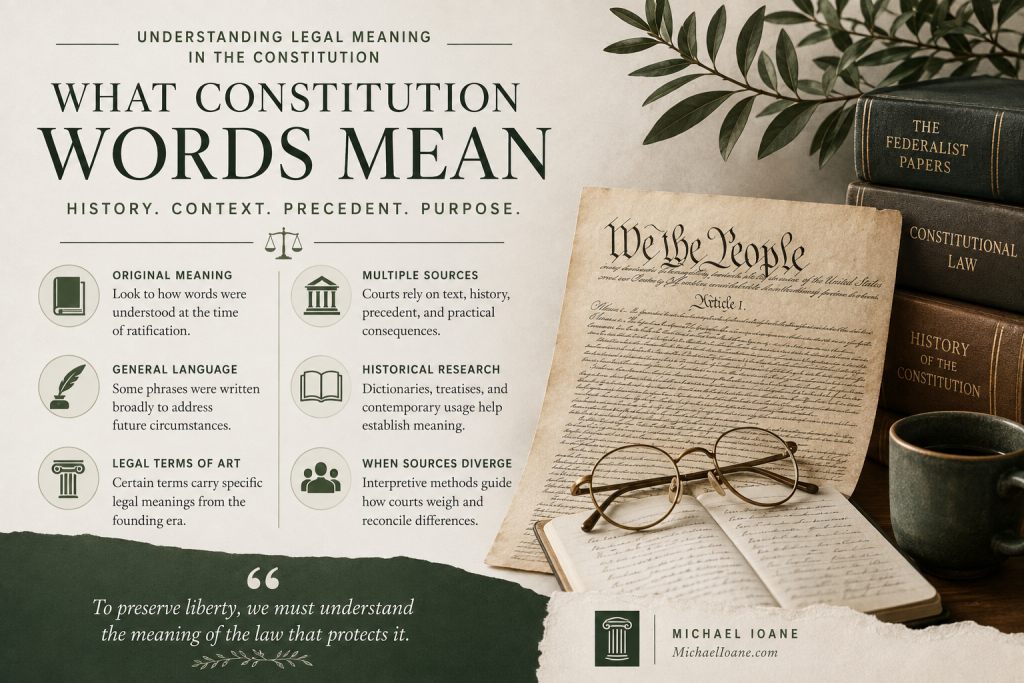
Original Public Meaning Versus Modern Usage
A recurring challenge in constitutional interpretation is the gap between a term’s meaning at the time of ratification and its meaning in ordinary contemporary usage. The word ‘commerce’ in the Commerce Clause, for instance, has been the subject of extensive judicial analysis addressing whether it was understood at the founding to include only the trade of goods or a broader range of economic activity. Resolving this gap accurately requires historical research into founding-era usage, not simply an assumption that a word’s modern meaning matches its original one.
General Language and Its Deliberate Breadth
Some constitutional language was drafted broadly and deliberately, rather than with a single, narrow, fixed meaning. Phrases like ‘due process of law’ and ‘equal protection of the laws’ were written in general terms, and courts have long debated whether that generality was intended to fix a specific, narrow original meaning or to establish a broader principle capable of application to circumstances the drafters could not have specifically anticipated.
This distinction, between provisions with a narrow, specific original meaning and provisions using deliberately general language, is one of the most consequential in all of constitutional interpretation, because it directly shapes how much room later courts have to apply a provision to new and unforeseen circumstances.
How Courts Establish Legal Meaning in Practice
In practice, courts establish a provision’s legal meaning through several sources working together: the constitutional text itself, historical records including the Federalist Papers and ratification debates, prior judicial decisions interpreting the same or related language, and, in more contested cases, the practical consequences of a given interpretation. No single source is treated as automatically dispositive; legal meaning typically emerges from how these sources align or, where they diverge, from how a court weighs and reconciles them.
This is why understanding legal meaning in the Constitution requires more than reading a dictionary definition of the relevant words. For a systematic breakdown of the specific interpretive methods courts use to reconcile these sources, see Methods of Constitutional Interpretation.
Legal Terms of Art Versus Ordinary Words
Some constitutional terms function as legal terms of art, carrying a specific technical meaning drawn from English common law or established legal usage at the time of drafting, rather than their plain, everyday sense. Terms like ‘habeas corpus,’ ‘bill of attainder,’ and ‘ex post facto’ each carried a settled legal meaning in the eighteenth century that a modern reader would not necessarily infer from the words alone, and interpreting them correctly requires understanding that specialized legal background rather than a purely literal, word-by-word reading.
Dictionaries and Historical Usage as Interpretive Tools
Courts and scholars examining the meaning of Constitution provisions frequently turn to historical dictionaries, contemporaneous legal treatises, and records of usage in other documents from the same period to establish how a specific term was understood at the time. This kind of historical linguistic research has become an increasingly prominent tool in modern constitutional litigation, particularly in disputes where the outcome turns heavily on the original public meaning of a specific word or phrase.
When Sources Point in Different Directions
The more difficult, and more litigated, cases arise when text, structure, history, and precedent do not all point toward the same conclusion. A term may have an ambiguous original meaning, or historical evidence may itself be contested among scholars. In these situations, the choice of interpretive method, discussed in detail in Methods of Constitutional Interpretation, often becomes decisive, since different methods assign different weight to each of these sources when they diverge.
Conclusion
The meaning of Constitution provisions is established through a combination of original text, historical linguistic research, legal terms of art, and accumulated precedent, not through a single, fixed reading available on the document’s face. Whether a given clause carries a narrow, specific original meaning or a deliberately general one capable of broader application is often the central question in understanding what that provision actually requires today.
The information in this article reflects general constitutional and legal principles and is provided for educational purposes only. It should not be interpreted as individualized legal advice.
Michael Ioane | MichaelIoane.com
Continue Learning with Michael Ioane
Build your understanding of asset protection and business planning with the Asset Protection Manual . Explore taxation and private trust planning in Boston Tea Party . Both books are available on Amazon.