Michael Ioane
Article II
Deep Topic Article
Historical Tax Resistance Movements
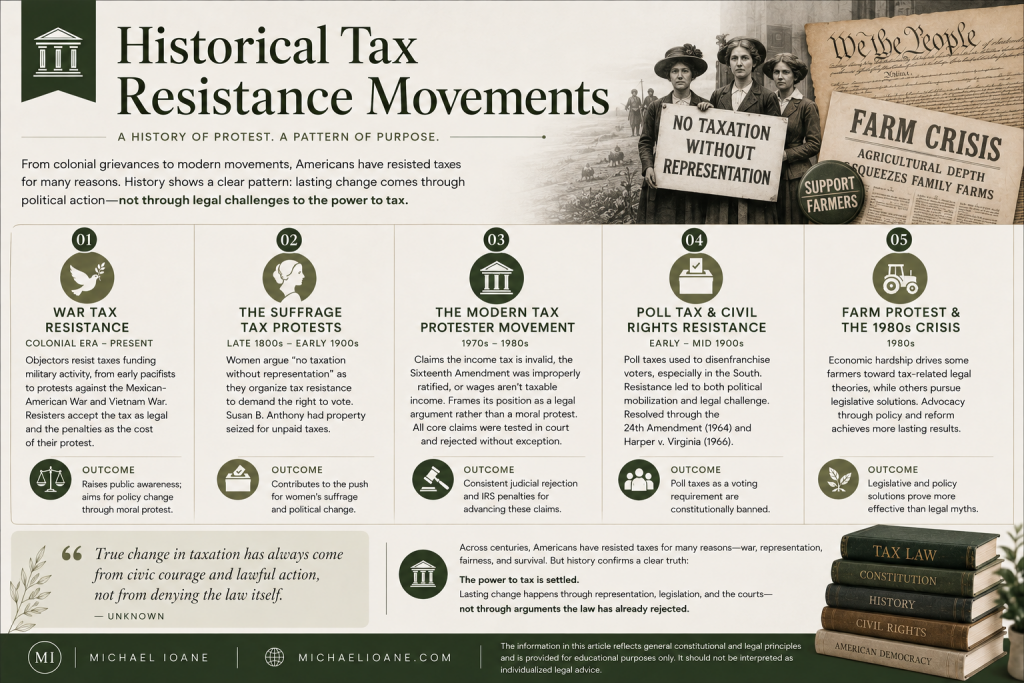
Historical tax protest in the United States spans several distinct movements, each with its own grievance, tactics, and legal outcome. Reviewing them together shows a consistent pattern: movements grounded in a moral or political objection to a specific policy proceeded very differently, legally, from movements that claimed the underlying taxing authority itself was invalid.
Michael Ioane finds this comparative history useful precisely because of that pattern: taxation history shows repeatedly that resistance movements achieve their stated aims, when they do, through political change rather than through legal arguments against the tax power itself.
War Tax Resistance
A recurring strand of American tax resistance objects specifically to taxes believed to fund military activity. Quaker and other pacifist objectors resisted war-related taxes as early as the colonial period, and the movement recurred during the Mexican-American War, the Vietnam War, and later conflicts, with resisters typically withholding a symbolic portion of their federal tax liability tied to military spending. These resisters generally accepted that they owed the tax as a legal matter and accepted the resulting penalties as the price of their protest, distinguishing their position sharply from claims that the tax itself was unlawful.
The Suffrage Tax Protests
Women’s suffrage activists in the late nineteenth and early twentieth centuries organized tax resistance under the banner ‘no taxation without representation,’ arguing that women who could be taxed but could not vote were subject to the same grievance that had animated the American Revolution. Figures such as Susan B. Anthony had property seized and sold for unpaid taxes as a result. This movement, like war tax resistance, used nonpayment as a form of public protest aimed at political change, specifically the extension of the franchise, rather than as a legal challenge to the tax itself.
The Modern Tax Protester Movement
A distinct and more recent movement emerged in the 1970s and 1980s, advancing a cluster of legal arguments claiming the federal income tax itself was invalid, that the Sixteenth Amendment was improperly ratified, or that wages did not constitute taxable income. Unlike earlier resistance movements, this movement framed its position as a legal argument rather than a moral protest, and unlike earlier movements, its core claims were tested extensively in federal court and rejected without exception.
This modern movement’s trajectory, widespread promotion of the arguments in the 1970s and 1980s, followed by consistent judicial rejection and, eventually, specific IRS penalties for advancing them, illustrates why taxation history distinguishes so sharply between resistance aimed at political change and resistance aimed at denying legal authority that courts have already confirmed. For a closer examination of how courts specifically addressed these claims, see Legal Context of Tax Resistance.
The Poll Tax and Civil Rights Era Resistance
Poll taxes, fees required as a condition of voting, became their own focus of resistance and legal challenge through the mid-twentieth century, particularly as a tool used to disenfranchise Black voters in several Southern states. This movement combined elements of both earlier patterns: political protest aimed at eliminating the tax, and, ultimately, direct legal challenge. The Twenty-Fourth Amendment, ratified in 1964, prohibited poll taxes as a condition of voting in federal elections, and the Supreme Court extended this prohibition to state elections in Harper v. Virginia State Board of Elections (1966), resolving the issue through constitutional amendment and judicial decision rather than through nonpayment alone.
Farm Protest and the 1980s Agricultural Crisis
A distinct wave of resistance emerged during the 1980s farm crisis, when falling land values and high interest rates pushed many American farmers toward foreclosure, and some protest groups blended legitimate economic grievance with the constitutional-argument tax theories circulating at the same time. This overlap illustrates a recurring risk in taxation history: genuine economic hardship and political grievance can become entangled with legally unsupported theories, to the detriment of those who acted on the theories rather than pursuing political or legislative remedies for the underlying grievance. Farm advocacy organizations that pursued debt relief, bankruptcy reform, and agricultural policy change through legislative channels generally achieved more durable results than those that pursued tax-based legal theories.
Conclusion
Historical tax resistance movements, from war tax resisters to suffrage activists to poll tax opponents to the modern tax protester movement, share a common form, refusal to pay or organized protest against a tax, but differ sharply in legal substance and outcome. Movements built on political or moral objection achieved change through legislation, amendment, or judicial decision; the movement built on legal denial of the tax obligation itself was tested in court and did not succeed.
The information in this article reflects general constitutional and legal principles and is provided for educational purposes only. It should not be interpreted as individualized legal advice.
Michael Ioane | MichaelIoane.com
Continue Learning with Michael Ioane
Build your understanding of asset protection and business planning with the Asset Protection Manual . Explore taxation and private trust planning in Boston Tea Party . Both books are available on Amazon.