Michael Ioane
Article II
Deep Topic Article
Creating Legal Advantage Through Structure
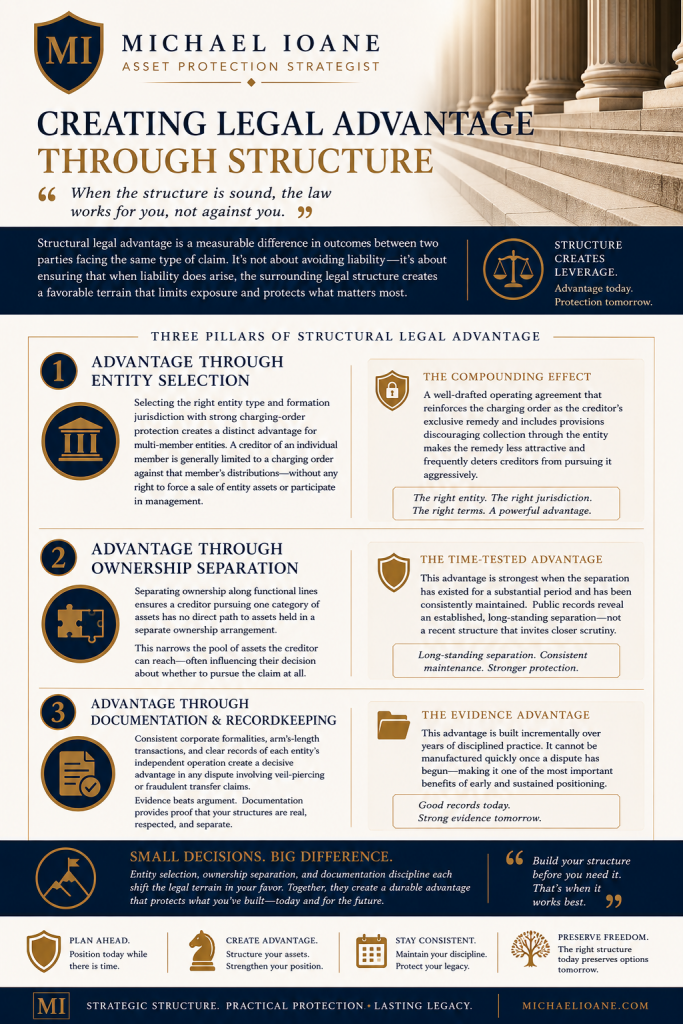
Structural legal advantage refers to a measurable difference in outcomes between two parties facing the same type of claim, where one has arranged ownership and entities to create a favorable legal terrain, and the other has not. This advantage is not about avoiding liability altogether, which is rarely achievable for an active business, but about ensuring that when liability does arise, the surrounding legal structure works in the owner’s favor rather than leaving every asset equally and immediately exposed.
Michael Ioane identifies structural advantage as the cumulative product of several individually modest decisions, including entity selection, jurisdiction choice, ownership separation, and documentation discipline, each of which shifts the legal terrain slightly in the owner’s favor, and which together produce a substantial difference in how a claim actually plays out.
Advantage Through Entity Selection
Selecting an entity type and formation jurisdiction with strong charging-order protection creates a structural advantage specific to multi-member entities: a creditor of an individual member is generally limited to a charging order against that member’s distributions, without gaining any right to force a sale of the entity’s assets or to participate in management. This advantage exists purely as a function of entity selection and jurisdiction, independent of the specific facts of any dispute the member might face.
This advantage compounds when combined with a properly drafted operating agreement that reinforces the charging order as the creditor’s exclusive remedy and includes provisions discouraging a creditor from pursuing collection through the entity at all, since the practical difficulty and limited payoff of a charging order remedy frequently discourage creditors from pursuing that route aggressively.
Advantage Through Ownership Separation
Separating ownership along functional lines, discussed at length elsewhere, creates a structural advantage by ensuring that a creditor pursuing a claim against one category of assets has no direct path to assets held in an entirely separate ownership arrangement. This advantage means that a creditor evaluating whether to pursue litigation must assess a narrower, more specific pool of assets rather than an owner’s entire net worth, which, in turn, can affect the creditor’s calculus about whether pursuing the claim is worthwhile.
This advantage is strongest where the separation has existed for a substantial period and has been consistently maintained, since a creditor’s counsel investigating an owner’s assets can find and confirm through public records an established, long-standing separation rather than a recently created one that might invite closer scrutiny.
Advantage Through Documentation and Recordkeeping
An owner who has consistently maintained proper corporate formalities, documented transactions between related entities on arm ‘s-length terms, and preserved clear records demonstrating each entity’s independent operation holds a structural advantage in any dispute that raises veil-piercing or fraudulent transfer questions, because that owner can produce evidence, rather than mere assertion, that the entities have been operated as genuinely separate enterprises.
Michael Ioane emphasizes that this documentation advantage is built incrementally over years of consistent practice and cannot be manufactured quickly once a dispute has begun, making it one of the structural advantages most dependent on early and sustained positioning rather than something that can be addressed reactively.
Structural legal advantage is the cumulative result of entity selection, ownership separation, and documentation discipline, each shifting the legal terrain incrementally in the owner’s favor. Built consistently over time, these individually modest advantages combine to produce a substantial, durable difference in how a claim ultimately unfolds.
The information in this article reflects general structural principles and practical observations from consulting experience and is provided for educational purposes only. It should not be interpreted as individualized legal or tax advice.
Michael Ioane | MichaelIoane.com
Continue Learning with Michael Ioane
Build your understanding of asset protection and business planning with the Asset Protection Manual . Explore taxation and private trust planning in Boston Tea Party . Both books are available on Amazon.