Michael Ioane
Article IV
Summary Guide Article
Guide: Financial Protection Strategies
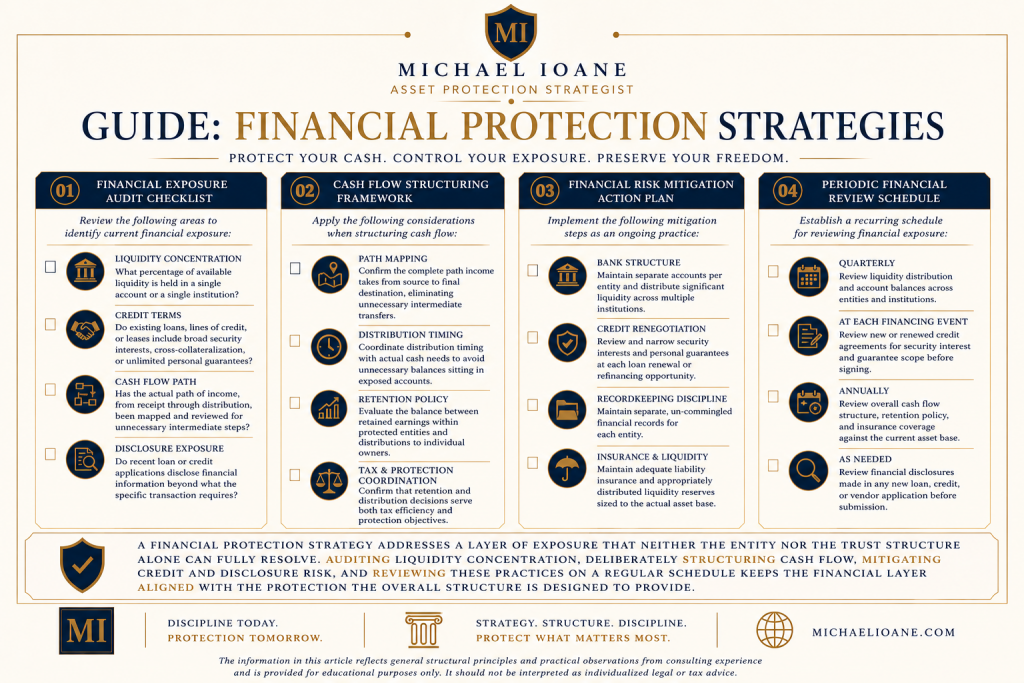
This guide provides a practical reference for identifying and mitigating financial exposure, as well as for structuring entities and trusts. The frameworks here reflect Michael Ioane’s approach to reviewing banking practices, credit relationships, cash flow, and financial disclosure as a distinct layer of asset protection planning.
Financial Exposure Audit Checklist
Review the following areas to identify current financial exposure:
- Liquidity concentration: what percentage of available liquidity is held in a single account or a single institution
- Credit terms: Do existing loans, lines of credit, or leases include broad security interests, cross-collateralization, or unlimited personal guarantees
- Cash flow path has the actual path of income, from receipt through distribution, been mapped and reviewed for unnecessary intermediate steps
- Disclosure exposure: Do recent loan or credit applications disclose financial information beyond what the specific transaction requires
Cash Flow Structuring Framework
Apply the following considerations when structuring cash flow:
- Path mapping: confirm the complete path income takes from source to final destination, eliminating unnecessary intermediate transfers
- Distribution timing: coordinate distribution timing with actual cash needs to avoid unnecessary balances sitting in exposed accounts
- Retention policy: evaluate the balance between retained earnings within protected entities and distributions to individual owners
- Tax and protection coordination: confirm that retention and distribution decisions serve both tax efficiency and protection objectives
Financial Risk Mitigation Action Plan
Implement the following mitigation steps as an ongoing practice:
Bank structure: maintain separate accounts per entity and distribute significant liquidity across multiple institutions
- Credit renegotiation: review and narrow security interests and personal guarantees at each loan renewal or refinancing opportunity
- Recordkeeping discipline: maintain separate, un-commingled financial records for each entity
- Insurance and liquidity: maintain adequate liability insurance and appropriately distributed liquidity reserves sized to the actual asset base
Periodic Financial Review Schedule
Establish a recurring schedule for reviewing financial exposure:
- Quarterly: review liquidity distribution and account balances across entities and institutions
- At each financing event: review new or renewed credit agreements for security interest and guarantee scope before signing
- Annually: review overall cash flow structure, retention policy, and insurance coverage against the current asset base
- As needed: review financial disclosures made in any new loan, credit, or vendor application before submission
A financial protection strategy addresses a layer of exposure that neither the entity nor the trust structure alone can fully resolve. Auditing liquidity concentration, deliberately structuring cash flow, mitigating credit and disclosure risk, and reviewing these practices on a regular schedule keep the financial layer aligned with the protection the overall structure is designed to provide.
The information in this article reflects general structural principles and practical observations from consulting experience and is provided for educational purposes only. It should not be interpreted as individualized legal or tax advice.
Michael Ioane | MichaelIoane.com
Continue Learning with Michael Ioane
Build your understanding of asset protection and business planning with the Asset Protection Manual . Explore taxation and private trust planning in Boston Tea Party . Both books are available on Amazon.