Michael Ioane
Article IV
Summary Guide Article
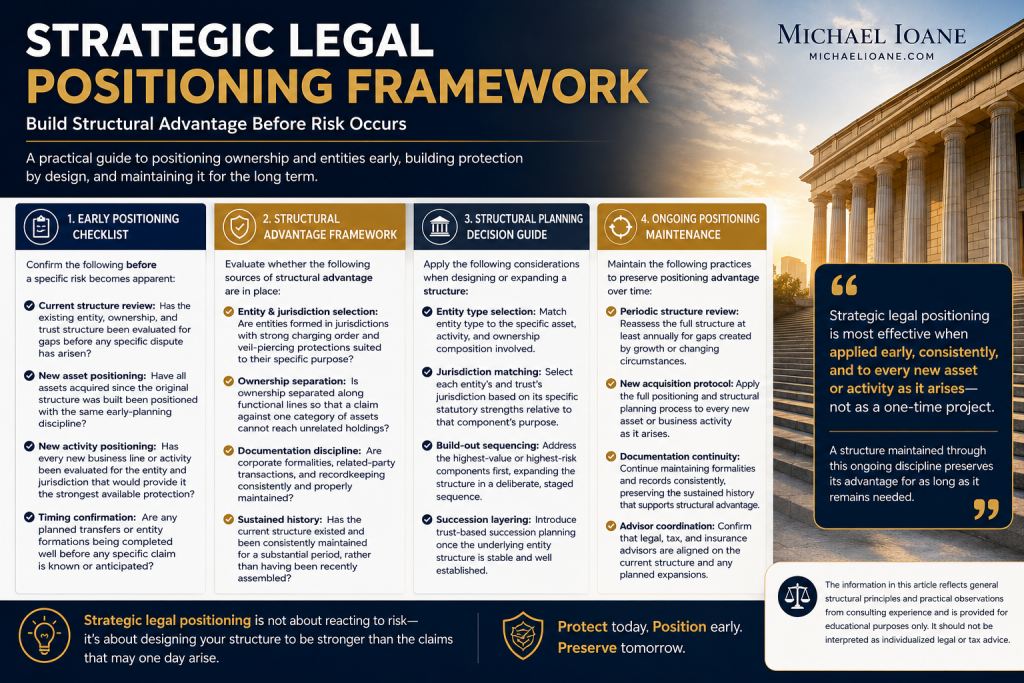
Guide: Strategic Legal Positioning
This guide provides a practical reference for applying strategic legal positioning to the structure of a business or an individual. The frameworks here reflect Michael Ioane’s approach to positioning ownership and entities before risk occurs, deliberately building structural advantage, and sequencing the resulting structure’s build-out in a disciplined order.
Early Positioning Checklist
Confirm the following before a specific risk becomes apparent:
- Current structure review: has the existing entity, ownership, and trust structure been evaluated for gaps before any specific dispute has arisen
- New asset positioning: have all assets acquired since the original structure was built been positioned with the same early-planning discipline
- New activity positioning: has every new business line or activity been evaluated for the entity and jurisdiction that would provide it the strongest available protection
- Timing confirmation: Are any planned transfers or entity formations being completed well before any specific claim is known or anticipated
Structural Advantage Framework
Evaluate whether the following sources of structural advantage are in place:
- Entity and jurisdiction selection: are entities formed in jurisdictions with strong charging order and veil-piercing protections suited to their specific purpose
- Ownership separation: Is ownership separated along functional lines so that a claim against one category of assets cannot reach unrelated holdings
- Documentation discipline: are corporate formalities, related-party transactions, and recordkeeping consistently and properly maintained
- Sustained history: has the current structure existed and been consistently maintained for a substantial period, rather than having been recently assembled
Structural Planning Decision Guide
Apply the following considerations when designing or expanding a structure:
- Entity type selection: match entity type to the specific asset, activity, and ownership composition involved
- Jurisdiction matching: select each entity’s and trust’s jurisdiction based on its specific statutory strengths relative to that component’s purpose
- Build-out sequencing: address the highest-value or highest-risk components first, expanding the structure in a deliberate, staged sequence
- Succession layering: introduce trust-based succession planning once the underlying entity structure is stable and well established
Ongoing Positioning Maintenance
Maintain the following practices to preserve positioning advantage over time:
- Periodic structure review: reassess the full structure at least annually for gaps created by growth or changing circumstances
- New acquisition protocol: apply the full positioning and structural planning process to every new asset or business activity as it arises
- Documentation continuity: continue maintaining formalities and records consistently, preserving the sustained history that supports structural advantage
- Advisor coordination: confirm that legal, tax, and insurance advisors are aligned on the current structure and any planned expansions
Strategic legal positioning is most effective when applied early, consistently, and to every new asset or activity as it arises, not as a one-time project completed at the outset of a business relationship. A structure maintained through this ongoing discipline preserves its advantage for as long as it remains needed.
The information in this article reflects general structural principles and practical observations from consulting experience and is provided for educational purposes only. It should not be interpreted as individualized legal or tax advice.
Michael Ioane | MichaelIoane.com
Continue Learning with Michael Ioane
Build your understanding of asset protection and business planning with the Asset Protection Manual . Explore taxation and private trust planning in Boston Tea Party . Both books are available on Amazon.