Michael Ioane
Article IV
Summary Guide Article
Guide: Asset Protection Philosophy
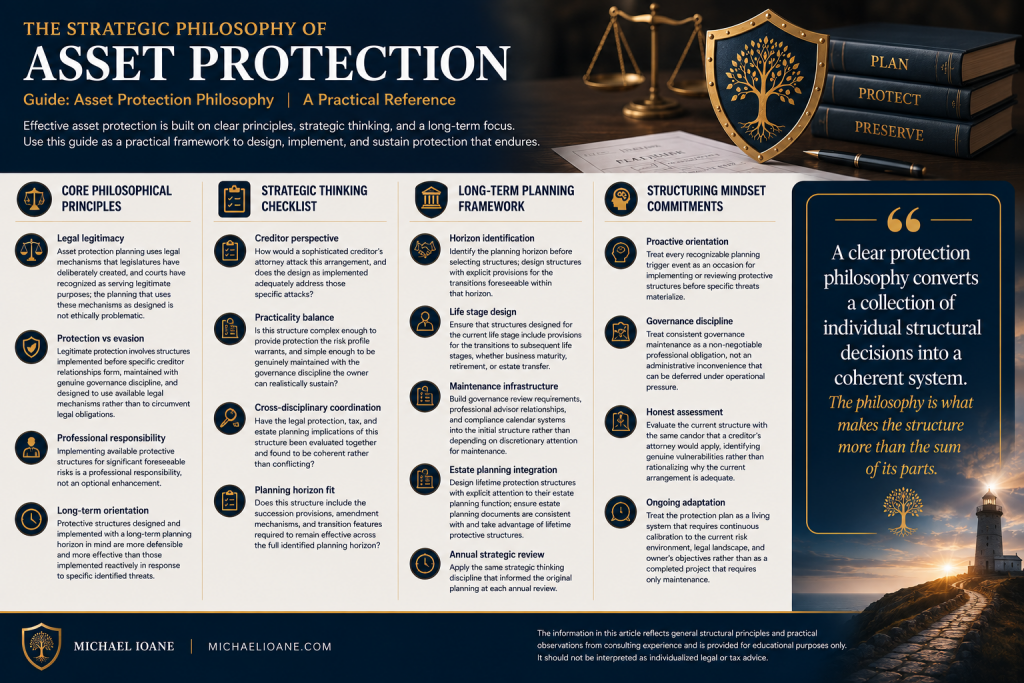
This guide provides a practical reference on the philosophical framework underlying effective asset protection planning. The frameworks here reflect Michael Ioane’s approach to the foundational principles, the strategic thinking discipline, and the long-term orientation that distinguish protection planning that delivers durable results from planning that produces impressive-looking structures that fail when tested.
Core Philosophical Principles
Apply the following foundational principles to every asset protection planning engagement:
- Legal legitimacy: asset protection planning uses legal mechanisms that legislatures have deliberately created, and courts have recognized as serving legitimate purposes; the planning that uses these mechanisms as designed is not ethically problematic
- Protection vs evasion: legitimate protection involves structures implemented before specific creditor relationships form, maintained with genuine governance discipline, and designed to use available legal mechanisms rather than to circumvent legal obligations; evasion involves the opposite of each of these characteristics
- Professional responsibility: implementing available protective structures for significant foreseeable risks is a professional responsibility, not an optional enhancement; the business owner who neglects available protection while managing other foreseeable risks has managed some risks while neglecting others
- Long-term orientation: protective structures designed and implemented with a long-term planning horizon in mind are more defensible and more effective than those implemented reactively in response to specific identified threats
Strategic Thinking Checklist
Apply the following strategic thinking checklist to every significant structural decision:
- Creditor perspective: how would a sophisticated creditor’s attorney attack this arrangement, and does the design as implemented adequately address those specific attacks
- Practicality balance: is this structure complex enough to provide protection the risk profile warrants, and simple enough to be genuinely maintained with the governance discipline the owner can realistically sustain
- Cross-disciplinary coordination: have the legal protection, tax, and estate planning implications of this structure been evaluated together and found to be coherent rather than conflicting
- Planning horizon fit: Does this structure include the succession provisions, amendment mechanisms, and transition features required to remain effective across the full identified planning horizon
Long-Term Planning Framework
Design and maintain long-term protection planning using the following framework:
- Horizon identification: identify the planning horizon before selecting structures; design structures with explicit provisions for the transitions foreseeable within that horizon
- Life stage design: ensure that structures designed for the current life stage include provisions for the transitions to subsequent life stages, whether business maturity, retirement, or estate transfer
- Maintenance infrastructure: build governance review requirements, professional advisor relationships, and compliance calendar systems into the initial structure rather than depending on discretionary attention for maintenance
- Estate planning integration: design lifetime protection structures with explicit attention to their estate planning function; ensure estate planning documents are consistent with and take advantage of lifetime protective structures
- Annual strategic review: apply the same strategic thinking discipline that informed the original planning at each annual review, evaluating whether the current structure continues to reflect the optimal balance between protection, practicality, and long-term effectiveness for the owner’s current circumstances
Structuring Mindset Commitments
Maintain the following structuring mindset commitments as standing disciplines throughout the protection planning relationship:
- Proactive orientation: treat every recognizable planning trigger event as an occasion for implementing or reviewing protective structures before specific threats materialize
- Governance discipline: treat consistent governance maintenance as a non-negotiable professional obligation, not an administrative inconvenience that can be deferred under operational pressure
- Honest assessment: evaluate the current structure with the same candor that a creditor’s attorney would apply, identifying genuine vulnerabilities rather than rationalizing why the current arrangement is adequate
- Ongoing adaptation: treat the protection plan as a living system that requires continuous calibration to the current risk environment, legal landscape, and owner’s objectives rather than as a completed project that requires only maintenance
A clear protection philosophy converts a collection of individual structural decisions into a coherent system. The philosophy is what makes the structure more than the sum of its parts.
The information in this article reflects general structural principles and practical observations from consulting experience and is provided for educational purposes only. It should not be interpreted as individualized legal or tax advice.
Michael Ioane | MichaelIoane.com
Continue Learning with Michael Ioane
Build your understanding of asset protection and business planning with the Asset Protection Manual . Explore taxation and private trust planning in Boston Tea Party . Both books are available on Amazon.