Michael Ioane
Article III
Practical Article
Long-Term Planning in Asset Protection
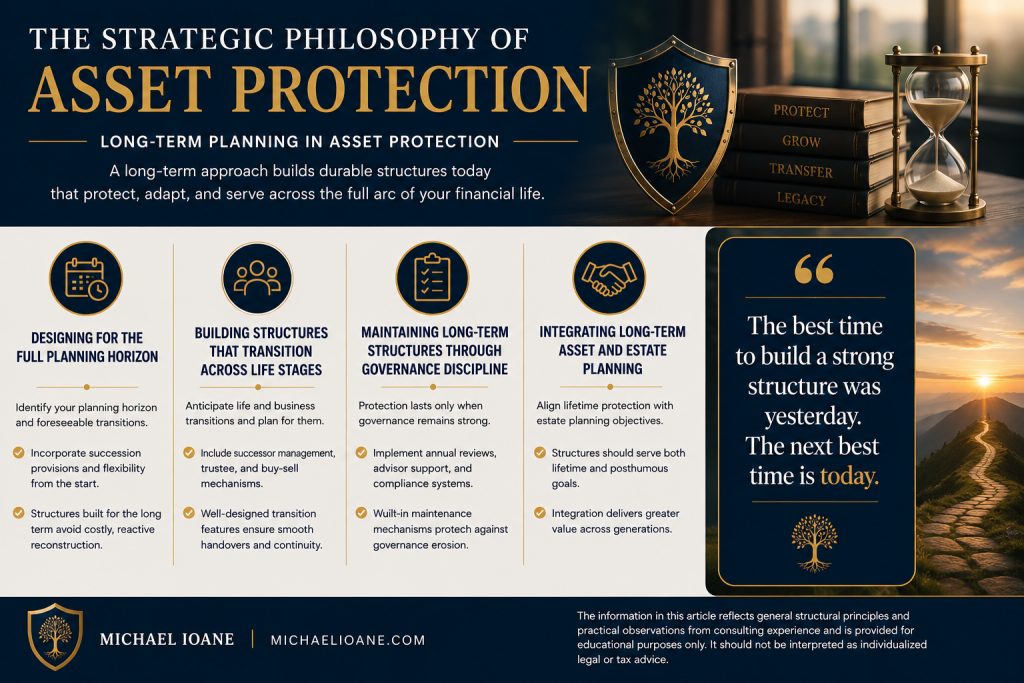
Long-term asset strategy requires a fundamentally different planning orientation than the transactional approach that addresses each protection need as it arises. A long-term approach designs the initial structures with explicit awareness of the transitions, developments, and changes in circumstances that will occur over the owner’s planning horizon and builds mechanisms into the initial design to accommodate those changes rather than reconstructing the structure reactively at each transition point.
Michael Ioane designs long-term protection strategies as systems built for durability rather than as collections of individually optimal transactions, because a system designed for its full lifecycle delivers more value over time than a collection of transactions optimized for each individual moment.
Designing for the Full Planning Horizon
Long-term asset protection planning begins with a clear identification of the planning horizon: how long the protective structures need to remain effective, what major transitions are foreseeable within that horizon, and what the structures need to accomplish at each stage. A business owner planning for the growth and eventual sale of a business has a different planning horizon than one planning for the transfer of wealth to the next generation, and the structures appropriate to each horizon differ accordingly.
Designing for the full planning horizon requires incorporating succession provisions, amendment mechanisms, and flexibility features into the initial structural design that would be difficult or impossible to add retroactively. The trust designed with dynasty provisions that allow it to benefit multiple generations can serve those generations without reconstruction; the trust designed without such provisions must be decanted, modified, or replaced when the planning horizon extends beyond its original design.
Building Structures That Transition Across Life Stages
Asset protection planning structures must accommodate the transitions a business owner goes through across their business and personal life stages. The entity structure appropriate for active business operations during the growth phase needs different features than the structure appropriate for passive asset holding during the retirement phase. The trust structure, with the owner as the primary beneficiary during their lifetime, requires succession provisions to transition beneficial interests to the next generation upon the owner’s death.
Long-term asset protection planning anticipates these transitions by building transition mechanisms into the initial structural design: successor management provisions in operating agreements, successor trustee provisions in trust documents, and buy-sell mechanisms that address the transition of business equity at each stage of the owner’s lifecycle. Structures that include these mechanisms transition smoothly; structures that lack them require reactive reconstruction at each transition point.
Maintaining Long-Term Structures Through Governance Discipline
The most significant long-term planning challenge is maintaining the governance discipline that keeps protective structures effective over the full planning horizon. Governance discipline that is strong in the early years of a structure’s existence often erodes as the structure ages, as initial planning attention fades, and as operational pressures create incentives to bypass formal governance processes in favor of informal convenience.
Asset protection planning that accounts for this long-term governance erosion challenge builds maintenance mechanisms into the initial design: annual governance review requirements, professional advisor relationships that provide ongoing maintenance support, and compliance calendar systems that ensure recurring obligations are met without depending on the owner’s voluntary attention to each individual obligation. The structure with built-in maintenance mechanisms is more likely to be maintained consistently than the one that depends entirely on the owner’s discretionary attention.
Integrating Long-Term Asset and Estate Planning
Long-term asset protection planning and estate planning are most effective when designed as integrated components of a single long-term financial plan rather than as independent disciplines. The trust that serves asset protection purposes during the owner’s lifetime should also serve estate planning purposes at the owner’s death, directing the transfer of protected assets to intended beneficiaries without requiring reconstruction at the transition from the owner’s lifetime to their estate.
Michael Ioane designs this integration as a standard feature of long-term protection engagements, ensuring that the structures implemented for lifetime protection are designed with explicit attention to their estate planning function, and that the estate planning documents that govern the disposition of the owner’s assets at death are consistent with, and take advantage of, the structures that were implemented during the owner’s lifetime. The integrated long-term plan that serves both lifetime protection and posthumous estate planning objectives delivers more value over the full planning horizon than two separate plans optimized independently for each phase.
Long-term asset protection planning requires a commitment that extends beyond the implementation of initial structures to include governance discipline, periodic adaptation, and ongoing strategic attention, ensuring those structures remain effective not just today but across the full horizon of the owner’s financial life.
The information in this article reflects general structural principles and practical observations from consulting experience and is provided for educational purposes only. It should not be interpreted as individualized legal or tax advice.
Michael Ioane | MichaelIoane.com
Continue Learning with Michael Ioane
Build your understanding of asset protection and business planning with the Asset Protection Manual . Explore taxation and private trust planning in Boston Tea Party . Both books are available on Amazon.