Michael Ioane
Article I
Authority Article
The Philosophy Behind Asset Protection
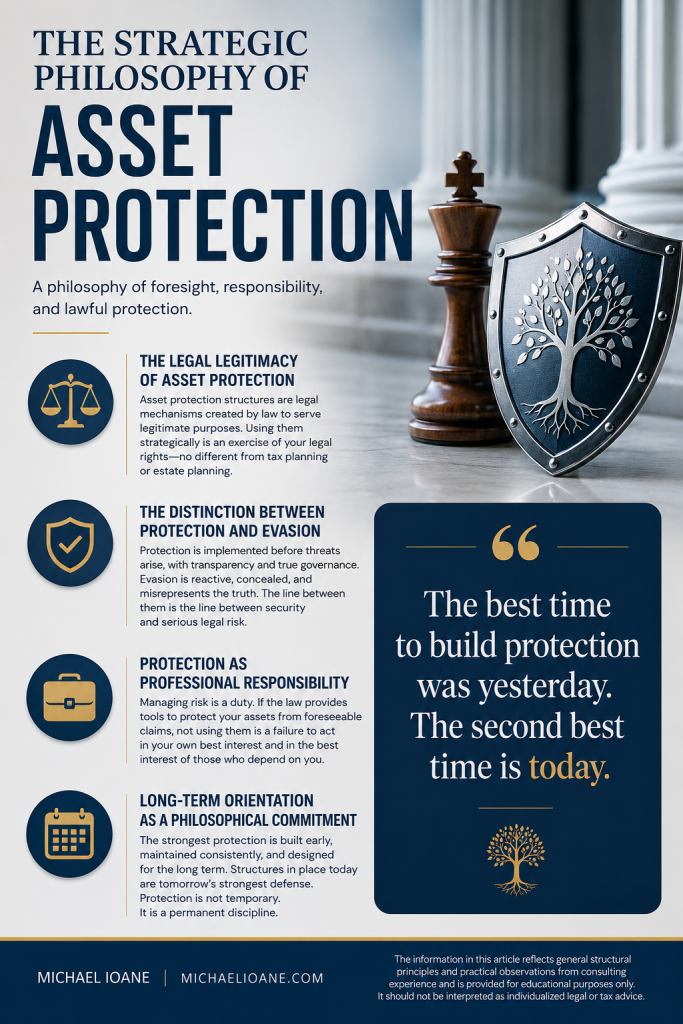
Asset protection philosophy is the conceptual foundation that gives coherence to the specific structural and legal decisions that make up a protection plan. Without a clear philosophy, asset protection planning risks becoming a collection of disconnected techniques applied opportunistically, optimized for individual transactions, with little regard for the long-term design logic that makes those techniques work together as a system. With a clear philosophy, every structural decision reflects a consistent set of principles that guide its design, implementation, and maintenance.
Michael Ioane approaches asset protection planning from a philosophy that treats the deliberate, lawful organization of a business owner’s financial affairs as both a professional responsibility and a genuine exercise of the legal rights afforded to every person who conducts business and accumulates wealth. This philosophy distinguishes sharply between legitimate protective planning, which uses legal structures as intended, and evasion, which misuses those structures or supplements them with concealment or dishonesty.
The Legal Legitimacy of Asset Protection
The first philosophical foundation of asset protection planning is its legal legitimacy. Asset protection structures are not loopholes exploited by those seeking to avoid accountability; they are legal mechanisms that legislatures have enacted, and courts have recognized as serving legitimate purposes. The entity structure, the trust, the statutory exemption, the charging order remedy: each of these is a deliberate creation of the law, established by legislators who understood that the ability to structure one’s affairs in protective ways serves legitimate social and economic purposes.
Strategic structuring that uses these legal mechanisms as they were designed to be used is not ethically problematic any more than using available tax deductions is. Both are exercises of legal rights that the law deliberately provides. The philosophical foundation that justifies asset protection planning is the same foundation that justifies careful tax planning, estate planning, and every other discipline that deliberately uses available legal mechanisms to serve the client’s legitimate objectives.
The Distinction Between Protection and Evasion
The most important philosophical distinction in asset protection is between legitimate protection and fraudulent evasion. Legitimate protection uses legal structures implemented before specific creditor relationships form, maintained with genuine governance discipline, for purposes that have independent legal validity beyond merely frustrating creditors. Fraudulent evasion involves implementing structures after specific creditor relationships have formed, concealing assets from legitimate legal disclosure obligations, or using structures in ways that misrepresent their true character.
This distinction is not merely semantic; it is the line between legally defensible planning and planning that creates legal exposure greater than the exposure it was intended to address. A business owner who implements protective structures in response to a known creditor, without disclosing the transfer in response to a valid legal process, and who characterizes informally controlled arrangements as genuinely independent structures, has crossed from protection into evasion. The legal protection planning mindset maintains this distinction rigorously because it is the foundation of defensible planning.
Protection as Professional Responsibility
The philosophical framework that Michael Ioane applies treats asset protection planning as a professional responsibility rather than an optional enhancement. A business owner who conducts activities that generate significant legal exposure without implementing available protective structures has failed to manage a foreseeable risk that the law provides mechanisms to address. The same business owner who maintains adequate property insurance, files their taxes accurately, and maintains proper employment practices, but neglects to implement structural protection against the legal claims their activities generate, has addressed some professional responsibilities while neglecting others.
This professional responsibility framing is important because it shifts the default presumption: the question is not why a business owner should implement protective structures, but why they would choose not to, given that the law provides them and they address genuine foreseeable risks. The answer to that question is almost always some combination of deferral, misunderstanding, and the assumption that the need is not urgent because no specific threat is currently visible. The philosophy that drives effective protection planning addresses that assumption directly: the urgency is always present because protection not in place before a threat materializes may not be available at all.
Long-Term Orientation as a Philosophical Commitment
The final philosophical foundation of effective asset protection planning is its long-term orientation. Protection structures designed and implemented with a specific immediate threat in mind are typically less effective and less legally defensible than those designed and implemented with a long-term planning horizon. The structure that has been in place for five years, when a creditor seeks to challenge it, is fundamentally more defensible than one that was implemented in response to the creditor’s claim.
The long-term orientation that a sound protection philosophy requires is a commitment to treating protective planning as a permanent discipline rather than a temporary response to a specific threat. The business owner who maintains this commitment implements structures early, maintains them consistently, updates them as circumstances change, and treats the ongoing governance discipline they require as a standing professional obligation rather than a burdensome administrative imposition.
Asset protection is not a technique for evading obligations. It is a philosophy that treats the deliberate, lawful organization of one’s financial affairs as a professional responsibility, no different from maintaining adequate insurance or keeping accurate financial records.
The information in this article reflects general structural principles and practical observations from consulting experience and is provided for educational purposes only. It should not be interpreted as individualized legal or tax advice.
Michael Ioane | MichaelIoane.com
Continue Learning with Michael Ioane
Build your understanding of asset protection and business planning with the Asset Protection Manual . Explore taxation and private trust planning in Boston Tea Party . Both books are available on Amazon.