Michael Ioane
Article III
Practical Article
Strategic Planning for Asset Protection
Strategic asset protection planning is the process of designing structural arrangements that address the full range of a client’s anticipated creditor exposure, implemented in the correct sequence and at the correct time, with the governance discipline that keeps each component of the system effective over the long term. It differs from incidental or reactive planning in its orientation: strategy addresses future risk systematically, while reactive planning addresses present risk incompletely.
Michael Ioane approaches strategic asset protection planning as an integrated planning discipline that operates across legal, financial, and governance dimensions simultaneously, because the plan that addresses only one dimension while leaving others unaddressed produces a structure that is vulnerable along the dimensions it ignores.
The Exposure Profile Assessment
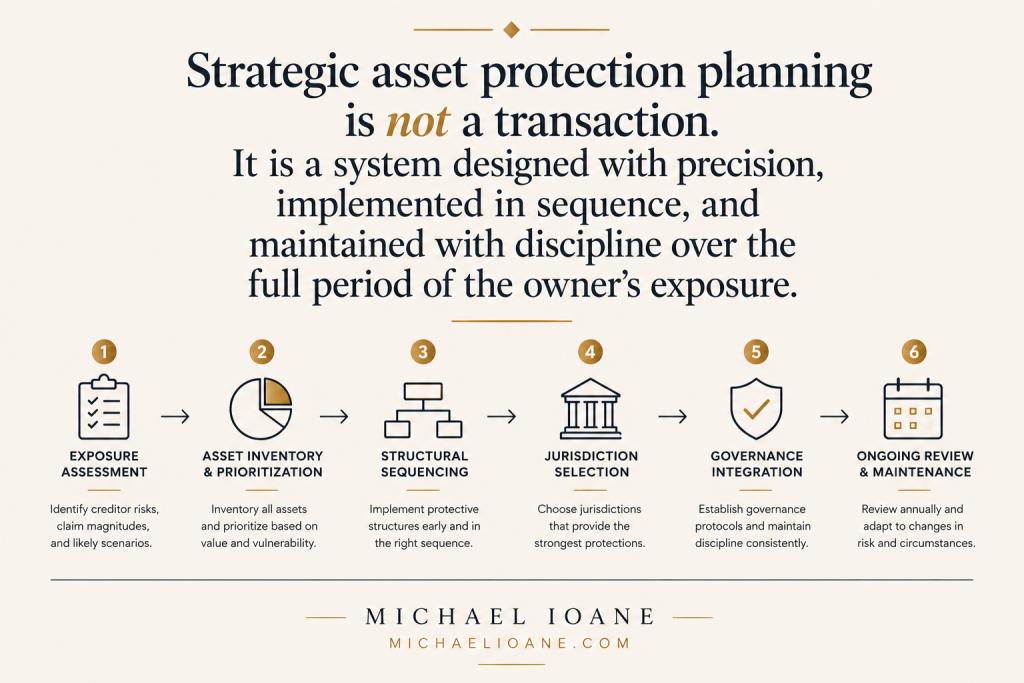
Strategic asset protection planning begins with a comprehensive assessment of the client’s exposure profile, which identifies the categories of creditor risk that are most likely to arise, the magnitude of potential claims in each category, and the assets that are most at risk in each scenario. The exposure profile is the planning input that drives all subsequent structural decisions: the structures selected, the jurisdictions chosen, the sequence of implementation, and the governance requirements that must be maintained.
Legal planning for asset protection without a comprehensive exposure profile assessment is like designing a defense without knowing the attack. The entity structure that is optimal for a business owner facing primarily operational creditor risk is not the same structure that is optimal for a professional facing primarily malpractice risk, or an investor facing primarily personal liability risk. Strategic planning uses the exposure profile to match the structural design to the specific risk categories the owner faces.
Asset Inventory and Prioritization
Strategic legal structuring requires an inventory of all significant assets and an assessment of their current vulnerability to each category of creditor risk identified in the exposure profile. The inventory should distinguish between assets held personally, assets held through entities, assets held in trust, and assets protected by statutory exemption. Each category of holding has a different vulnerability profile and requires a different strategic approach.
Prioritization in asset protection planning focuses protective attention on the assets that are most valuable and most vulnerable. An asset that is both high-value and held personally in a high-risk jurisdiction is the highest planning priority. An asset that is low-value and already protected by statutory exemption requires the least planning attention. Strategic planning allocates the investment in protective structures according to the risk-adjusted value of the assets at risk.
Structural Sequencing and Implementation
Strategic asset protection planning implements structures in a sequence that maximizes the legal defensibility of each component. The general sequencing principle is that structures addressing the highest-priority risks should be implemented first, before the lower-priority structures, and all structures should be implemented as early as possible in the owner’s planning timeline.
The sequencing of structural implementations also affects the fraudulent transfer analysis for each transfer. A transfer made at a time when the owner is generally solvent and has no specific creditors is more defensible than a transfer made later, when the owner’s financial position may have changed and more potential creditor relationships may have formed. Implementing the most significant protective transfers early in the planning process maximizes their temporal distance from any future creditor claims.
Jurisdiction Selection in Strategic Planning
Strategic structuring includes jurisdiction selection for each component of the protective structure. Different states offer different levels of statutory protection for the same structural mechanisms. A domestic asset protection trust established in Nevada, South Dakota, or Alaska enjoys stronger statutory protection than the same trust established in a state without a domestic asset protection trust statute. An LLC formed in Wyoming or Delaware offers stronger charging order protections than an LLC formed in a state with weaker statutory language.
Strategic legal planning identifies the optimal jurisdiction for each structural component based on the specific protections needed, the owner’s operational context, and the practical considerations of establishing and maintaining entities or trusts in jurisdictions other than the owner’s home state. The choice of jurisdiction is a planning decision with long-term consequences that should be made with full awareness of the statutory landscape and its evolution.
Governance as a Strategic Component
Strategic asset protection planning integrates governance as a core component of the plan rather than an afterthought. The structural arrangements that survive creditor challenge are those that have been consistently maintained with genuine governance discipline: current governing documents, complete governance records, strict financial separation, and arm’s-length intercompany relationships. Governance failures are the most common cause of protective structure failure in enforcement proceedings.
Incorporating governance as a strategic component means establishing governance protocols at the time of implementation and committing them to their maintenance over the full life of the structure. Michael Ioane includes annual governance review as a mandatory component of every strategic asset protection plan, because the structures that are in place for years without review are the structures that accumulate the governance failures that creditors exploit.
Strategic asset protection planning is not a transaction. It is a system designed with precision, implemented in sequence, and maintained with discipline over the full period of the owner’s exposure.
The information in this article reflects general structural principles and practical observations from consulting experience and is provided for educational purposes only. It should not be interpreted as individualized legal or tax advice.
Michael Ioane | MichaelIoane.com
Continue Learning with Michael Ioane
Build your understanding of asset protection and business planning with the Asset Protection Manual . Explore taxation and private trust planning in Boston Tea Party . Both books are available on Amazon.