Michael Ioane
Article II
Deep Topic Article
Misapplied Asset Protection Structures
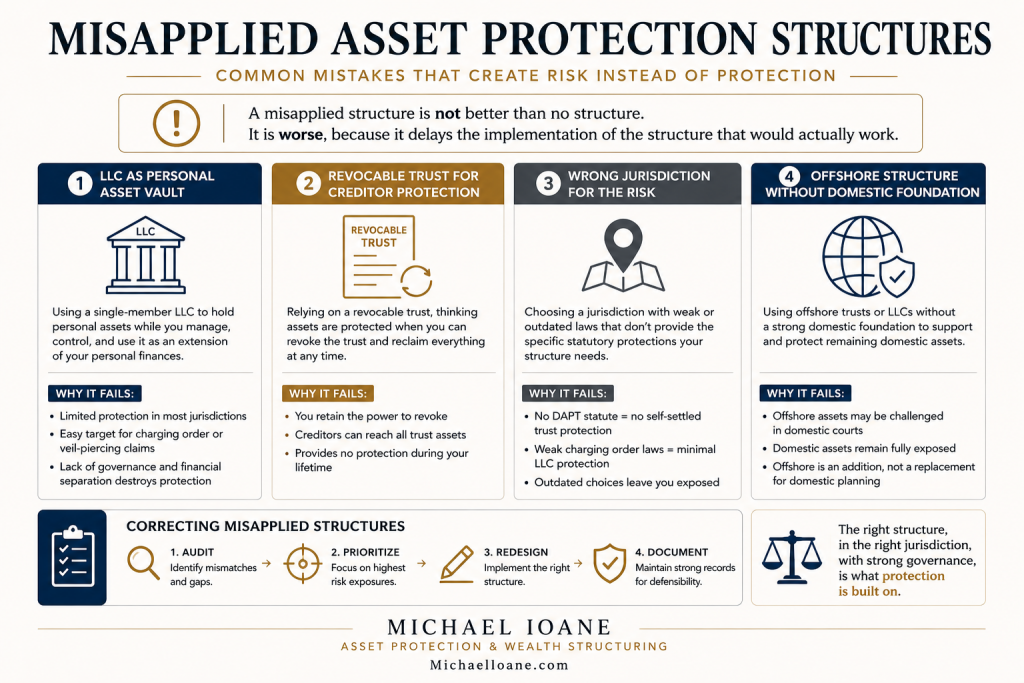
A misapplied asset protection structure is one that is legally valid in its design but mismatched to the specific risk profile it is intended to address, creating the appearance of protection while leaving the owner exposed to the attack vectors the structure does not actually counter. Misapplied structures are more dangerous than the absence of structures in one specific respect: they provide the owner with false confidence that protection is in place, which may cause the owner to defer corrective planning until after a creditor claim has arisen.
Michael Ioane identifies misapplied structures as a distinct category of planning error, separate from governance failures and timing errors, because the misapplication error originates in the structural design phase rather than the implementation or maintenance phase. Correcting a misapplied structure requires redesign and redigning after a creditor claim has arisen is significantly more constrained than redesign conducted in the pre-exposure environment.
The LLC Used as a Personal Asset Vault
One of the most common structural missteps is the use of a single-member LLC as a personal asset vault, holding the owner’s personal assets in an entity that the owner manages, controls, and uses as an extension of their personal financial life. This arrangement is misapplied because the single-member LLC, in most jurisdictions, provides limited protection against personal creditors who seek to reach the assets held within the entity.
Structuring errors of this type are compounded when the single-member LLC lacks genuine governance substance. An entity that holds personal assets but is managed without formality, without governance records, and without financial separation provides almost no protection against a creditor pursuing either a charging order or a veil-piercing claim. The protection that a well-maintained multi-member LLC with a genuine management structure provides is qualitatively different from the protection that a nominally formed but operationally neglected single-member LLC provides.
The Revocable Trust Used for Creditor Protection
Revocable trusts are widely used for estate planning purposes, and they are effective for that purpose. However, a revocable trust provides no protection against the settlor’s creditors during the settlor’s lifetime because the settlor retains the right to revoke the trust and reclaim the assets at any time. A creditor of the settlor can reach the trust assets to the extent of the settlor’s power to revoke, which in most revocable trusts extends to all assets in the trust.
Legal missteps involving revocable trusts as asset protection vehicles are extremely common because the trust document looks similar to an irrevocable trust and because most clients do not understand the legal significance of revocability. The owner who believes that assets held in a revocable living trust are protected from creditors has a misapplied structure that provides no actual protection, and may be deferred from implementing the irrevocable arrangements that would actually provide the protection they seek.
The Wrong Jurisdiction for the Risk
Jurisdiction selection is one of the most consequential structural decisions in asset protection planning, and jurisdiction mismatches are a common form of structural misapplication. A domestic asset protection trust established in a state without a DAPT statute provides no self-settled trust protection. An LLC formed in a state with weak charging order statutes provides minimal charging order protection even if the operating agreement includes language purporting to limit creditors to charging order remedies.
The structural misstep of jurisdiction mismatch is particularly common in plans that were designed years earlier and have not been updated as the statutory landscape has evolved. A structure that was optimally designed for the statutory environment of a given year may become suboptimal as the jurisdiction’s law changes or as other jurisdictions enact stronger protections. Periodic review of jurisdiction selection is a maintenance requirement that many asset protection plans neglect.
The Offshore Structure Without Domestic Foundation
Offshore asset protection structures, including foreign trusts and foreign LLCs, can provide significant additional protection in certain circumstances. However, an offshore structure established without a properly designed and maintained domestic structural foundation creates a different kind of vulnerability: the offshore structure may be challenged through domestic courts that have jurisdiction over the settlor, and the absence of a domestic structural foundation means that assets not yet transferred offshore remain fully exposed.
The misapplication in this scenario is treating the offshore structure as a replacement for comprehensive domestic planning rather than as an additional layer on top of a complete domestic protective foundation. The owner who transfers a portion of assets offshore while leaving the domestic structure incomplete has created an arrangement that may provide offshore protection for transferred assets while leaving the remaining domestic assets fully exposed to the attack vectors that a complete domestic structure would have addressed.
Correcting Misapplied Structures
Correcting a misapplied structure requires a structural analysis that identifies the specific mismatch between the structure in place and the risk profile it is intended to address, followed by a redesign process that implements the correct structure while managing the fraudulent transfer implications of making changes to existing arrangements. The redesign process is most effective when conducted before any creditor claim has arisen, but even in the post-claim environment, some corrective measures remain available.
Michael Ioane approaches structural correction as a deliberate planning process that begins with a comprehensive structural audit, identifies all misapplications and gaps, prioritizes corrections based on the risk-adjusted vulnerability of each unaddressed exposure, and implements corrections in the sequence that minimizes fraudulent transfer exposure while maximizing the protective effectiveness of the corrected arrangement.
A misapplied structure is not better than no structure. It is worse, because it delays the implementation of the structure that would actually work.
The information in this article reflects general structural principles and practical observations from consulting experience and is provided for educational purposes only. It should not be interpreted as individualized legal or tax advice.
Michael Ioane | MichaelIoane.com
Continue Learning with Michael Ioane
Build your understanding of asset protection and business planning with the Asset Protection Manual . Explore taxation and private trust planning in Boston Tea Party . Both books are available on Amazon.