Michael Ioane
Article IV
SUMMARY GUIDE ARTICLE
Guide: Long-Term Strategy
This guide provides a practical reference for long-term strategic planning across business, asset protection, and estate planning dimensions. The frameworks here reflect Michael Ioane’s approach to designing structures that remain effective through personnel changes, lifecycle transitions, and shifts in the legal landscape over extended time horizons.
Planning Horizon Framework
Identify the planning horizon before designing any structure. The planning horizon is determined by the structure’s purpose, not by the client’s preference. Common planning horizons include:
• Business lifecycle: formation through sale or succession, typically 10 to 30 years
• Generational transfer: assets held and transferred across one or more generations, typically 20 to 50 years
• Trust duration: Some trust structures are designed to last for multiple generations under dynasty trust law
• Retirement planning: personal financial structures designed to provide for the owner’s retirement and eventual estate transfer
The planning horizon defines which structural features are required. Longer horizons require more robust succession provisions, more flexible amendment mechanisms, and greater attention to how the legal landscape may change over the relevant period.
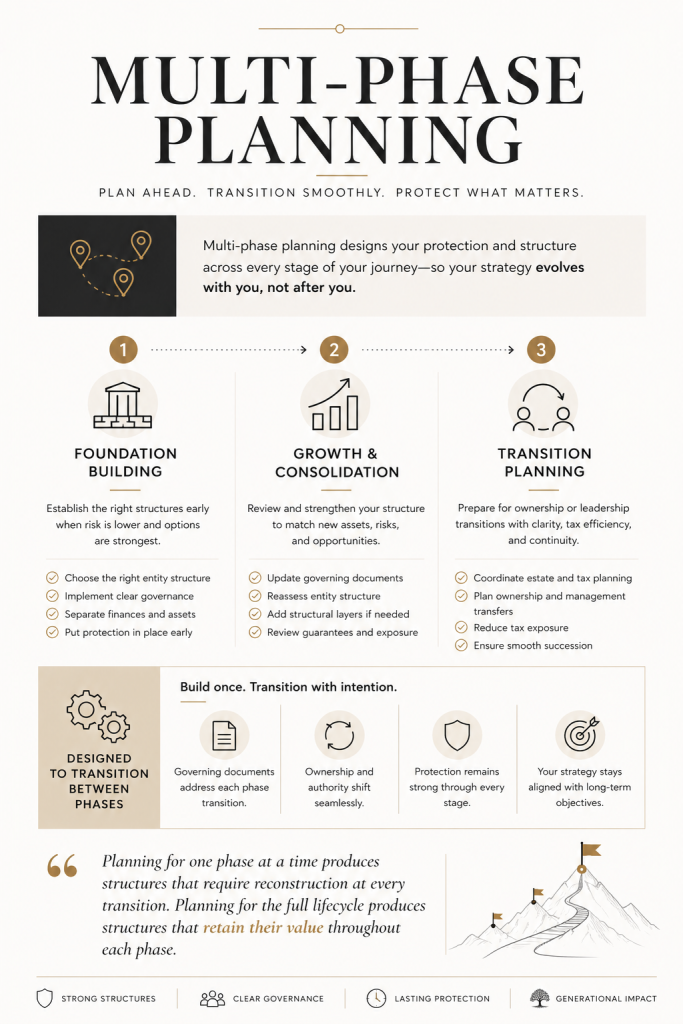
Phase-Based Planning Priorities
Foundation phase priorities (business formation through early growth):
• Entity selection and formation with adequate capitalization
• Operating agreement or bylaws with specific governance role definitions
• Personal asset protection structures implemented proactively
• Financial separation practices established as standard operations
Growth phase priorities (business maturity and expansion):
• Governing document review and update to reflect current structure
• Additional structural layers if warranted by scale and risk profile
• Personal guarantee review and management
• Estate planning coordination with business structure
Transition phase priorities (succession or sale preparation):
• Transition structure design initiated several years before the intended transition
• Tax planning for ownership transfer integrated with a protection structure
• Governance succession mechanisms documented and tested
• Post-transition personal financial security addressed
Structural Longevity Requirements
Every long-term structure should include the following longevity mechanisms:
• Succession provisions for every governance role: manager, trustee, director, protector
• Amendment mechanism allowing governing document updates without full reconstruction
• Dispute resolution provisions that do not require litigation for governance conflicts
• Periodic review schedule: annual or biannual governance and document review
• Documented institutional memory: governance history, strategic rationale, and operational records accessible to successors
• Contingency provisions for foreseeable scenarios: death, incapacity, divorce, and predeceased beneficiaries
Integration Checklist
Long-term planning is most effective when the following dimensions are integrated in a single coherent design:
• Business structure: entity selection, governance design, operational protection
• Asset protection: separation of ownership and control, creditor protection mechanisms, timing considerations
• Estate planning: trust structures, beneficiary designations, transfer tax planning
• Tax planning: entity tax elections, income tax optimization, transfer tax minimization
• Personal financial planning: retirement income, liquidity, and personal security after business transition
Gaps between these dimensions are where planning failures occur at transition points. A regular review that examines all dimensions together is the most reliable mechanism for identifying and correcting gaps before they become problems.
When to Initiate or Update Long-Term Planning
Initiate or conduct a comprehensive review of long-term planning at each of the following trigger events:
• Formation of a business or significant new venture
• Acquisition of assets that materially change the planning landscape
• Material change in personal or family circumstances: marriage, divorce, birth of children, death of a beneficiary
• Significant change in business value or risk profile
• Any identified intention to transition the business within the next five years
• Changes in applicable law that affect the structure’s design assumptions
• Annually, as a standing practice, regardless of whether specific trigger events have occurred
Long-term planning is not a single engagement. It is an ongoing relationship between a well-designed structure and the circumstances it must navigate over time. The value of that relationship compounds with every year the structure remains effective.
The information in this article reflects general structural principles and practical observations from consulting experience and is provided for educational purposes only. It should not be interpreted as individualized legal or tax advice.
Michael Ioane | MichaelIoane.com
Continue Learning with Michael Ioane
Build your understanding of asset protection and business planning with the Asset Protection Manual . Explore taxation and private trust planning in Boston Tea Party . Both books are available on Amazon.