Michael Ioane
Article IV
SUMMARY GUIDE ARTICLE
Guide: Control vs Ownership Strategy
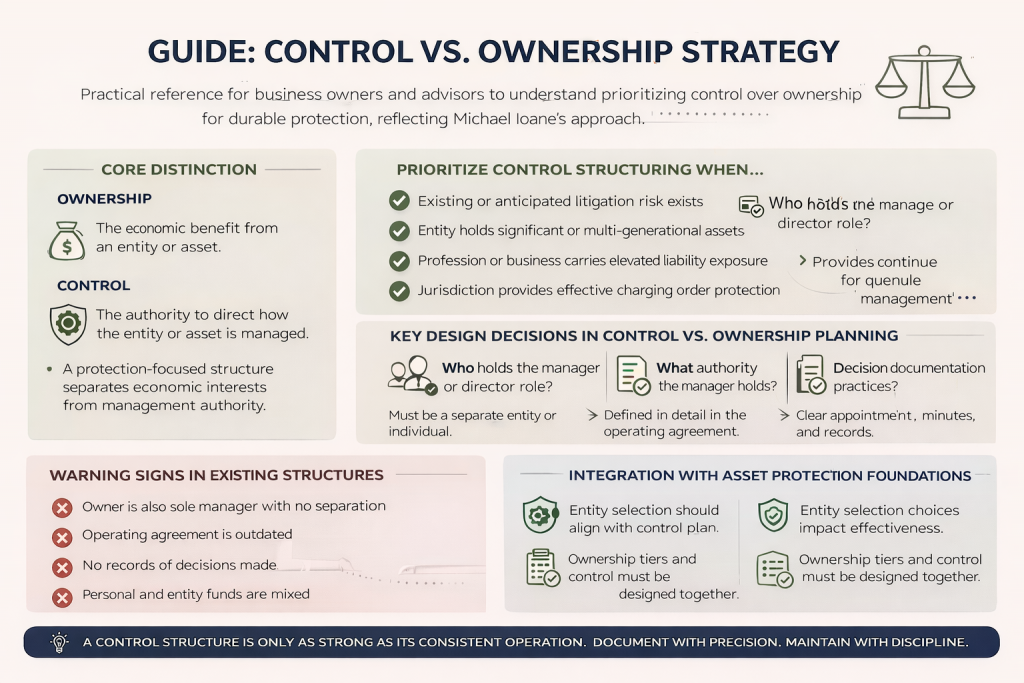
This guide provides a practical reference for business owners and advisors who want to understand the control vs. ownership strategy and how to apply it to structuring decisions. The frameworks here reflect Michael Ioane’s approach to designing structures that provide durable protection by separating economic interests from management authority.
Core Distinction
Ownership: the right to receive economic benefit from an entity or asset, including distributions, appreciation, and proceeds on sale.
Control: the authority to direct how the entity or asset is managed, including operational decisions, significant transactions, and distribution authorizations.
In a default structure, the same party holds both. In a protection-focused structure, these are deliberately assigned to different parties through the governing documents.
When to Prioritize Control Structuring
Control structuring deserves primary attention in the following situations:
• The owner faces existing or anticipated litigation risk
• The entity holds significant assets that a creditor could target through the ownership interest
• The structure is intended to provide long-term protection across generations
• The owner is in a profession or business with elevated liability exposure
• The jurisdiction provides strong charging order protection that depends on genuine management separation
Key Design Decisions in Control vs Ownership Planning
Who holds the manager or director role? This should be a separate entity or individual, not the owner in their personal capacity, to create a genuine separation.
What authority the manager holds: defined specifically in the operating agreement, including what decisions require owner consent and what decisions the manager can make independently.
How the manager is appointed and replaced: the succession mechanism for management authority must be documented clearly in the governing documents.
How decisions are recorded: written resolutions, meeting minutes, and consistent documentation practices are required to build the evidentiary record.
How ownership interests are characterized: the governing documents should make explicit that ownership interests do not carry management rights.
Risk Indicators in Existing Structures
Evaluate existing structures for the following warning signs, which indicate that control structures are not providing the intended protection:
• The owner is also the sole manager with no formal separation of roles
• The operating agreement has not been updated since formation
• No written resolutions or meeting minutes have been maintained
• The owner makes decisions informally without reference to governing documents
• There is no documented succession mechanism for management authority
• Entity and personal finances have been commingled
Integration With Asset Protection Foundations
The control vs. ownership strategy is most effective when integrated with a comprehensive asset protection plan. Entity selection, jurisdiction choices, and the design of ownership tiers all interact with how control is allocated. Strategic business structuring requires designing all of these dimensions together rather than treating control planning as a separate or secondary concern.
The governing documents are the foundational instrument. They define the relationship between ownership and control, establish the governance framework, and create the evidentiary record that will be examined if the structure is challenged. Investing in well-drafted governing documents and maintaining consistency between those documents and how the entity is actually operated is the most direct path to a structure that works under pressure.
A control structure is only as strong as the consistency with which it is operated. The documentation is the evidence, and the evidence is what determines whether the protection holds.
The information in this article reflects general structural principles and practical observations from consulting experience and is provided for educational purposes only. It should not be interpreted as individualized legal or tax advice.
Michael Ioane | MichaelIoane.com
Continue Learning with Michael Ioane
Build your understanding of asset protection and business planning with the Asset Protection Manual . Explore taxation and private trust planning in Boston Tea Party . Both books are available on Amazon.