Michael Ioane
Article III
PRACTICAL ARTICLE
Why Control Structures Matter More Than Ownership
Most business owners focus on ownership when they structure their affairs. Who holds the equity, how it is allocated, and how it passes on death or sale: these are the questions that receive the most attention in most planning engagements. Control structures receive considerably less attention, and this is a serious error. In a contest between a sophisticated creditor and a business owner whose ownership is clearly documented but whose control structure is weak or inconsistent, the creditor will frequently prevail. The opposite arrangement, where ownership is held diffusely, but control structures are precisely designed and consistently maintained, tends to produce much stronger protection outcomes.
Michael Ioane addresses the control vs. ownership strategy as a primary framework for structuring engagements, precisely because the bias toward ownership planning leaves most business structures with a significant and correctable vulnerability.
Why Ownership Focus Creates Predictable Vulnerabilities
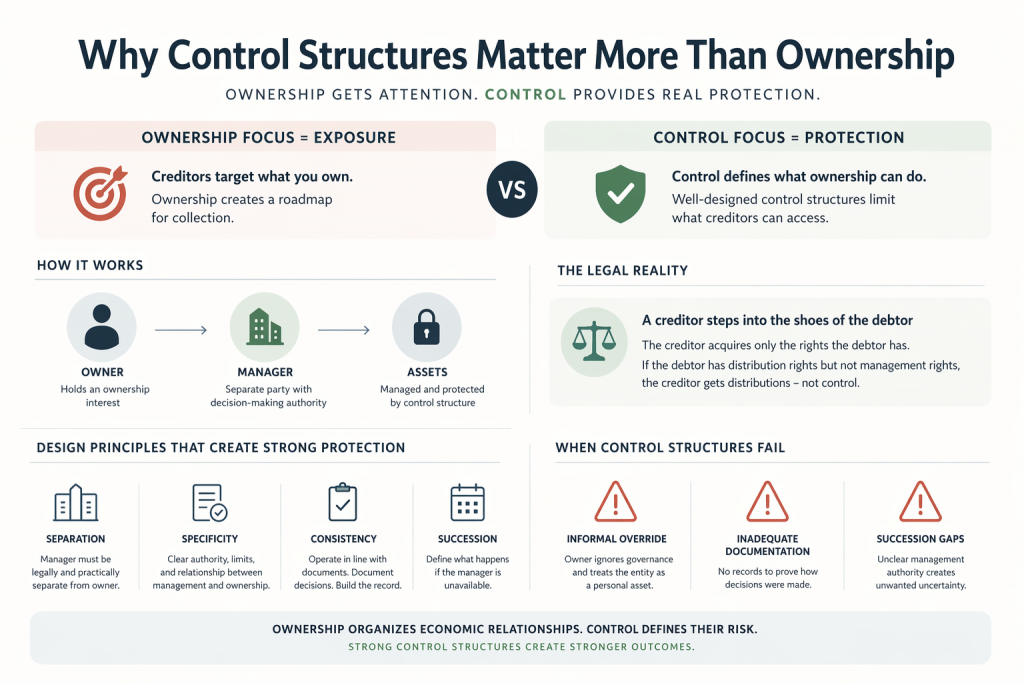
Ownership, by itself, is a target. A creditor who obtains a judgment against a debtor will pursue whatever the debtor owns. If the debtor owns interests in entities that hold valuable assets, those interests are the target. The ownership structure that was designed to organize economic relationships becomes the roadmap for collection. This is not a failure of the ownership structure per se; it is a consequence of the structure being designed around ownership without adequate attention to how control is allocated and defended.
Control structures, by contrast, define what the ownership interest actually gives the holder the right to do. An ownership interest in a well-controlled entity may entitle the holder to receive distributions when the manager authorizes them, and little else. The manager, who may be a separate corporate entity with its own governance, holds the practical authority over the underlying assets. This is not a theoretical distinction; it is the operational reality that determines how useful ownership interests are to a creditor who obtains them.
The Legal Mechanics of Control-Based Protection
The legal basis for control-based protection is the principle that a creditor steps into the shoes of the debtor with respect to the debtor’s rights, not with respect to rights the debtor does not hold. If the debtor’s membership interest carries distribution rights but not management rights, the creditor who acquires or litigates against that interest acquires distribution rights and not management rights. The creditor cannot force distributions if the manager does not authorize them. The creditor cannot liquidate the entity without the manager’s consent. The creditor cannot access the underlying assets directly.
This is the protection that charging order statutes are designed to preserve in jurisdictions with strong charging order protection. The protection works because of how control is structured, not because of how ownership is held. Control structures and ownership risk are not independent variables. The way control is allocated determines how much risk is attached to the ownership interest, and therefore how exposed the owner is when a creditor obtains that interest.
Designing Control Structures That Hold Under Pressure
An effective control structure has several characteristics that are worth understanding in detail. First, the manager or controlling party must be legally and practically separate from the owner. A single-member LLC in which the member is also the sole manager provides essentially no separation of control; the member and the manager are the same party, and courts will treat them accordingly.
Second, the separation must be reflected in the governing documents with specificity. A generic operating agreement that designates a manager without defining the scope of management authority, the limits on that authority, and the relationship between management and ownership leaves too much ambiguity to be relied upon under pressure. Third, the structure must be operated consistently with the governing documents. Management decisions must be made by the manager, documented as manager decisions, and not overridden informally by the owner. The consistency of operation over time is what builds the evidentiary record that a court will rely on when the structure is challenged.
When Control Structures Fail
Control structures fail in predictable ways. The most common failure is informal override: the owner treats the entity as a personal asset, makes decisions without reference to the governance structure, and creates a record that contradicts the formal documents. Courts examining this pattern will generally find that the formal control structure was not genuine, and will allow the creditor to reach assets that the structure was supposed to protect.
A second failure mode is inadequate documentation. Even where the owner has respected the formal structure operationally, the absence of records documenting how decisions were made leaves the structure vulnerable to challenge. Risk management for entrepreneurs must include regular governance documentation as a core practice, not an administrative afterthought. A third failure mode is succession gaps: control structures that do not specify what happens to management authority when the current manager is unavailable create uncertainty that courts will resolve in ways that do not necessarily favor the owner or their beneficiaries.
Ownership without a properly designed control structure is an asset with a known vulnerability. Fixing that vulnerability is the work of governance design, not ownership planning.
The information in this article reflects general structural principles and practical observations from consulting experience and is provided for educational purposes only. It should not be interpreted as individualized legal or tax advice.
Michael Ioane | MichaelIoane.com
Continue Learning with Michael Ioane
Build your understanding of asset protection and business planning with the Asset Protection Manual . Explore taxation and private trust planning in Boston Tea Party . Both books are available on Amazon.