Michael Ioane
Article I
Authority Article
What Control Really Means in Business Structures
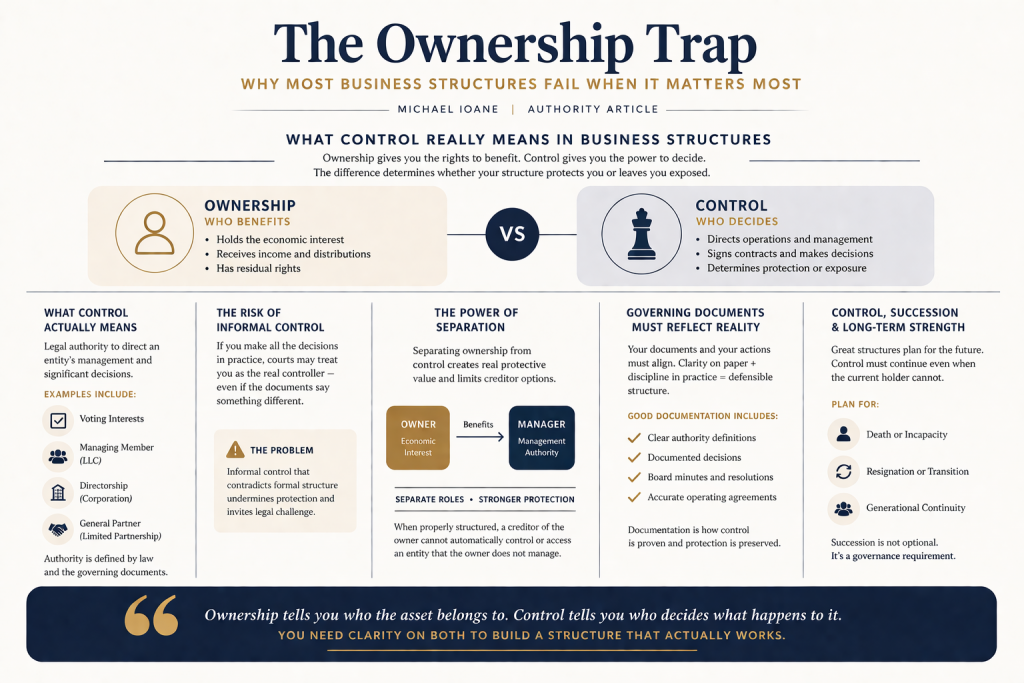
Control in business structures is a legal and practical concept that most business owners misunderstand until a dispute forces clarity. Ownership describes who holds the economic interest in an entity. Control describes who directs how that entity behaves: who signs the contracts, who authorizes distributions, and who makes the decisions that determine whether assets are protected or exposed. The distinction between these two concepts is not academic. It is the difference between a structure that works under pressure and one that fails precisely when it is needed most.
Michael Ioane treats control in business structures as one of the primary design variables in every structuring engagement. The question is not simply who owns the entity. The question is who holds authority over the entity, how that authority is defined, and whether the governing documents accurately reflect how authority is actually exercised.
What Control Actually Means
In a legal context, control means having the authority to direct an entity’s management and significant decisions. That authority can be exercised through several mechanisms: holding a majority of the voting interests, serving as the managing member of an LLC, holding a directorship in a corporation, or serving as the general partner of a limited partnership. Each of these positions carries defined powers and limits, and the entity’s governing documents determine both.
Control can also be held informally, and this is where significant legal risk arises. A person who does not hold a formal management title but directs all significant decisions, communicates those directions as binding, and operates as the de facto decision-maker may be treated as a controlling party by courts evaluating the structure. Informal control that contradicts formal structure is evidence that the formal structure is not genuine, and courts will not honor protections built on that foundation. This principle directly relates to strategic business structuring and to how entities are evaluated in litigation.
The Separation of Control and Ownership
A well-designed business structure often separates the economic interest in the entity from the authority to manage it. The owner holds the right to receive income and distributions. A separate party, whether an individual manager, a corporate manager, or a board of directors, holds the authority to direct operations. This separation is not just an organizational preference; it has direct consequences for asset protection.
When ownership and control are genuinely separated and clearly documented, creditors pursuing claims against the owner face significant limitations. A creditor can generally reach the debtor’s property. If the debtor does not control the entity, and if the entity’s assets are not the debtor’s personal property, the creditor’s legal options narrow considerably. The strength of this protection depends entirely on how clearly and consistently the separation is maintained, which is why asset protection foundations must include both ownership and governance design.
Why Governing Documents Must Reflect Reality
The legal value of a control structure depends on the governing documents accurately reflecting how authority is actually exercised. An operating agreement that designates a corporate manager with defined authority and an entity operated through that manager’s documented decisions presents a coherent and defensible structure. An operating agreement that designates a formal manager, while the owner makes all decisions informally, provides evidence that the formal structure is a facade.
Board minutes, written resolutions, management decisions documented through proper process, and operating agreements that accurately reflect the current structure all contribute to the evidentiary record that courts examine when evaluating whether an entity’s protections are real. Documentation is how control is proven and how protection is maintained when challenged.
Control, Succession, and Long-Term Structures
Control planning must also address what happens when the person holding control is no longer available to exercise it. A structure in which control depends on a single individual, with no documented succession mechanism, is vulnerable to disruption precisely when continuity matters most. Governing documents should specify who assumes management authority when the current manager dies, becomes incapacitated, resigns, or is otherwise unable to continue.
This is particularly important in structures designed to hold assets across generations or over extended periods. The entity designed to protect family assets can become a source of conflict if the governing documents do not clearly address succession. Risk management for entrepreneurs requires treating succession planning as a governance requirement, not an optional addition. Every significant structure should have a documented answer to the question of who holds control when the current holder cannot.
Ownership tells you who the asset belongs to. Control tells you who decides what happens to it. You need clarity on both to build a structure that actually works.
The information in this article reflects general structural principles and practical observations from consulting experience and is provided for educational purposes only. It should not be interpreted as individualized legal or tax advice.
Michael Ioane | MichaelIoane.com
Continue Learning with Michael Ioane
Build your understanding of asset protection and business planning with the Asset Protection Manual . Explore taxation and private trust planning in Boston Tea Party . Both books are available on Amazon.