Michael Ioane
Article III
Practical Article
Methods of Legal Interpretation
Legal interpretation is not a single method but a set of competing, well established approaches, each offering a distinct account of what a court should treat as authoritative when constitutional text does not resolve a dispute on its own.
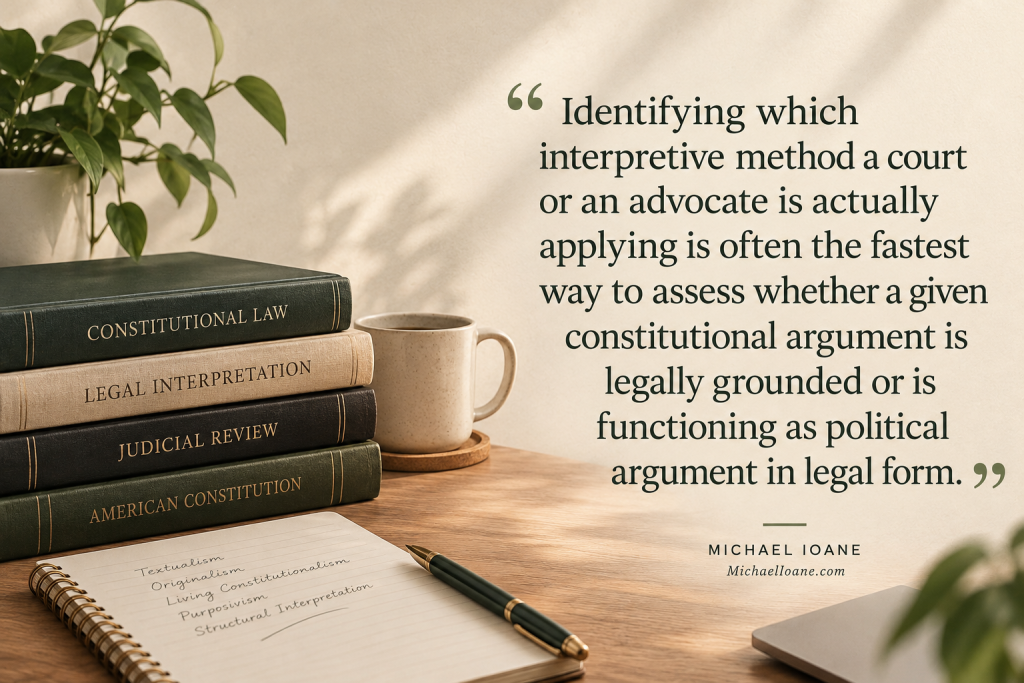
Michael Ioane treats familiarity with these competing methods as a practical necessity, since identifying which interpretive method a court or an advocate is actually applying is often the fastest way to assess whether a given constitutional argument is legally grounded or is functioning as political argument in legal form.
Textualism
Textualism directs interpreters to the ordinary public meaning of the constitutional text at the time it was adopted, treating that meaning, rather than the drafters’ subjective intentions or the interpreter’s preferred policy outcome, as the controlling authority. Textualist constitutional reasoning generally resists reliance on legislative history or purpose where the text itself is reasonably clear.
Originalism
Originalism, related to but distinct from textualism, asks how a provision was understood at the time of ratification, and constitutional reasoning under this method often draws directly on the historical record discussed in Legal Intent Behind Constitutional Design, treating that original understanding as binding on later interpreters regardless of how social or political circumstances have since changed.
Living Constitutionalism
Living constitutionalism treats the Constitution’s broad language as capable of evolving application as social understanding changes, an approach frequently associated with cases extending constitutional protection to circumstances the framers could not have specifically anticipated. Critics of this method argue it risks substituting an interpreter’s contemporary values for the text’s original meaning, while defenders argue that broadly worded provisions were deliberately drafted to permit exactly this kind of application to new circumstances.
Purposivism and Structural Interpretation
Purposivist law analysis asks what purpose a provision was designed to serve and interprets ambiguous language in light of that purpose, while structural interpretation, discussed at length in Structural Thinking in Constitutional Law, resolves ambiguity by asking how a given reading fits within the Constitution’s overall architecture of divided and limited power. Both methods remain distinct from political interpretation because each requires the interpreter to justify a reading by reference to the constitutional system itself, not to a preferred policy result.
Conclusion
Methods of legal interpretation, textualism, originalism, living constitutionalism, and purposivist and structural approaches, each supply a distinct account of interpretive authority, and identifying which method is actually being applied is a practical first step in evaluating any constitutional argument. Bringing these methods together with the legal versus political distinction covered elsewhere in this cluster is addressed in Guide: Legal vs Political Interpretation.
The information in this article reflects general constitutional and legal principles and is provided for educational purposes only. It should not be interpreted as individualized legal advice.
Michael Ioane | MichaelIoane.com
Continue Learning with Michael Ioane
Build your understanding of asset protection and business planning with the Asset Protection Manual . Explore taxation and private trust planning in Boston Tea Party . Both books are available on Amazon.