Michael Ioane
Article III
Practical Article
Legal Debate in Constitutional Issues
Law debate over constitutional issues follows recognizable patterns of argument and counterargument, and understanding these patterns makes it possible to evaluate a specific debate on its merits rather than simply by counting which side appears to have more prominent supporters.
Michael Ioane treats structured legal reasoning as the appropriate standard for evaluating any constitutional debate, since a position’s persuasiveness should depend on the quality of the argument supporting it rather than on the confidence with which it is asserted.
Identifying the Actual Point of Disagreement
Productive legal reasoning in a constitutional debate begins with identifying precisely where the parties actually disagree, whether over the facts, the applicable interpretive method, the weight of a relevant precedent, or the ultimate legal conclusion, since arguments that talk past this underlying disagreement rarely advance the debate regardless of how forcefully they are made. Many extended constitutional debates persist longer than necessary because the parties have not clearly identified which of these categories their disagreement actually falls into.
Evaluating Argument Quality Independent of Outcome
A central discipline in constitutional law debate is evaluating an argument’s quality independent of whether its conclusion is personally appealing, applying the same standard of textual, structural, and precedential support to arguments regardless of which side they favor. This discipline is what separates legal analysis from political advocacy, discussed further in Legal vs Political Interpretation Explained, and applying it consistently is often more difficult in practice than it sounds.
Weighing Competing Authorities
Constitutional debate frequently requires weighing competing legal authorities against one another, an older Supreme Court precedent against a more recent lower court decision narrowing it, or a clear constitutional text against a well established but arguably inconsistent line of case law, and resolving these conflicts requires an explicit hierarchy of authority rather than an intuitive sense of which source feels more persuasive. Applying this hierarchy consistently, rather than selectively depending on which authority favors a preferred outcome, is a core requirement of sound legal reasoning.
Distinguishing Resolved from Unresolved Debate
Not every constitutional law debate remains genuinely open: some questions have been definitively resolved by binding precedent even though public debate over the underlying policy continues, while others remain genuinely unsettled because no controlling authority has yet addressed the specific question presented. Correctly distinguishing between these two categories prevents treating settled law as though it remains an open legal question, and prevents treating a genuinely unresolved question as though it were already settled.
Conclusion
Legal debate in constitutional issues is best conducted by identifying the actual point of disagreement, evaluating argument quality independent of preferred outcome, weighing competing authorities through an explicit hierarchy, and correctly distinguishing resolved from unresolved questions. Bringing these debate skills together with the controversy categories and competing interpretations covered elsewhere in this cluster is addressed in Guide: Legal Controversy Analysis.
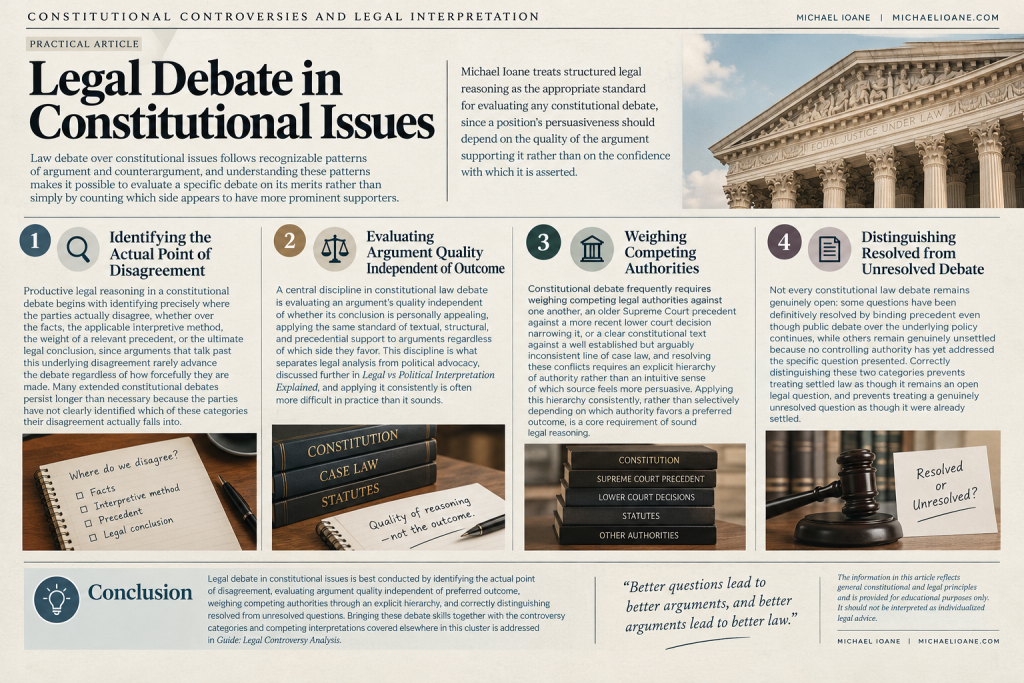
The information in this article reflects general constitutional and legal principles and is provided for educational purposes only. It should not be interpreted as individualized legal advice.
Michael Ioane | MichaelIoane.com
Continue Learning with Michael Ioane
Build your understanding of asset protection and business planning with the Asset Protection Manual . Explore taxation and private trust planning in Boston Tea Party . Both books are available on Amazon.