Michael Ioane
Article II
Deep Topic Article
Legal Constraints on Government Power
Legal limits government action through a range of specific doctrinal mechanisms that translate the general principle of limited government into enforceable legal standards. Understanding these mechanisms in detail is what allows a general constitutional principle to be applied to a specific, concrete exercise of government power.
Michael Ioane approaches these constraints the way he approaches any body of applied doctrine: by identifying which specific mechanism governs a given type of government action and confirming that the action has actually satisfied it.
Enumerated Powers as a Constraint on Federal Action
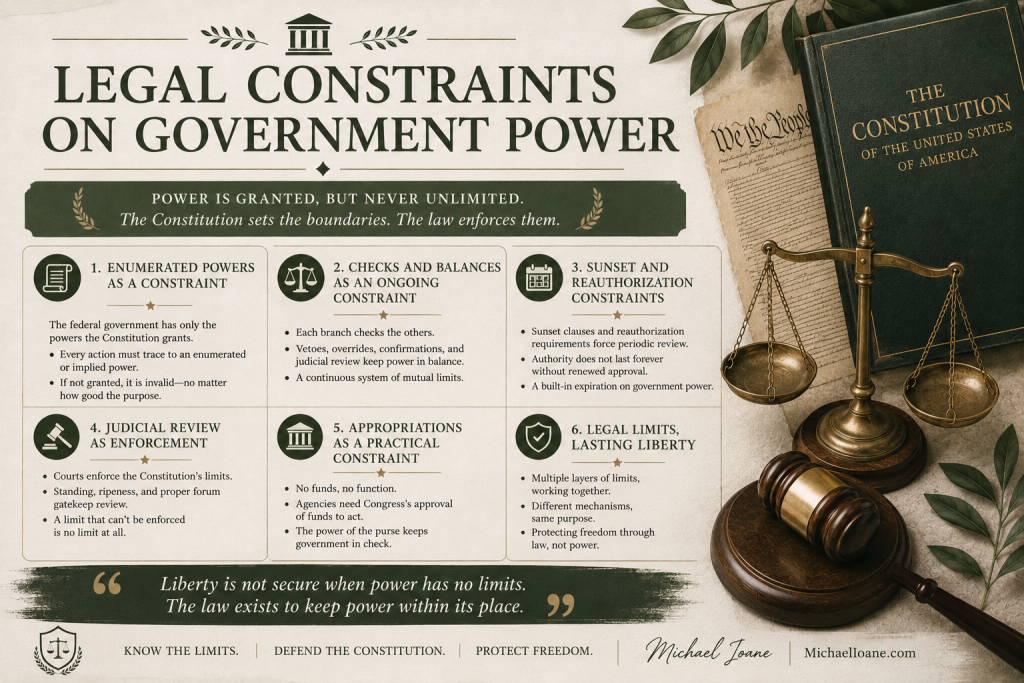
The single most significant constraint on federal government power is the enumerated powers doctrine itself. Because the federal government holds only the specific powers the Constitution grants it, any federal action must be traceable to a specific enumerated or implied power, and an action that cannot be so traced is invalid regardless of its underlying merit. This constraint operates independently of any individual rights claim, addressing instead whether the federal government had authority to act in the first place.
Checks and Balances as an Ongoing Constraint
Beyond the initial grant of authority, checks and balances impose an ongoing constraint on how each branch exercises its own authority: a presidential veto constrains legislative action, congressional override constrains the veto, judicial review constrains both, and the appointment and confirmation process constrains judicial and executive appointments. These checks function continuously, not merely at the moment of a law’s enactment, providing an ongoing rather than one-time constraint on government power.
Sunset and Reauthorization Constraints
Some legal constraints on government power are self-imposed through statutory design rather than constitutional command: sunset provisions and periodic reauthorization requirements force Congress to affirmatively renew certain grants of authority rather than allowing them to persist indefinitely by default. This mechanism, discussed further in Federal Governance Framework, functions as a legislative constraint on the legislature’s own prior grants of authority.
Together, enumerated powers, checks and balances, and self-imposed statutory constraints operate at different points in the lifecycle of a government action, from its initial authorization through its ongoing exercise, complementing the structural boundaries discussed in Structural Boundaries of Government Power.
Judicial Review as an Enforcement Mechanism
None of these legal constraints are self-enforcing; they depend on judicial review through the specific procedural mechanisms discussed in Challenging Government Authority Legally: standing, ripeness, and the proper forum, before a court will even consider whether a constraint has been violated. A legal limit on government power that is never actually litigated functions, in practice, as no limit at all, which is why the doctrinal constraints themselves must be paired with an available avenue for enforcing them.
Appropriations as a Practical Constraint
Beyond judicially enforceable doctrine, Congress’s control over federal appropriations functions as an ongoing practical constraint on government power: an agency cannot implement a program, however valid its underlying statutory authority, without funding Congress has specifically appropriated for that purpose. This power of the purse often constrains government action more immediately than litigation-based mechanisms, since it operates through the annual budget process rather than waiting for a specific dispute to reach the courts.
Conclusion
Legal constraints on government power operate through several distinct mechanisms: the enumerated powers doctrine constraining the initial grant of federal authority, checks and balances providing an ongoing constraint on how that authority is exercised, self-imposed statutory limits like sunset provisions, judicial review as the enforcement mechanism, and Congress’s appropriations power as a practical check. Understanding which mechanism governs a specific government action is essential to evaluating whether it remains within proper legal limits.
The information in this article reflects general constitutional and legal principles and is provided for educational purposes only. It should not be interpreted as individualized legal advice.
Michael Ioane | MichaelIoane.com
Continue Learning with Michael Ioane
Build your understanding of asset protection and business planning with the Asset Protection Manual . Explore taxation and private trust planning in Boston Tea Party . Both books are available on Amazon.