Michael Ioane
Article II
Deep Topic Article
Legal Strategy in Constitutional Matters
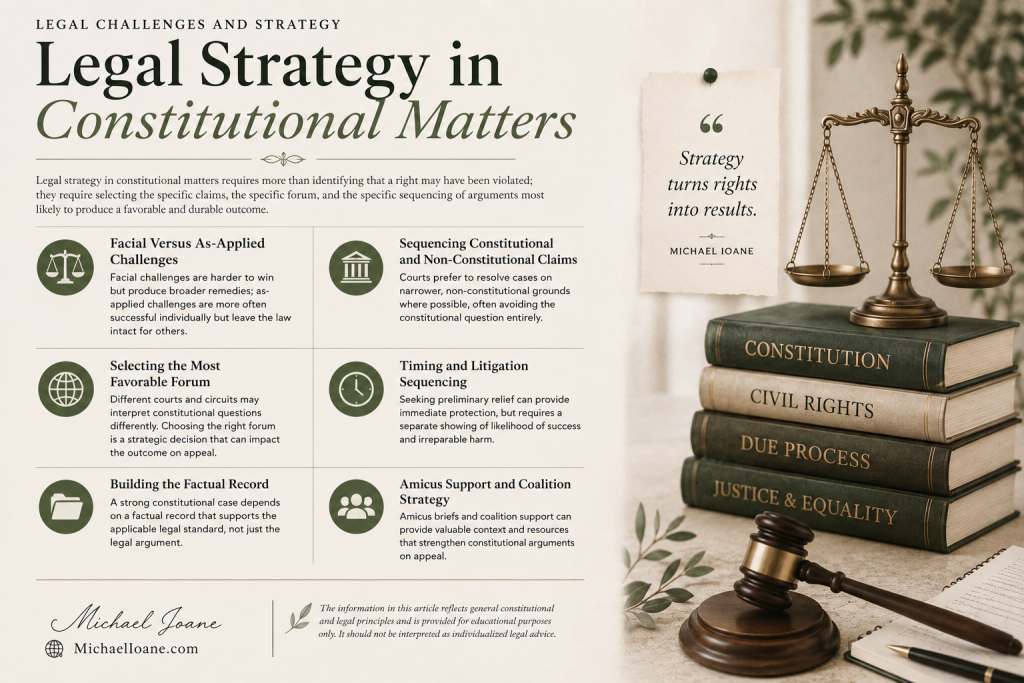
Legal strategy in constitutional matters requires more than identifying that a right may have been violated; they require selecting the specific claims, the specific forum, and the specific sequencing of arguments most likely to produce a favorable and durable outcome. This strategic layer sits on top of the substantive law and often determines whether an otherwise sound constitutional argument actually succeeds.
Michael Ioane approaches constitutional planning as a deliberately sequenced process: identifying every plausible claim first, then evaluating which claims are strongest, which forum is most favorable, and in what order the claims should be presented.
Facial Versus As-Applied Challenges
A foundational strategic choice is whether to bring a facial challenge, arguing that a law is unconstitutional in all or nearly all of its applications, or an as-applied challenge, arguing that a law is unconstitutional only as applied to the specific plaintiff’s particular circumstances. Facial challenges are harder to win, since a court must be persuaded the law cannot be validly applied to any set of facts, but they produce a broader remedy when successful. As-applied challenges are more often successful individually but leave the underlying law intact for other circumstances.
Sequencing Constitutional and Non-Constitutional Claims
Courts generally prefer to resolve cases on narrower, non-constitutional grounds where possible, a principle sometimes called constitutional avoidance. Effective legal strategy accounts for this preference by presenting statutory or regulatory arguments alongside constitutional ones, since a court may resolve the matter favorably without ever reaching the constitutional question. This outcome is often faster and more certain than winning on constitutional grounds alone.
Selecting the Most Favorable Forum
Federal circuits and state courts can differ meaningfully in how they have interpreted a given constitutional question, and where a plaintiff has a genuine choice of forum, this difference is a legitimate strategic consideration. This is distinct from forum shopping undertaken solely to exploit outlying, unrepresentative precedent; sound strategy accounts for how a chosen forum’s precedent is likely to be received on appeal, not merely how favorable it appears in isolation.
These strategic considerations- claim selection, sequencing, and forum- only matter once a challenge has cleared the procedural gateway discussed in Challenging Government Authority Legally, and they work in tandem with the specific structural arguments discussed in Structural Legal Arguments in Constitutional Law.
Timing and Litigation Sequencing
Effective legal strategy also accounts for timing: whether to seek preliminary relief, such as a temporary restraining order or preliminary injunction, before the underlying merits are fully litigated, or to proceed directly to a full merits determination. Preliminary relief requires a separate showing, typically including a likelihood of success on the merits and irreparable harm absent immediate relief, and pursuing it prematurely or without adequate factual support can weaken the overall litigation position even if the underlying claim is otherwise sound.
Building the Factual Record
Constitutional claims, like any legal claim, succeed or fail substantially on the factual record developed to support them. A strategically sound approach identifies early what specific facts will be needed to satisfy the applicable legal standard, whether that is the compelling interest and narrow tailoring required under strict scrutiny or the intelligible principle required to defeat a non-delegation challenge. It builds the record accordingly rather than assembling it reactively after a dispute over the law is already underway.
Working With Amicus Support and Coalition Strategy
In significant constitutional matters, strategy also extends beyond the immediate parties: amicus curiae briefs from interested organizations, industry groups, or scholars can provide courts with additional context, historical research, or practical consequences the primary parties may not have the resources to develop fully. Coordinating this kind of outside support, where available and appropriate, is a legitimate part of a broader litigation strategy, particularly in cases likely to be reviewed by an appellate court or the Supreme Court, where the volume and quality of amicus participation can meaningfully shape how a case is perceived and ultimately decided.
Conclusion
Legal strategy in constitutional matters involves a series of deliberate choices: facial versus as-applied framing, sequencing constitutional and non-constitutional claims, selecting the most favorable defensible forum, timing preliminary relief, building the supporting factual record, and coordinating amicus support where appropriate, layered on top of the underlying substantive law. A constitutionally sound argument presented without this strategic layer is considerably less likely to succeed than the same argument presented with it.
The information in this article reflects general constitutional and legal principles and is provided for educational purposes only. It should not be interpreted as individualized legal advice.
Michael Ioane | MichaelIoane.com
Continue Learning with Michael Ioane
Build your understanding of asset protection and business planning with the Asset Protection Manual . Explore taxation and private trust planning in Boston Tea Party . Both books are available on Amazon.