Michael Ioane
Article II
Deep Topic Article
Scope of Legal Authority
Authority scope law addresses not only whether a court or government body has jurisdiction in the abstract, but how far that jurisdiction actually extends once established. A court with proper jurisdiction over a matter does not necessarily have unlimited authority within that matter; jurisdiction is itself bounded by geography, subject, and the specific relief a court is empowered to grant.
Michael Ioane treats this distinction, between having jurisdiction at all and understanding the actual scope of that jurisdiction, as essential to any serious legal analysis, since the two questions, while related, are analytically separate and each requires its own confirmation.
Geographic and Territorial Limits
A court’s authority is generally bounded by the territory of the sovereign that created it: a state court’s jurisdiction generally does not extend beyond that state’s borders, absent a specific basis such as long-arm jurisdiction over an out-of-state defendant with sufficient minimum contacts with the state. Federal courts, while nationwide in their underlying authority, are organized into specific judicial districts, each with jurisdiction generally confined to matters connected to that district absent a specific statutory or venue-based basis for hearing a matter elsewhere.
Concurrent and Exclusive Jurisdiction
Some matters fall within concurrent jurisdiction, meaning more than one court, for example both a state court and a federal court, may properly hear the same type of dispute. In contrast, other matters fall within exclusive jurisdiction, reserved to a single court system, such as federal jurisdiction over patent and bankruptcy matters. Understanding which category a given dispute falls into determines not only where a case may be filed but sometimes where it must be filed.
Jurisdiction to Grant Specific Relief
Even within a court’s proper subject matter and personal jurisdiction, the scope of relief that court may grant is itself limited by the specific authority the relevant law confers; some courts may issue injunctions and equitable relief, while others, limited to specific statutory jurisdiction, may be confined to monetary damages or a specific defined category of remedy. A court exceeding the scope of relief it is authorized to grant, even while otherwise properly exercising jurisdiction over the underlying dispute, risks having that portion of its judgment invalidated on appeal.
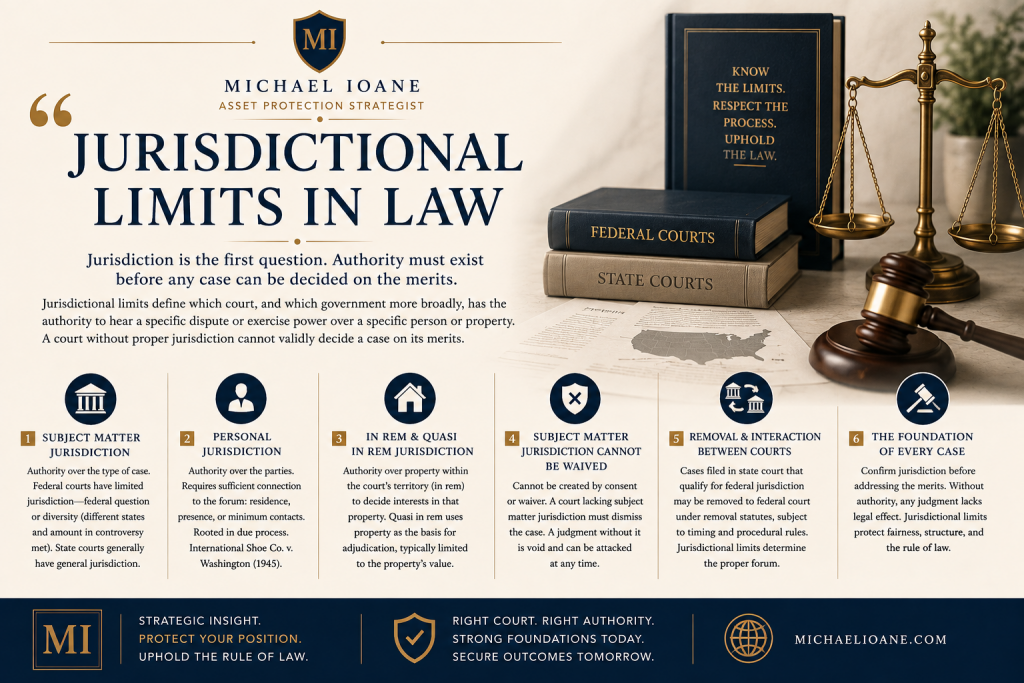
These scope questions, geographic limits, concurrent versus exclusive jurisdiction, and authorized relief, build directly on the jurisdictional foundations discussed in Jurisdictional Limits in Law and inform the practical boundary analysis in Legal Boundaries of Authority.
Ancillary and Supplemental Jurisdiction
Courts also exercise supplemental jurisdiction, the authority to hear claims closely related to a case already properly within the court’s jurisdiction, even where those related claims would not independently satisfy the court’s jurisdictional requirements. This doctrine allows a court to resolve an entire dispute efficiently in one proceeding, rather than requiring closely related claims to be litigated separately in different forums. However, supplemental jurisdiction remains discretionary, and a court may decline to exercise it under specific circumstances defined by statute.
Jurisdiction Stripping and Congressional Control
Congress retains substantial authority to define and limit federal court jurisdiction, including the authority to remove certain categories of cases from federal court jurisdiction entirely, a practice sometimes called jurisdiction stripping. This authority is itself bounded by constitutional limits, particularly where it would effectively eliminate any forum for a constitutionally protected claim, illustrating that even the legislature’s control over jurisdictional scope operates within its own constitutional boundaries.
Conclusion
Scope of legal authority extends beyond the threshold jurisdictional question to the geographic reach, exclusivity, remedial limits, supplemental jurisdiction, and legislative control that define exactly how far a court’s properly established jurisdiction actually extends. Evaluating any specific exercise of judicial authority requires confirming both that jurisdiction exists and that its scope has not been exceeded.
The information in this article reflects general constitutional and legal principles and is provided for educational purposes only. It should not be interpreted as individualized legal advice.
Michael Ioane | MichaelIoane.com
Continue Learning with Michael Ioane
Build your understanding of asset protection and business planning with the Asset Protection Manual . Explore taxation and private trust planning in Boston Tea Party . Both books are available on Amazon.